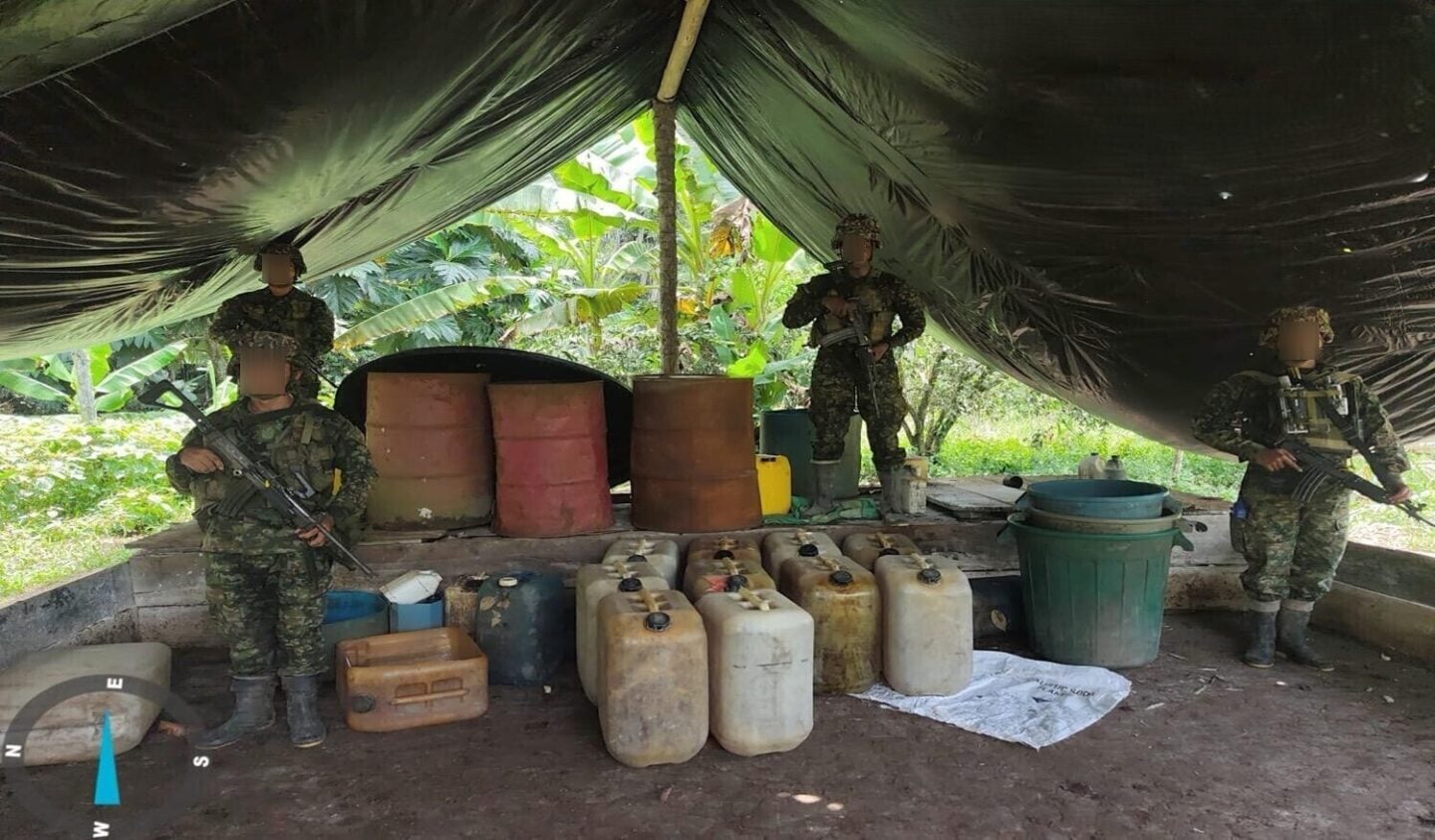

In the Colombian Amazon, clandestine caches, camps, and mobility corridors are far more than places to store weapons and supplies. They form part of the logistics networks that enable armed groups to resupply, move personnel, and maintain operations across vast, hard-to-reach areas.
In July, authorities located a cache belonging to the Jhon Linares Structure of the Jorge Suárez Briceño Bloc in Puerto Cachicamo, in the municipality of San José del Guaviare. Inside, they found 500 improvised antipersonnel mines, 200 kilograms of ANFO explosives, grenades, ammunition of various calibers, detonators, logistics supplies, and communications equipment.
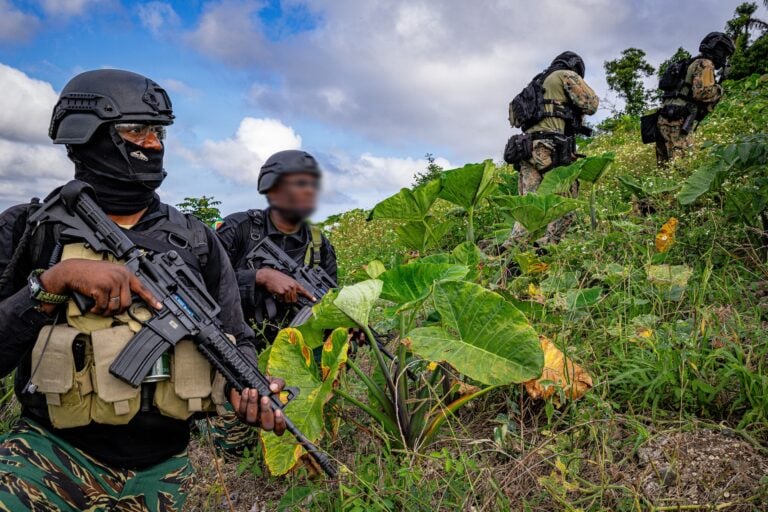
A month later, in Caño Cuma, also in San José del Guaviare, the Colombian Army, with support from the Colombian Navy and Colombian Aerospace Force, discovered a clandestine camp capable of housing some 120 people, along with two caches containing rifles, grenades, mines, ammunition, tactical vests, and field equipment.
According to Colombian defense and security expert Erich Saumeth, discoveries like these can provide security forces with valuable information about the origin and intended destination of the materials, routes used to transport them, and possible connections to other structures. “A cache must be analyzed based on its contents and its position within the network,” Saumeth told Diálogo.
These sites are part of a broader support infrastructure that allows armed groups to maintain a presence in an especially challenging operational environment. The Colombian Amazon covers some 483,000 square kilometers, or 42.3 percent of the country’s continental territory, and is characterized by vast distances, low population density, and limited road connectivity. In this environment, support and resupply points connected by land and river routes allow armed groups to move personnel, weapons, and supplies while supporting illicit activities ranging from cocaine trafficking to illegal gold mining.
For security forces, every cache or camp discovered can also yield intelligence about the larger network, helping them reconstruct routes, identify logistics nodes and the individuals responsible for them, and establish links among different structures. “A fighter can be replaced; a consolidated logistics network is much harder to rebuild,” Saumeth said.

A network of corridors
In the Amazon, an armed group’s ability to maintain its presence and territorial influence depends on a network that ensures supplies, mobility, and communications. Caches and camps are key nodes in these networks, but the intelligence they can yield extends well beyond the materiel seized. Weapons and explosives can reveal offensive capabilities; radios can provide insight into communications systems; and the location of a site, combined with the materials and other evidence found there, can help identify suppliers, recipients, and routes.
“The challenge is to establish the connections among people, places, movements, communications, and transactions, and that requires both human and technical intelligence,” Saumeth said.
Rivers are central to these logistics networks. According to the Colombian Military Forces General Command (CGFFMM), territorial control depends in part on controlling river corridors, which serve as natural highways for illicit economies. In the Amazon, rivers largely serve the function that roads do elsewhere, while trails, secondary roads, and overland routes provide additional connection to other parts of Colombia and international border areas.
The network is also structured to make movements more difficult to detect. “The advantage is that large movements of personnel or materiel are not necessary. A fragmented logistics chain, with small successive movements and intermediate caches, is much harder to detect than a conventional concentration of logistics,” Saumeth said. This fragmentation spreads risk and allows armed groups to take advantage of corridors also used by local communities and legitimate operators.
The network also extends across borders. Corridors in the Colombian Amazon connect with border areas of Ecuador, Peru, and Brazil, giving criminal networks opportunities to move people, supplies, drugs, and other illicit resources across the region. Reconstructing these networks requires combining information gathered on the ground with data on seizures, communications, financial transactions, and transit routes, including activity that extends beyond national borders.
Rebuilding the network
The impact of an operation is measured not only by the number of arrests or the amount of materiel seized, but also by how effectively it disrupts a network’s ability to rebuild. A structure can withstand the loss of some of its members if it retains access to suppliers, transportation, caches, and financial resources.
When a structure is forced to replace explosives, equipment, communications systems, and supply channels at the same time, however, it must invest time and resources to restore capabilities that were already in place. Under those circumstances, the loss of a single node can have broader effects across the network.
The July operation against the Jhon Linares Structure in Meta and Guaviare provides an example. According to security forces, the cache discovered in Puerto Cachicamo was located along one of the structure’s main mobility corridors. Dismantling it affected not only the resources stored there, but also the structure’s logistics, armed, and communications capabilities.
“If suppliers, routes, and financial resources are disrupted simultaneously, the organization faces logistical pressure that can reduce its operational tempo and force it to disperse or strategically reconsider its position in a particular territory,” Saumeth said.
Cooperation and integrated capabilities
In a region where criminal networks operate simultaneously across land, rivers, and airspace, security forces must integrate capabilities across those same domains. The Army operates on land, the Navy patrols river corridors, and the Aerospace Force provides surveillance and mobility, while the Police contributes intelligence and investigative capabilities.
This integration allows security forces to bring together information collected across different operational environments. “The combination of technical intelligence, drone surveillance, and ground reconnaissance makes it possible to identify potential changes on the ground, unusual movements, supply routes, and possible logistics points. The key is to combine that information to identify patterns and prioritize operations,” Saumeth said.
Control of river corridors is particularly important because it allows security forces to target several parts of the network at the same time. “Controlling or monitoring specific transit points, landing sites, resupply points, and connections between corridors can simultaneously affect mobility, communications, supplies, and illicit economies,” he added.
In the Amazon, however, these corridors do not end at Colombia’s borders. Their connections to border areas in Ecuador, Peru, and Brazil make intelligence sharing and coordination with neighboring countries particularly important.
The objective is to turn tactical results — a cache seized, a vessel intercepted, or a route identified — into sustained pressure on an organization’s ability to rebuild its infrastructure. “The main challenge is to move from seizing individual components to dismantling entire logistics systems and, consequently, the terrorist structures themselves,” Saumeth concluded.