
Colombia is intensifying its offensive against criminal organizations with a strategy aimed not only at their armed members and drug trafficking operations, but also at the finances and illicit economies that allow them to maintain territorial control.
“We are going to strike their structures, their leaders, their finances, and the illicit economies that fuel their criminal machinery,” President Abelardo De La Espriella said September 5, as he announced a new security strategy for the Catatumbo region following an attack by the National Liberation Army (ELN) against Colombian troops.
From August 7 through September 19, Colombian security forces carried out more than 21,900 arrests, seized more than 92 metric tons of narcotics and more than 2,300 firearms, and targeted at least 24 leaders of major criminal structures, according to the Presidency. The operations also targeted illicit economies, drug trafficking infrastructure, mobility corridors, and criminal assets.
Targeting those different components is critical because Colombia’s armed groups have developed multiple sources of revenue and support networks that allow them to absorb losses and adapt to pressure. Extortion, illegal mining, illicit financing, and the coercion of local communities can sustain these groups even after military or law enforcement setbacks. In some areas, armed groups also restrict movement, pressure merchants and producers, and impose rules on communities, allowing them to maintain influence even as security forces make gains on the ground.
“It is important to talk about markets rather than countries,” Guillermo Holzmann, an international affairs analyst at Chile’s University of Valparaíso, told Diálogo. “Criminal organizations structure their operations around the production, transportation, export, and distribution of drugs across different international markets.”
Targeting the networks behind criminal control
The Ideas for Peace Foundation (FIP) describes a networked criminal model in which organizations of different sizes cooperate or compete for illicit markets, while some groups control specific criminal activities or provide services to larger organizations. This structure allows criminal groups to distribute functions across their networks and limit the impact of losing a member, route, or source of revenue.
“It is a matter of managing losses: They are willing to lose up to 20 percent to preserve the other 80 percent,” Holzmann said.
“You have to follow the money and identify those who move and finance resources at the higher levels,” he added. He warned that “when one activity stops working, these organizations turn to other crimes to maintain their structure.”
Cauca provides examples of how Colombian authorities are targeting different components of this system.
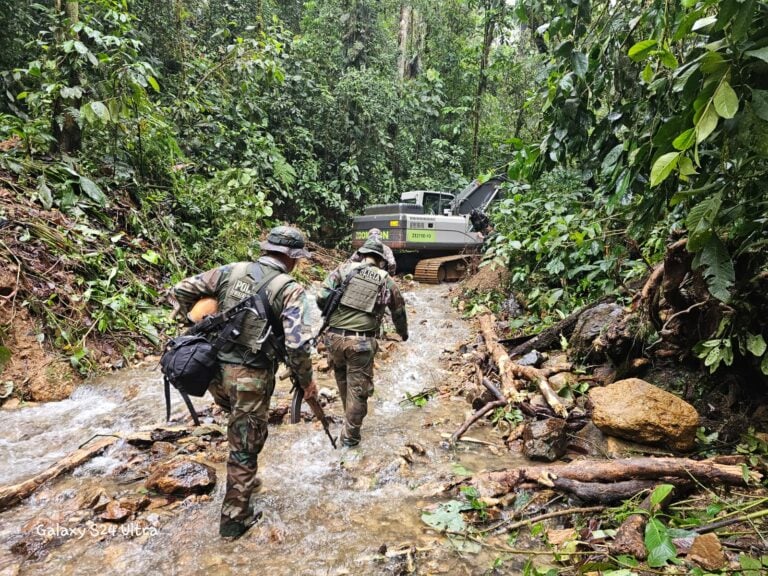
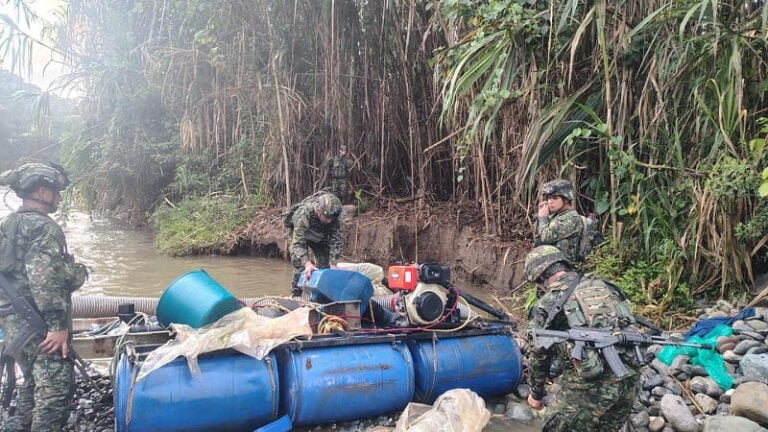
In May 2026, Colombian Army troops, drawing on capabilities from the Brigade Against the Illicit Exploitation of Mineral Deposits and working in coordination with the Colombian National Police, targeted two illegal mining operations in Caldono and Santander de Quilichao. According to military intelligence, the illicit activity generated more than $500,000 per month and benefited members of the Jaime Martínez structure.
Two months later, the Army captured alias Tulande in Suárez, Cauca. Authorities identified him as one of the main figures behind illegal mining in the Los Farallones area and an alleged member of the same group’s support networks. Investigators determined that proceeds from illegal mining fed criminal finances through extortion and the violent control of territory.
In June, the Colombian National Police also arrested an alleged member of a Carlos Patiño support network in El Tambo on aggravated extortion charges following an investigation into threats and demands for money made against a teacher.
Taken together, the operations illustrate a strategy that goes beyond confronting armed members of criminal groups. It seeks to disrupt the activities that generate revenue, the individuals who move those resources, and the networks that enable these organizations to exert pressure on the population.
From military control to institutional control
The challenge does not end when security forces enter a territory. De La Espriella has ordered Colombia’s military and police leadership to “restore security and state authority in every corner of the country,” placing territorial control at the center of the security effort.
A September 2026 FIP analysis underscored the importance of a coordinated security response that protects communities, contains the expansion of armed groups, strengthens territorial and institutional control, and reinforces the justice system and security forces.
Sustaining that control requires more than a security presence. It also means reducing criminal groups’ ability to intimidate communities, finance their operations, settle disputes through force, and maintain control over local livelihoods and markets.
Connecting intelligence, finance, and justice
Disrupting these networks also requires ensuring that information obtained by security forces reaches the institutions capable of turning it into financial investigations and judicial action.
Holzmann emphasized the importance of strengthening coordination among the institutions involved in confronting criminal networks. “The challenge is to restore convergence among police, military, and political institutions, as well as the coordination and trust […],” he said.
Permanent channels between intelligence agencies and prosecutors are particularly important so that intelligence can support financial investigations and judicial action against criminal networks, Holzmann added.
Such coordination can help authorities identify the financial, logistical, and support networks behind armed groups, including individuals who may operate far from the territories where those groups maintain a presence. That can broaden investigations from those carrying out violence on the ground to those who finance, supply, and facilitate criminal operations.
The cross-border dimension
Criminal networks operating in southwestern Colombia are also connected to illicit economies and trafficking routes that extend into Ecuador and beyond. Money, supplies, and services can move across jurisdictions as criminal organizations adapt to pressure from authorities.
Colombia and Ecuador have strengthened their ability to confront that cross-border activity through coordinated operations. In March 2026, the two countries launched Binational Operation Mirror against drug trafficking, smuggling, illegal mining, extortion, and other forms of transnational crime. They established areas for coordinated action, while the United States provided intelligence support to strengthen interdiction capabilities.
That bilateral coordination is complemented by broader regional efforts. Colombia joined the Americas Counter Cartel Coalition in August. During a September 8 meeting with U.S. Secretary of State Marco Rubio, Colombia reaffirmed its participation in the initiative and discussed strengthening security capabilities, including radar, drones, intelligence, cyber defense, and special operations.
Andrés Macías, an expert at Colombia’s Externado University, said cooperation among Colombia, Ecuador, and the United States must target criminal organizations’ financing, structure, and operations to prevent the so-called “balloon effect,” in which pressure in one territory simply pushes criminal activity into another, he told Ecuadorian outlet NotiMundo.
The same principle applies within Colombia. Destroying a laboratory, removing a leader, or retaking a strategic location can reduce a group’s immediate capabilities without eliminating the financial, logistical, and coercive networks that allowed it to operate there.
Weakening criminal control therefore requires sustained pressure not only on armed members and drug production, but also on the finances, illicit economies, support networks, and coercive structures that allow these organizations to survive.