
The Colombian armed group Comandos de La Frontera (CDF) has expanded its relationships and logistical networks in Ecuador through an alliance with Ecuadorian gang Los Lobos. Together, the groups have become part of a transnational criminal system that moves cocaine and other illicit goods between southern Colombia, Ecuador’s Amazon region, and ports on the Pacific coast.
The CDF emerged following Colombia’s 2016 peace agreement from an alliance between dissidents of the Revolutionary Armed Forces of Colombia (FARC) and members of La Constru, a criminal structure with roots in post-paramilitary networks. The organization established its principal stronghold in Colombia’s lower Putumayo department, where it became involved in cocaine production, extortion, illegal mining, and control of riverine and overland corridors.
Its influence has also extended across the border. Investigative outlet Amazon Underworld reported a CDF presence around La Bonita and the parish of Santa Bárbara, in Ecuador’s Sucumbíos province, as well as activity deeper inside Ecuadorian territory.
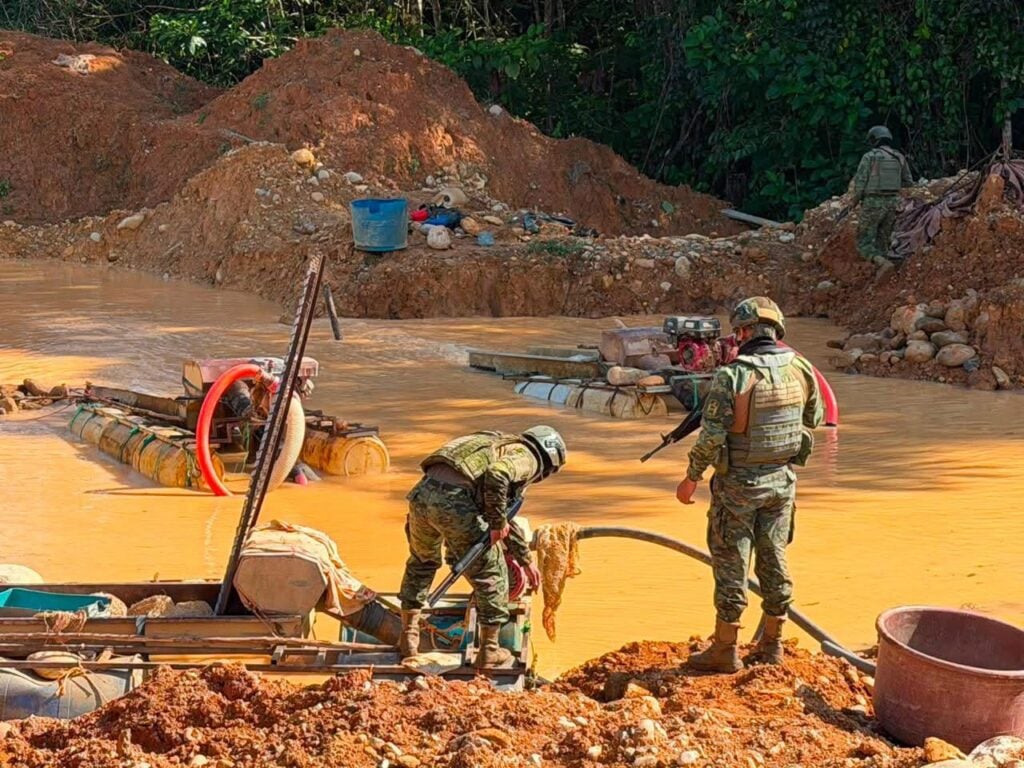
The expansion of illegal gold mining in the Amazon has created an additional source of revenue and territorial competition for armed groups. According to the Monitoring of the Andean Amazon Project (MAAP), mining affected 1,422 hectares in the Punino River watershed between 2019 and the first half of 2024.
In parts of Orellana and Sucumbíos, the CDF established protection and extortion rackets around mining operations previously associated with the Ecuadorian gang Los Choneros. A growing relationship between the CDF and Los Lobos subsequently emerged, directed against their mutual rival, Ecuadorian news outlet Primicias reported.
On May 9, 2025, approximately 80 Ecuadorian soldiers conducting an operation against illegal mining in the Alto Punino region were ambushed by armed men. Eleven soldiers were killed. Among the dead was Miller Rodríguez Ortega, alias Compadre, whom Ecuadorian authorities identified as a CDF leader involved in illegal mining and extortion.
The structure of networks
The relationship between the CDF and Los Lobos supports a broader logistics network connecting coca-producing areas in southern Colombia to trafficking routes in Ecuador. These networks facilitate cocaine shipments while also enabling the movement of weapons, fuel, chemical precursors, illegally mined gold, and other contraband.
Southern Colombia remains one of the principal coca-growing and cocaine-processing regions in the country. In March 2026, Colombian authorities dismantled a cocaine-processing laboratory in Barbacoas, Nariño department, and seized more than 1.3 tons of cocaine, along with thousands of liters and kilograms of chemical precursors.
Although the operation was not publicly attributed to the CDF, it illustrates the scale of the cocaine economy operating in the border departments where Colombian criminal groups compete for production areas and transportation corridors.
To counter these organizations, Ecuadorian and Colombian forces have conducted coordinated mirror operations, in which each country deploys personnel on its respective side of the border.
During one such operation in June 2025, Colombian troops destroyed a cocaine-processing laboratory near the Ecuadorian border. Authorities estimated that the facility had the capacity to produce some 1.4 tons of cocaine per month. While Colombian forces raided the facility Ecuadorian personnel established containment positions on their side of the boundary to block possible escape routes.
According to a member of Ecuador’s military intelligence services who spoke to Amazon Underworld on condition of anonymity, criminal networks use the Putumayo and San Miguel rivers to connect CDF areas of influence around Puerto Asís and La Hormiga, Colombia, with contacts and transportation networks inside Ecuador.
From the border, illicit cargo can be moved through Ecuador toward the Pacific coast and port areas around Guayaquil. The remote riverine frontier is especially difficult to monitor because of its dense jungle, dispersed communities, informal crossings, and limited permanent infrastructure.
The trafficking routes operate in both directions. Coca paste and refined cocaine move from Colombian production areas into Ecuador, while weapons, ammunition, chemical precursors, and smuggled fuel move toward Colombia.
“It’s a flow that goes both ways […] especially gasoline for refining the drug, goes mainly from Ecuador to Colombia […] on the other side, it’s more the export from Colombia to Ecuador of coca paste and already-refined, already-processed cocaine,” said Glaeldys González Calanche of International Crisis Group.
Gasoline, often stolen or diverted from Ecuadorian pipelines and distribution systems, is used as a solvent during the initial processing of coca leaves, and has therefore become an important enabling component of cocaine production.
Alliance with Los Lobos
According to analysts, Los Lobos purchase cocaine and coca paste from Colombian groups, including networks associated with the CDF, and help transport the drugs from Ecuador’s Amazon region toward the coast.
From there, the group works with brokers, port contacts, and international trafficking organizations to move cocaine toward markets in the United States and Europe. Los Lobos has also developed connections with Mexican cartels, including the Jalisco New Generation Cartel.
“The Ecuadorian groups in some way raise their influence by becoming these intermediaries, which became key to all the trafficking […] taking [narcotics] from the border toward the coastal zones and then out of the country,” González Calanche said.
The CDF’s access to Colombian production areas and border rivers complements Los Lobos’ networks inside Ecuador. Their cooperation also extends beyond narcotrafficking. In the Amazon region, both organizations have sought revenue from illegal mining and have challenged the position of Los Choneros around mines, fuel-distribution routes, and river corridors.
According to Ecuadorian National Police Lieutenant Colonel Juan Carlos Espín, the CDF carried out what he described as “social cleansing” to remove Los Choneros from parts of Sucumbíos in a series of massacres, he told Primicias. International Crisis Group has also reported that the CDF killed members of Los Choneros who entered southern Colombia to purchase cocaine.
“It’s in the interest of the Comandos de la Frontera to be with the winner of those rivalries […],” González Calanche said. “Choneros right now are also in a defensive position; they don’t have the capacity to expand; they don’t have the capacity to grow.”
Enforcement challenges
The transnational character of these networks complicates military and police operations.
According to Byron Villagómez of the Ecuadorian Observatory of Organized Crime, the CDF “can operate across that whole territorial zone, taking advantage to some extent of this border situation, in which supposedly two states have or should have control, but which don’t necessarily always share the same agenda, the same interests, or ease of cooperation.”
In March 2025, suspected CDF members attacked an Ecuadorian military unit along the Putumayo River. According to the Ecuadorian Army, armed men fired from a boat toward the facility while other assailants attempted to enter a section of the base used to store ammunition.
The attackers later returned to demand the release of fuel that troops had seized during an earlier operation. Between the confrontations, the armed men crossed the river into Colombian territory, placing them beyond the immediate authority of Ecuadorian forces and demonstrating how criminal groups exploit international borders.
Ecuador subsequently increased its military presence in the Amazon. Following the Alto Punino attack in May 2025, the government deployed more than 1,500 troops to search for those responsible and intensify operations against illegal mining and armed groups.
The response continued in 2026. On March 6, Ecuador’s Ministry of Defense announced that Ecuadorian forces, supported by U.S. intelligence, struck a CDF camp in Cascales canton, Sucumbíos province. According to the ministry, the installation served as a rest area for a CDF commander known as Mono Tole and as a training site with capacity for approximately 50 narcotraffickers.
The operation demonstrated the value of intelligence cooperation in identifying and disrupting criminal infrastructure in remote jungle terrain. But dismantling camps and deploying additional troops address only part of the network. The same organizations rely on fuel suppliers, transport operators, financial facilitators, weapons traffickers, and local intermediaries that allow illicit economies to endure.
The relationship between the CDF and Los Lobos illustrates how criminal organizations operating across national borders can combine complementary capabilities to move cocaine, protect illegal mining, and expand their reach. Countering those networks will require sustained intelligence sharing, coordinated cross-border operations, and continued cooperation among Ecuador, Colombia, Peru, and international partners.