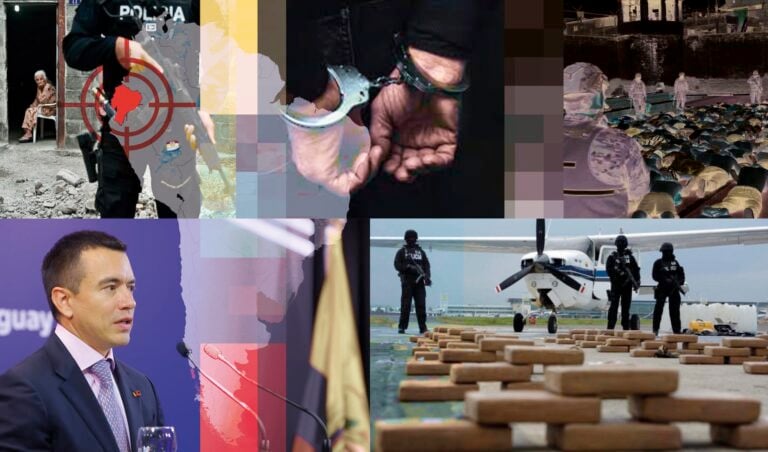
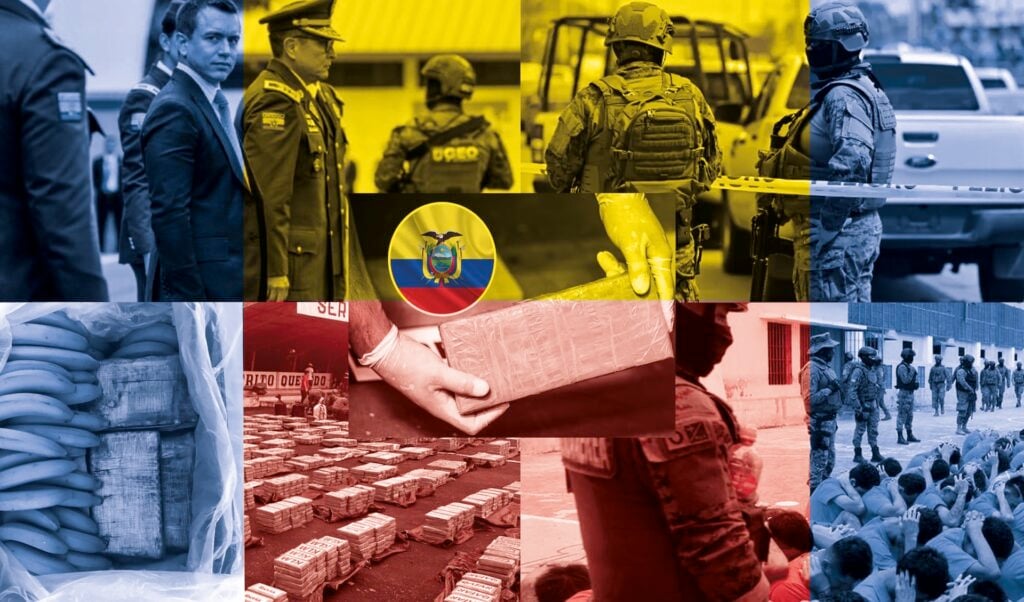

For decades, Ecuador was perceived as an exception in a region plagued by drug trafficking, armed violence, and criminal capture of the state. While neighboring countries faced open wars between cartels and state forces, Ecuador seemed to remain on the sidelines of these dynamics. That image began to slowly crack and finally collapsed in January 2024, when President Daniel Noboa declared an internal armed conflict and designated 22 criminal organizations as terrorist groups.
The measure exposed a reality that had been brewing for years, with a dramatic increase in homicides, armed gangs vying for territorial control, prisons turned into criminal syndicates’ operational hubs, and overwhelmed institutions. Ecuador was no longer a peripheral player in regional drug trafficking, but a strategic hub in transnational criminal networks.
As discussed in the first part of this report, the crisis did not arise suddenly, nor can it be explained by a single factor. It is the result of a prolonged convergence of internal institutional weaknesses and profound transformations in the regional and global criminal market. For years, almost silently, Ecuador consolidated its position as a key platform for the storage, processing, and export of cocaine, in addition to other illicit economies.
“Ecuador ended up playing a functional role within a regional criminal architecture linked to states aligned with so-called 21st-century socialism or Castro-Chavism, where organized crime acts as a political and economic actor,” said Carlos Sánchez Berzaín, director of the Inter-American Institute for Democracy (IID) and former Bolivian defense minister, in an interview with Diálogo.
The result is a profound reconfiguration of Ecuador’s criminal landscape, with fragmented but interconnected structures operating both locally and within global illicit networks, whose effects transcend borders, posing direct risks to national security and regional democratic governance.
“Ecuador is no longer just a local scene of violence, but a key link in a constantly adapting transnational criminal system,” said regional security expert Evan Ellis, research professor of Latin American Studies at the U.S. Army War College Strategic Studies Institute, in an interview with Diálogo.
A changing criminal landscape
According to the Armed Conflict Location & Event Data Project (ACLED), an international database that records and analyzes conflicts and violence around the world, Ecuador ended 2025 with at least 37 active criminal groups. The increase does not reflect the emergence of new structures, but rather an accelerated fragmentation of the criminal ecosystem with internal splits, unstable alliances, and forced realignments under state pressure.
“The fragmentation of organized crime in Ecuador is the result of state pressure that has made the concentration of power unviable. Without a narco-state or political protector, each group operates in isolation, defending its own turf,” said Berzaín.
This process has been accompanied by a series of events that have eroded the traditional structures of organized crime. One of the most decisive occurred in December 2020, with the assassination of Jorge Luis Zambrano, alias Rasquiña, the historic leader of Los Choneros. For more than a decade, this organization had functioned as a relatively stabilizing force in the Ecuadorian criminal world, articulating alliances and cushioning internal disputes.
His death created an immediate power vacuum. From this fracture emerged groups such as Los Lobos, Los Tiguerones, and Los Chone Killers, which not only inherited operational structures but also triggered an open war for the most profitable illicit markets, especially cocaine trafficking and control of strategic corridors.
This fragmentation was compounded by subsequent blows that constantly reconfigured the criminal landscape. In October 2024, the arrest in Spain of William Joffre Alcívar Bautista, alias Negro Willy, leader of Los Tiguerones, marked a new turning point. Judicial investigations confirmed that Alcívar continued to direct criminal operations from Europe, including the armed attack on a television station in Guayaquil in January 2024, an episode that symbolized the ability of these networks to operate over long distances.
His capture sparked violent internal disputes, weakened the group’s cohesion, and fueled new splits, according to reports by the Global Initiative Against Transnational Organized Crime (GI-TOC). This was compounded by the murder of Benjamin Camacho, alias Ben 10, leader of Los Chone Killers, in December 2024, another blow that deepened the instability of the criminal ecosystem.
The most recent turning point came in July 2025, with the extradition to the United States of José Adolfo Macías Villamar, alias Fito, who had assumed leadership of Los Choneros after Rasquiña’s murder. His departure, a political and judicial victory for the Noboa government, left a new critical power vacuum, intensifying internal disputes over control of one of the most influential criminal structures in the country.
Los Lobos and the race for hegemony
In this scenario of fragmentation, Los Lobos emerges as the most aggressive and lethal actor on Ecuador’s new criminal map. According to ACLED, between January 2023 and May 2025, the organization was involved in at least 184 violent events, including targeted killings, armed clashes, attacks with explosives, and disputes within the prison system.
The territorial expansion of criminal gangs now covers more than two-thirds of the country’s municipalities, with a particularly high concentration in the coastal provinces of Guayas, Manabí, El Oro, Santa Elena, and Esmeraldas. This is no coincidence. These areas, which account for nearly 80 percent of recorded violence, are also the main corridors for cocaine exports to international markets.
The violence, however, is not solely the result of local rivalries. It is articulated through tactical alliances and constant ruptures, such as occasional cooperation between Los Lobos and the Latin Kings, and direct confrontations with organizations such as Los Tiguerones.
“Ecuador has become one of the most volatile criminal spaces in Latin America, where no hegemony manages to consolidate itself and every power vacuum triggers new explosions of violence,” Henry Zimmer, associate researcher for the Americas Program at the Center for Strategic and International Studies (CSIS), said in an interview with Diálogo.
Despite this fragmentation, investigations agree that Los Choneros and Los Lobos continue to be the dominant centers of organized crime in the country. Both structures maintain a real capacity to sustain international cocaine trafficking operations, control strategic logistics corridors, exert influence in the prison system, and coordinate corruption networks. Their designation as terrorist organizations by the United States confirms that the phenomenon exceeds the domestic sphere and is fully part of a transnational threat.
From local gangs to regional cogs
“The Ecuadorian criminal ecosystem is no longer peripheral,” Zimmer explained. “Today, it is fully integrated into transnational trafficking chains.” In this scheme, local gangs have ceased to operate on the margins and now perform logistical and operational functions within criminal architectures with a hemispheric reach.
Official investigations confirm direct links to the major Mexican cartels. Los Lobos have documented connections to the Jalisco New Generation Cartel (CJNG), while Los Choneros maintain their historical links to the Sinaloa Cartel. Experts agree that this “imported” competition has exponentially increased levels of violence by introducing greater flows of weapons, financing, and pressure for results in the territories.
In the north of the country, the provinces bordering Colombia add a critical dimension to the conflict. Dissidents from the Revolutionary Armed Forces of Colombia (FARC), the Border Command, and cells of the National Liberation Army (ELN) operate in coordination with Ecuadorian gangs, disputing strategic corridors for cocaine and arms trafficking.
“The main driver of the security challenge facing Ecuador today is the flood of cocaine,” Ellis said. These alliances facilitate both the entry of drugs from Colombia and the reverse smuggling of chemical precursors, particularly fuel used in the refining process.
This phenomenon can also be explained by a structural weakening of border control. During Rafael Correa’s decade in office, immigration policy liberalized entry requirements and relaxed controls. “This created opportunities for criminal groups to occupy strategic spaces in Ecuadorian territory,” Berzaín said.
The magnitude of the problem was exposed in March 2008, when FARC leader Raúl Reyes was killed on Ecuadorian territory. The episode revealed the state’s inability to exercise effective control over strategic and border areas and highlighted the limited institutional presence in areas where transnational armed actors could operate with relative freedom. “Ecuador functioned as a transit space and as a terrain where armed actors consolidated strategic positions that were previously unthinkable,” added Berzaín.
A global mosaic
The Ecuadorian criminal map extends beyond the region and is embedded in transnational organized crime circuits. European mafias such as the Italian ‘Ndrangheta, Sicilian and Albanian organizations, and other Balkan networks use Ecuadorian ports as strategic platforms for shipping cocaine to Europe.
The GI-TOC has documented that Balkan mafias launder nearly $3.5 billion annually through the Ecuadorian financial system, a trend that is on the rise. These operations are sustained by a network of couriers, emissaries, and businesspeople who coordinate Albanian and Ecuadorian actors to consolidate and expand their activities.
Various investigations indicate that these organizations prefer to hire Ecuadorian groups to secure drugs and routes, and that in many cases payment is not made in cash but in weapons, a model that has intensified internal violence.
“European networks offer better conditions than Mexican or Colombian groups, which generates rivalry between local gangs to prove who is stronger and more reliable, fueling bloody clashes,” Zimmer explained.
Added to this network is a less visible but strategically decisive actor: Chinese organized crime and China’s role as an indirect facilitator of illicit economies. “Unlike Latin American cartels, their influence is not expressed in territorial violence, but in key intermediary functions,” Zimmer said.
Networks linked to China excel at money laundering and supplying essential inputs for illegal activities, from machinery for illegal gold mining to chemical precursors used in the production of synthetic drugs, including fentanyl, which supplies Mexican markets.
At the same time, China has established itself as a central destination for trafficking in wildlife and environmental resources, including jaguar parts, birds, butterflies, and wood, which, although not always originating in Ecuador, pass through strategic ports such as Guayaquil on their way to the Chinese market.
“The growing trade between Ecuador and China has expanded this margin for illegal and criminal activity, allowing these networks to operate under the radar,” Zimmer explained. Their role, Zimmer says, has gone unnoticed because they are not directly involved in violence or drug sales, but he asserts that it is becoming increasingly clear that they play a critical intermediary role in the organized crime architecture that now spans Ecuador and Latin America.
Tren de Aragua: the Venezuelan shadow
In addition to the transnational networks already established in Ecuador, there is the Tren de Aragua (TdA), a Venezuelan criminal organization that has found fertile ground to expand its illicit economies. Emerging from Venezuelan prisons, the gang evolved from a prison group to a transnational network with an active presence in several countries in the region.
Its expansion coincides with the arrival of 475,000 Venezuelan migrants, a flow that, according to experts, creates opportunities for criminal structures on both sides of the border. “The combination of forced migration, institutional weakness, and corruption allows for their rapid insertion into illegal markets,” Ellis warned.
In January 2025, the Ecuadorian government declared TdA an organized crime terrorist group. Since then, the state has intensified efforts to degrade TdA’s footprint, executing the capture of a member in Playas, Guayas, in June 2025, and later deploying units to neutralize suspected TdA members during the violent protests in Otavalo in September.
“Their emergence shows how new, less visible but highly adaptable structures are joining the illicit network, taking advantage of social vulnerability and institutional weaknesses,” Ellis said.
The big push: domestic politics and global market changes
The reconfiguration of Ecuador’s criminal landscape also responds to a structural shift in the global drug market. By 2021, Europe had established itself as the world’s leading destination for cocaine, according to joint research by InSight Crime and GI-TOC. Colombian criminal groups began systematically redirecting their operations toward the European market, while exploring new routes and destinations in Asia and Australia.
From a strictly commercial standpoint, cocaine trafficking to Europe offered higher profit margins and lower operational risks. The result was increasing pressure on Atlantic and Pacific maritime routes to Europe and a strategic revaluation of certain departure points in Latin America.
Ecuador, and in particular the port of Guayaquil, acquired strategic value as a departure point for shipments to Europe, consolidating its position as a key logistics hub for transnational drug trafficking. “Changes in the regional drug market can quickly reshape a country’s security landscape,” Ellis said, underscoring how quickly these networks adapt, relocate, and exploit institutional weaknesses, especially those that Ecuador faced a decade ago.
Ecuador’s rise within this criminal architecture coincided with a profound transformation of its security policy. During the Correa administration, the country drastically reduced its cooperation with the United States, closed the Manta Air Base, and expelled anti-drug agencies, military advisers, and trainers. “This weakened the intelligence-sharing mechanisms that had until then sustained the state’s ability to detect and contain organized crime,” Zimmer explained.
This external withdrawal was accompanied by an internal strategy of the Correa administration that sought to pacify urban gangs, including the Latin Kings, by granting them legal status as social and cultural organizations. While intended to facilitate social inclusion, the measure provided a formal framework for these groups to expand and infiltrate social and political spaces.
Experts and analysts agree that the measure ended up legitimizing preexisting criminal structures, facilitating their expansion, internal reorganization, and progressive infiltration into social and political spaces. “Narco-politics became a normalized variable in Ecuadorian public life,” Berzaín said.
Far from being dismantled, these policies kept criminal networks in a state of strategic latency; they retained their membership, maintained low-visibility illicit activities, and preserved their ability to adapt.
Thus, when large international traffickers began to operate more intensively in Ecuador, they did not find an institutional vacuum, but rather an existing criminal ecosystem ready to be absorbed or articulated within larger-scale illicit chains. Added to this vulnerability was the loss of international cooperation capabilities that, in previous years, had made it possible to anticipate, prevent, and neutralize these dynamics.
“Ecuador created the ideal conditions for the expansion and consolidation of transnational criminal networks, and the violence it is experiencing today is nothing more than the cumulative cost of dismantling a narco-state,” Berzaín added.
Regional implications and challenges for hemispheric security
The evolution of organized crime in Ecuador and the escalation of violence the country is experiencing can no longer be understood solely as an internal security problem. The expansion of flexible criminal networks, with hemispheric reach and global projection, has turned the country into a critical point in the new dynamics of drug trafficking on the continent, with direct effects on regional and hemispheric security.
For neighboring countries, the security in Ecuador creates reciprocal border challenges and complex displacement effects. “As criminal organizations expand their radius of action, the flow of drugs, weapons, and illicit capital increases, along with the violence associated with disputes over strategic corridors,” Andrés Rugeles, vice president of the Colombian Council on International Relations, explained to Diálogo.
As a result, historically vulnerable border areas are becoming consolidated as spaces of criminal convergence where armed dissidents, local gangs, and transnational structures with the capacity to operate on both sides of the border converge.
From a broader perspective, the Ecuadorian case confirms a structural trend that can be observed throughout the hemisphere. Drug trafficking no longer depends on large, centralized cartels and today operates through a network of specialized actors who cooperate in a flexible manner. “Drug trafficking is no longer the domain of a single large cartel; now there are many small actors who coordinate with each other and change strategies faster than governments,” Rugeles explained.
Adding to this scenario is an even deeper challenge related to the growing penetration of organized crime into state institutions, including security forces, the judicial system, and local politics. This infiltration poses a critical risk to democratic governance and redefines the nature of the problem.
“We are facing a transnational phenomenon that has become one of the main challenges to democracy in the region,” Rugeles said. He emphasized the capacity of these criminal organizations to overwhelm national sovereignty and penetrate the social and institutional fabric of countries. “Faced with a threat that transcends national borders, no country can tackle organized crime in isolation. Containing it requires a joint effort based on regional, hemispheric, and global cooperation,” he added.
From targeted alliances to the search for a unified hemispheric strategy
Faced with the advance of organized crime and the escalation of violence in Ecuador, cooperation with the United States has become one of the central pillars of the country’s security strategy. “There is already a shared response, led by the United States,” Berzaín said.
This statement is supported by a series of agreements and mechanisms that, in recent years, have strengthened the Ecuadorian state’s operational capacity in the face of the evolution of criminal organizations.
In August 2024, Ecuador and the United States signed a comprehensive security agreement focused on specialized training, technical assistance, and intelligence sharing to combat organized crime. This built upon earlier milestones, including the 2023 Security Sector Assistance Roadmap and the 2024 Status of Forces Agreement (SOFA). Together, these instruments prioritize the modernization of Ecuador’s defense capabilities and facilitate joint efforts to disrupt transnational criminal logistics.
These frameworks translated into operational actions with concrete results, especially in the maritime domain. Joint interdiction operations in the eastern Pacific became one of the most visible areas of bilateral cooperation. In October 2025, a combined operation between Ecuadorian forces, the U.S. Coast Guard, and the DEA led to the seizure of nearly 10 tons of cocaine and the arrest of 18 individuals linked to international trafficking, one of the most significant blows to drug trafficking in the region in recent years.
Building on this momentum, Ecuador and the United States launched a new phase joint counternarcotics and security operations in early March 2026, aimed at strengthening maritime surveillance, intelligence cooperation, and interdiction capabilities along key trafficking routes in the Eastern Pacific.
“Today, sustained cooperation is no longer an option, but a strategic imperative,” Ellis stressed. The Ecuadorian case seems to confirm this premise, as it is only through operational alliances, intelligence sharing, and coordinated actions that it has been possible to contain, albeit partially, a rapidly evolving criminal threat that directly affects regional and hemispheric security.
However, the bilateral emphasis also highlights the ongoing challenge of synchronizing diverse regional security agendas. Experts agree that a more integrated multilateral framework is critical for achieving long-term stability across shared borders.
“Political will is required to combat organized crime, but in some cases, that will simply does not exist, especially in countries linked to 21st-century socialism,” Rugeles said.
These political asymmetries continue to shape the regional dynamics of drug trafficking. “Ecuador is not a major cocaine producer, while Peru and Colombia account for most of the world’s coca leaf production, which makes collaboration between those countries essential,” Zimmer noted.
Beyond the political situation, analysts agree on the need to expand formal and permanent cooperation mechanisms, such as regular working groups on border security, money laundering, and criminal threats, as well as sustained joint operations that include effective intelligence sharing, coordinated border control, strengthening of judicial systems, and combating money laundering in major financial centers.
“We must work together to close the gaps that currently allow transnational crime to challenge the state, capture institutions, and weaken democracy,” Rugeles said.
The regional reality is evident: The networks driving organized crime across Latin America and the Caribbean operate without regard for national boundaries. Addressing this challenge effectively requires moving toward a synchronized hemispheric strategy rooted in shared responsibility and integrated security frameworks.
“Without coordinated responses at the hemispheric level, Ecuador runs the risk of becoming a permanent hub for transnational crime, with lasting consequences for the security of the continent,” Ellis concluded.