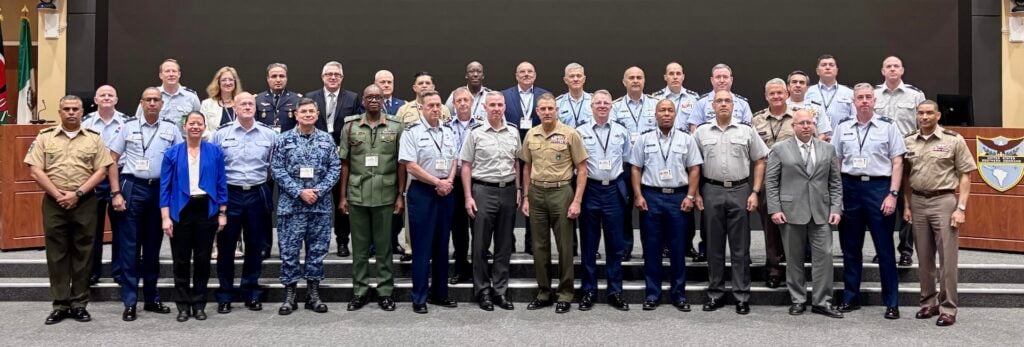

As space becomes increasingly important for security, defense, disaster response, and technological development, military leaders and representatives from partner nations from across the hemisphere gathered at U.S. Southern Command (SOUTHCOM) headquarters in Doral, Florida, April 28–30, for the Space Conference of the Americas 2026, hosted by SOUTHCOM in collaboration with U.S. Space Command (SPACECOM).
The conference brought together senior military space leaders and representatives from Argentina, Brazil, Chile, Colombia, Ecuador, Mexico, Paraguay, Peru, and Uruguay. Senior representatives from Canada, France, and Germany also participated, while Costa Rica, Panama, the Dominican Republic, Suriname, and Guyana attended as invited observer countries. The conference also welcomed for the first time observers from Angola, Kenya, Morocco, and Nigeria.
Over the course of the three-day event, military leaders, government officials, and industry experts exchanged perspectives on the growing strategic importance of the space domain and the need for greater regional cooperation to address emerging security challenges.
“Military strategy has long recognized the importance of controlling the high ground,” said U.S. Marine Corps General Francis L. Donovan, SOUTHCOM commander, during his opening remarks. “In the 21st century, that high ground is space. We must seize the initiative to ensure supremacy over our adversaries in this key domain.”
Gen. Donovan also highlighted concerns about China’s influence and infrastructure development in the space domain across the Western Hemisphere.
“China continues its malign activities via the Belt and Road Initiative to project hard power and threaten key terrain. The Western Hemisphere now hosts the largest collection of Chinese-built space infrastructure outside of mainland China,” Gen. Donovan said.
U.S. Space Force General Stephen N. Whiting, SPACECOM commander, emphasized the importance of space-enabled cooperation in addressing shared regional threats.
“We have a moral responsibility to provide space enabled solutions to address the terrestrial threats that compromise our way of life,” Gen. Whiting said during the conference.
Speakers also discussed how satellite-based systems, AI-assisted analysis, and space-derived data are increasingly supporting partner nation efforts to detect illicit trafficking activity and identify infrastructure used by transnational criminal organizations.
Multinational integration and interoperability were recurring themes throughout the conference, particularly in discussions focused on military exercises and regional cooperation.
“One of the most compelling ways we can advance our collective strength is through multinational integration into our war games and exercises,” Gen. Whiting said. “Our space partnership exercise, Apollo Sentinel, involves 28 nations, including Brazil, Chile, Colombia, and Peru, plus the NATO Space Center of Excellence, and several observers.”
The conference also served as a platform for partner nations to present their own advances and priorities in the space domain.
“This allows each of our institutions and countries to continue promoting and advancing the development of a joint force across the hemisphere,” said Chilean Air Force Colonel Ignacio Baeza, foreign liaison officer assigned to U.S. Air Forces Southern, during his opening remarks.
Regional leadership in the space domain
Partner nations from across the Western Hemisphere highlighted efforts to strengthen national capabilities and expand cooperation in the space sector.
“Brazil, as one of the founding members of the United Nations Committee on the Peaceful Uses of Outer Space and a signatory to the five principal space treaties, understands the space environment as a scarce resource,” said Brazilian Air Force Brigadier General Sandro Bernardon, director of the Aerospace Operations Command’s Space Operations Center (COPE), during a panel on Space Centers of Excellence. “We treat space almost like a commodity. The use of space and the preservation of the space domain can be addressed through international collaboration and partnerships between countries. From our perspective, the establishment of space centers of excellence will foster this cooperation and help develop specific capabilities in the region.”
Colombian Aerospace Force Colonel Eliana Mallarino, director of Space Capabilities of the Space Operations Directorate, emphasized the importance of education and long-term development in the country’s space ambitions.
“We primarily believe that understanding space is the path through which we can cooperate correctly […]. Colombia wants to establish a space center at Marco Fidel Suárez Air Base, where the officer training school is located. This has a dual purpose: to develop space capabilities while also motivating new generations […] because we have a national security responsibility,” Col. Mallarino said.
Peru also highlighted the development of its recently established Space and Cyberspace Command.
“This new domain is reaching all nations around the world. We are not isolated from it because we have PERUSAT-1, one of the most advanced satellites in Latin America, which has been operating for 10 years and has been mainly focused on research and development,” Peruvian Air Force Major General Mariano Rodríguez, commander of the Peruvian Air Forces Space and Cyberspace Command, told Diálogo. “However, we had remained distant from security and defense issues. By creating this space command, combined with cyberspace, we are achieving objectives and developing new capabilities in these fields, especially to contribute to both regional and global security.”
Conference participants also recommended taking concrete steps toward establishing regional Space Centers of Excellence and expressed support for adopting a standardized Space Common Operating Picture through SOUTHCOM’s Enhanced Domain Awareness tool, according to the conference’s joint statement.
Artemis Accords and expanding cooperation
The conference also highlighted the growing participation of Latin American countries in the Artemis Accords, a U.S.-led initiative that establishes principles for peaceful, transparent, and sustainable space exploration.
Since the accords were introduced in 2020, countries including Argentina, Brazil, Chile, Colombia, Ecuador, Mexico, Peru, the Dominican Republic, and Uruguay have joined the initiative as part of broader efforts to expand national space capabilities and international cooperation.
One week after the conference, Paraguay officially joined the Artemis Accords during a May 7 ceremony in Asunción, becoming the 67th country to sign the agreement. Paraguay’s space agency, established in 2014, has focused on developing Earth observation capabilities through projects such as GuaraníSat-1 and the upcoming GuaraníSat-2 satellite, scheduled for launch in October 2026 from Vandenberg Space Force Base in California.
Kathleen Karika, senior advisor in NASA’s Office of International and Interagency Relations, highlighted the growing participation of Latin American nations in the Artemis Accords while presenting a model of the future lunar space station during the conference.
The growing participation of countries across the Americas in initiatives such as the Artemis Accords reflected one of the conference’s broader themes: the expansion of regional cooperation and technological development in the space domain.
The conference underscored how space is becoming an increasingly strategic domain for the Americas, where cooperation, interoperability, and shared technological capabilities are emerging as key components of hemispheric security.