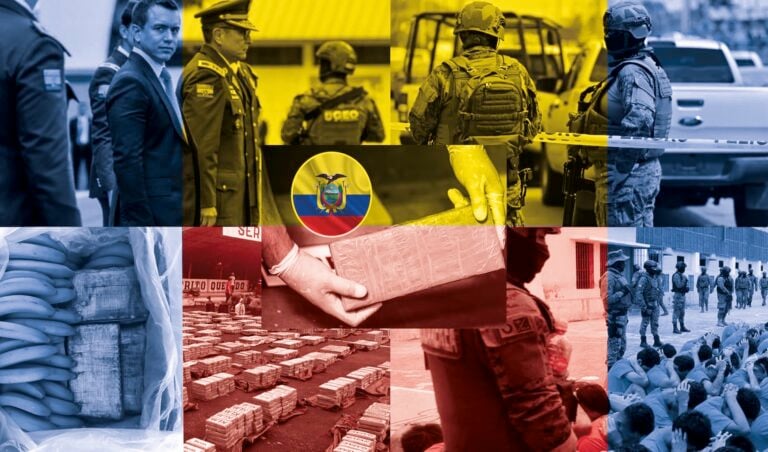


Since January 2024, Ecuador has ceased to be a peripheral actor on the regional security map and has become a hemispheric concern. President Daniel Noboa’s declaration of an internal armed conflict and the designation of 22 criminal groups as terrorist organizations marked a turning point in the face of violence that had overwhelmed the traditional capacity of the state. The sustained increase in homicides, the territorial control exercised by armed gangs, and a prison system captured by criminal structures exposed the collapse of a model that for years had sustained the perception of stability in the country.
Until then, Ecuador had been considered an oasis of peace in a region ravaged by drug trafficking and organized violence. Despite undergoing profound political and institutional crises, the country did not experience the levels of homicide seen in its neighbors. However, its strategic location between Colombia and Peru — the world’s two largest cocaine producers according to the United Nations Office on Drugs and Crime (UNODC) — gradually made it an increasingly attractive link for transnational criminal networks, until it became a key logistics hub for global drug trafficking.
From drug trafficking corridor to security collapse
“Although it sounds alarming today, the security challenge in Ecuador has been brewing for years,” security expert Evan Ellis, research professor of Latin American Studies at the U.S. Army War College Strategic Studies Institute, said in an interview with Diálogo. Investigative findings and analysts suggest that this evolution is the result of a combination of regional and local factors that have reshaped the map of organized crime in South America.
Among the determining factors is the failed peace process in Colombia in 2016, which fragmented the criminal ecosystem and multiplied illegal actors, encouraging the expansion of their operations beyond Colombia’s borders, with an enormous impact on its southern neighbor. Added to this was the sustained boom in cocaine production in the Andean region, especially in Colombia, where it increased by 53 percent in 2023, the highest figure since 2001, according to the UNODC.
“The expansion of cocaine production flowed to criminal groups that already saw Ecuador as a storage and export hub. Added to this were security failures in Colombia during the administration of Juan Manuel Santos and border permissiveness under the administration of Rafael Correa, which marked a turning point,” Ellis said.
At the same time, links between Ecuadorian gangs and foreign criminal organizations were consolidated. The Mexican cartels of Sinaloa and Jalisco New Generation (CJNG) intensified their collaboration with local groups and Colombian organizations to bring cocaine into the country, store it, and subsequently export it through strategic ports such as Guayaquil, Manta, and Esmeraldas. European organizations, such as the Albanian mafia and the Italian ‘Ndrangheta, which specialize in exporting drugs to Europe, joined this already alarming dynamic.
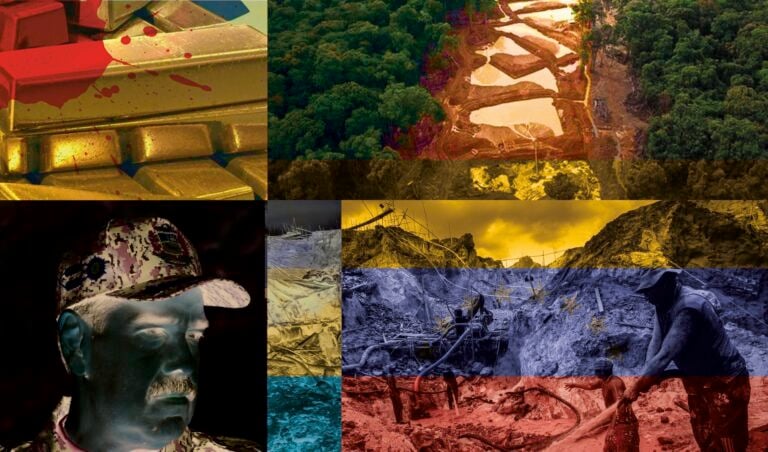
In this context, and in close interaction with drug trafficking flows, an illegal mining economy emerged in Ecuador that spread throughout the country. “Cocaine and the illegal mining economy, including extortion of legally operating mines, have also become a focus for terrorist groups and criminal structures based in Colombia that operate in the country,” Ellis added.
Institutional erosion and state capture
Beyond these operational machinations, analysts warn that the current crisis is the culmination of a legacy of institutional vulnerability in Latin America. Historically weak state controls and the past co-opting of key institutions have facilitated the penetration of organized crime. “Ecuador has been functioning for years as a link in organized crime, protected by corrupt state structures and sheltered by 21st-century socialism or Castro-Chavism,” said Carlos Sánchez Berzaín, director of the Inter-American Institute for Democracy and former Bolivian defense minister, in an interview with Diálogo.
This institutional deterioration was not an abstract or spontaneous phenomenon, but rather the result of specific political decisions that weakened the state and facilitated its criminal capture. “During Rafael Correa’s administration, organized crime co-opted the state, infiltrated politics, public institutions, and the private sector, penetrating throughout society,” explained Andrés Rugeles, political scientist and vice president of the Colombian Council on International Relations (CORI), in an interview with Diálogo.
The consequences of this convergence of factors became fully visible in 2023. In just one year, Ecuador went from being considered an “island of peace” to leading the region in violence rates. The country became the most violent in South America and the fourth most violent in Latin America and the Caribbean, behind only Haiti, Trinidad and Tobago, and Jamaica. This dramatic turn not only reshaped the international narrative about Ecuador but also exposed the cumulative cost of years of negligence, corruption, and institutional neglect.
“The violence Ecuador faces today is the cost of dismantling a narco-state,” Berzaín said. “For more than a decade, crime took root in the country, causing enormous damage to institutional integrity, and removing it is not only complex, but also provokes a violent reaction because these structures have nowhere to retreat.”
Containment, control, and initial results
Faced with the rapid deterioration of security, the state’s response was immediate and high impact. The Noboa administration deployed police and military forces in unprecedented numbers to urban areas, borders, strategic ports, and prisons, combining territorial control operations with targeted actions against drug trafficking, illegal mining, and other illicit economies. These measures were reinforced by successive states of emergency, as tools to restore public order and recover the state’s presence.
The first effects began to be reflected in violence indicators. According to the Ecuadorian Observatory on Organized Crime (OECO), homicides fell by 14.7 percent and prison massacres, one of the most visible symbols of gang power, declined significantly. For the executive branch, these data confirmed that the state offensive had succeeded in curbing, at least initially, the escalation of violence.
Added to this assessment were impressive results in the fight against drug trafficking. According to data provided by the Ministry of the Interior, 2024 closed with a record number of drug seizures, an increase of 29 percent over 2023, highlighting the impact of reinforced territorial control and operations at ports and borders.
At the same time, the state made progress on one of the central pillars of organized crime: its financial capacity. In September 2025, Operation Northern Border 2 (Operación Frontera Norte 2) resulted in the seizure of 103 properties valued at more than $313 million. Considered the largest offensive against criminal finances in Ecuador’s history, the offensive dismantled the economic network of the Comandos de la Frontera, a dissident group of the Revolutionary Armed Forces of Colombia (FARC), seizing farms, businesses, and gas stations, key assets for money laundering and the operational sustainability of the illicit organization.
From episodic violence to a structural and endemic threat
The security strategy deployed by the Ecuadorian government, aimed at strengthening internal security, regaining territorial control, and containing the expansion of organized crime, led to an initial improvement in the security environment and laid the groundwork for a broader and more sustained response. During 2025, the government expanded and deepened these operations in a context marked by the rapid adaptability of criminal networks.
Despite these efforts, developments in the situation highlighted the complexity of the challenge. Throughout 2025, the country saw a further increase in violence, accompanied by the silent expansion of organized crime into areas previously considered low risk. A critical turning point occurred in July 2025 with the extradition of José Adolfo Macías Villamar, alias Fito, to the United States. While his removal was a landmark victory for the Noboa administration, it triggered a power vacuum within Los Choneros (one of Ecuador’s main criminal organizations), resulting in internal purges and the aggressive territorial expansion of rival groups like Los Lobos and catalyzing a second wave of violence.
“This is the result of organized crime ceasing to be organized, and this weakening is driving fragmentation and the struggle for control of territories and illicit economies,” Berzaín said.
According to the OECO, 2025 ended as the most violent year in the country’s recent history, with homicide rates surpassing 50 per 100,000 inhabitants. At the same time, drug trafficking, particularly of cocaine, continued to flow in significant volumes from Ecuadorian ports to multiple international markets.
For analysts and experts, these indicators reflect that Ecuador is confronting a criminal architecture that transcends isolated outbursts of violence. This threat operates structurally, both locally and across borders, requiring comprehensive and sustained responses over time.
“The expansion of coca production and illegal mining, coupled with persistent corruption in certain institutions, has presented the state with challenges that, in some cases, are beyond its control,” Ellis said. These dynamics have consolidated Ecuador as a relevant node within the logistics chains of transnational organized crime, increasing pressure on the security system and weakening state control over strategic territories and routes.
Experts consulted by Diálogo warn that this accelerated transformation has given way to a hybrid threat. Transnational organized crime, in coordination with political actors aligned with so-called 21st-century socialism and networks of influence built over the last few decades, has resorted to violence, institutional infiltration, and political destabilization to preserve spaces of power, explained Berzaín, who also warned that “Ecuador has become a key player in the drug trafficking chain driven by Castro-Chávez countries.”
The combination of control of illicit economies with strategies of undue interference in institutions and, at the same time, exerting political pressure to undermine public functioning, has amplified the impact of the phenomenon. “What is happening in Ecuador has a transnational dimension and requires regional, hemispheric, and global cooperation to be effectively addressed,” Rugeles said.
From a strategic perspective, Ecuador’s security crisis can no longer be interpreted solely as a domestic challenge. Its evolution has direct implications for regional stability and for hemispheric cooperation efforts aimed at containing transnational organized crime. In this scenario, Ellis warned, “the Ecuadorian state’s ability to sustain and adapt its security policies will be a key factor not only for its internal stability, but also for regional security.”
Part II
The second part of this report reveals the configuration of Ecuador’s new criminal map, which has now become a strategic hub for regional organized crime, after going from facing a few gangs to recognizing more than 20 organizations classified as terrorists. The convergence of Mexican cartels, Colombian armed structures, and European networks has created a transnational criminal ecosystem, and understanding who is involved and how they operate is key to grasping its complexity.
Experts point out that this process reached a turning point in March 2008, with the bombing of Angostura and the death of Raúl Reyes, a top ranking member and senior spokesperson for the Revolutionary Armed Forces of Colombia (FARC), on Ecuadorian territory, an episode that highlighted the presence of foreign armed actors in the Andean country and the vulnerabilities of state border control. With tens of thousands of people of multiple nationalities linked to these illicit economies, the report analyzes the regional response to a growing threat, bolstered by U.S. support and an urgent call for greater regional cooperation. “A firm commitment to combat organized crime is required, but in some cases in the region, that willingness simply does not exist,” Rugeles says.