Illicit maritime networks operating across the Western Hemisphere are becoming increasingly sophisticated. No longer relying solely on isolated smuggling vessels or covert nighttime movements, sanctioned actors and transnational criminal organizations (TCOs) now operate through complex maritime structures designed to obscure ownership, conceal cargo origins, and exploit legal and regulatory gaps across jurisdictions.
These evolving networks — often referred to as “shadow fleets” or “dark fleets” in the context of sanctions-evasion shipping — rely on tactics such as Automatic Identification System (AIS) manipulation, fraudulent registries, shell companies, covert ship-to-ship (STS) transfers, and falsified documentation to evade detection while moving sanctioned oil and other restricted cargo.
The expansion of deceptive maritime practices
The use of shadow-fleet tactics has expanded significantly in recent years. According to S&P Global, a financial data and analytics firm, nearly 1,000 tankers — roughly 17 percent of the global oil tanker fleet — were involved in sanctions-evasion networks in 2025, a more than 40 percent increase from the previous year. Much of this activity has been driven by efforts to sustain Russian oil exports under sanctions, with shadow fleets estimated to carry roughly 60 percent of Russia’s seaborne crude shipments.
Vessels linked to these sanctions-evasion networks frequently change names, flags, ownership structures, and operating companies, often cycling through multiple registries and offshore shell corporations. According to Kimberly Donovan, director of the Economic Statecraft Initiative at the Atlantic Council’s GeoEconomics Center, throughout 2025, over 70 percent of sanctioned vessels changed flags to obscure ownership and complicate enforcement efforts. In February 2026, investigative news outlet Follow the Money reported that more than 500 vessels were operating without valid flag registration, further illustrating the scale of opaque maritime activity.
“These vessels often operate under false flags, lack of proper insurance, and pose higher risks of spills, collisions, and abusive labor conditions for crews — making global shipping less safe,” Donovan told global risks analytics platform Kharon.
Another persistent tactic involves AIS manipulation. Vessels may disable tracking systems entirely — commonly referred to as “going dark” — or broadcast false positional data to conceal routes, rendezvous points, or cargo transfers. Ship-to-ship transfers conducted in international waters further complicate monitoring by masking cargo origin and destination, particularly in sanctions-evasion schemes involving oil shipments.
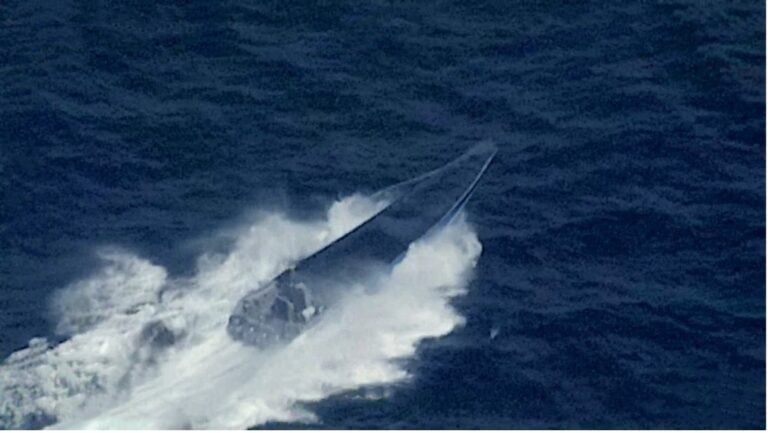
These practices are not limited to sanctions evasion. In the Eastern Pacific and Caribbean, similar methods are increasingly used by TCOs to move narcotics, precursor chemicals, weapons, and other illicit cargo while seeking to avoid detection by maritime patrols and coastal authorities.
Maritime enforcement is adapting
In response, maritime enforcement strategies across the hemisphere are evolving from reactive interdictions toward persistent, intelligence and technology-driven operations.
Regional agencies and multinational coordination bodies such as Joint Interagency Task Force South (JIATF-S) — primarily focused on counternarcotics efforts — are increasingly integrating satellite imagery, AIS analysis, artificial intelligence-assisted systems, financial intelligence, and law enforcement data to identify suspicious patterns before vessels conduct illicit activity or reach port. This reflects a broader operational change: Rather than focusing solely on individual vessels, authorities are targeting the networks that enable them — including registries, insurers, and ownership structures that allow these vessels to operate across jurisdictions.
“The threat is evolving and the adversary is still highly resourced and motivated,” a former JIATF-S director previously warned. “We cannot rest on our laurels. There are a number of challenges yet to overcome.”
From strategy to operations
Across the region, partner nations are applying these approaches to counter a range of illicit maritime networks. While these tactics are most visible in sanctions-evasion shipping, similar methods — deception, concealment, and network-based logistics — are increasingly observed in transnational criminal maritime activity.
In Colombia, the Navy has expanded its role as a regional hub for multinational counternarcotics operations through initiatives such as the Orion strategy, which integrates dozens of countries and international organizations in coordinated efforts against transnational trafficking networks. Combining sustained maritime presence, intelligence sharing, aerial and naval surveillance, and interagency coordination, the strategy has strengthened the ability of participating nations to identify trafficking routes, detect suspicious maritime activity, and disrupt illicit logistics networks operating across the Caribbean, Pacific, and transatlantic corridors.
Ecuador has also strengthened its maritime enforcement capabilities. In early 2026, the Ecuadorian Navy incorporated the Isla Santa Rosa LG-40, an Island-class patrol vessel, expanding operational reach along key Pacific trafficking routes and improving response to suspicious maritime activity. The vessel’s incorporation comes amid intensified joint counternarcotics and maritime security operations with the United States, particularly across the Eastern Pacific corridor.
Panama, meanwhile, is reinforcing oversight around one of the hemisphere’s most strategic maritime corridors. The Panama Canal Authority introduced a risk-based vessel inspection model in late 2025, prioritizing inspections based on vessel risk profiles, including those potentially linked to sanctions-evasion schemes or opaque commercial networks. In parallel, Panama’s National Air and Naval Service (SENAN) continues to expand patrol capabilities along both Caribbean and Pacific approaches to the Canal while intensifying intelligence sharing, joint training, and operational coordination with the United States and other regional partners to strengthen maritime domain awareness and counter illicit trafficking activity around critical trade routes.
Early 2026 interdictions illustrate how these combined capabilities are being applied in practice. On January 7, U.S. authorities interdicted the motor tanker M/T Sophia, which U.S. Southern Command (SOUTHCOM) described as a “stateless, sanctioned dark fleet motor tanker,” operating in the Caribbean Sea. The vessel, Reuters reported, was carrying oil at the time of the interdiction, linking the case to broader efforts to counter sanctions-evasion shipping networks operating through deceptive maritime practices.
Conducted with support from the U.S. Coast Guard and interagency partners, the operation highlighted the increasing ability of enforcement agencies to identify vessels operating with unclear registry status, manipulated tracking data, and links to illicit networks before they could offload cargo or evade oversight.
Persistent monitoring, continued enforcement
The challenge posed by shadow fleets is not new — but the operating environment around them is changing.
What once allowed illicit actors to operate with relative anonymity — fragmented jurisdiction, limited visibility, and delayed information sharing — is being steadily reduced. The integration of maritime surveillance, financial intelligence, and multinational coordination is compressing the time between detection and action.
The message is increasingly clear: Vessels relying on deception, opaque ownership structures, or manipulated tracking systems will be identified, tracked, and where applicable, interdicted. As monitoring becomes more persistent and interconnected, the operational space available to illicit maritime networks is steadily closing.