

The fight against criminal structures in Central America has entered a new phase: dismantling their growing operational sophistication. In both Honduras and Guatemala, security forces are not only confronting criminal networks but are identifying and dismantling their advanced physical and technological infrastructure, reflecting a broader regional effort to counter transnational criminal organizations. This shift underscores the increasing importance of intelligence-driven operations that prioritize the identification and disruption of criminal capabilities, not just the apprehension of individuals.
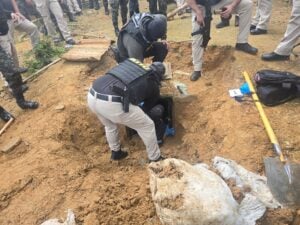
In Honduras, the Armed Forces and the Technical Agency for Criminal Investigation (ATIC) dismantled an underground bunker belonging to Mara Salvatrucha (MS13). The hideout, located in the remote area of Vida Nueva, in the municipality of Omoa, contained drugs, weapons, and ammunition, according to a report by local daily La Tribuna. The discovery highlights the level of preparation and organization these groups have reached, while also underscoring authorities’ growing ability to detect and neutralize such structures.
“The gangs have invested not only in logistics but also in training some of their members. They now have professionals such as lawyers, doctors, and engineers,” Leonardo Pineda, an expert on public safety and public policy in Honduras, told Diálogo. “We are seeing a higher level of sophistication: It is no longer just a gang, but an organized criminal group.”
Operations underway: Weapons, drugs, and uniforms
The operation was led by ATIC’s Transnational Anti-Gang Center. During the operation, several gang members escaped following a confrontation with law enforcement, which was acting under the coordination of the Special Prosecutor’s Office Against Organized Crime and the Directorate for the Fight Against Drug Trafficking (DLCN). Authorities also arrested several gang members and confiscated weapons, drugs, and police uniforms, the Honduran Public Prosecutor’s Office reported. The coordination among specialized units highlights the importance of multi-agency approaches capable of integrating intelligence, legal authorities, and operational capabilities in complex security environments.
For Pineda, the growing sophistication of these organizations is not only a natural evolution but also the result of convergence with other criminal groups. “That is why we see that they have grown in logistical capabilities,” he said.
In San Pedro Sula, the operation included raids on 17 businesses used as fronts to hide weapons and transport drugs. According to news outlet Noticias 24/7, shipments were gradually transported to Tegucigalpa in vehicles with hidden compartments. Targeting these logistical and financial nodes is increasingly critical to disrupting the broader networks that sustain transnational criminal operations.
Jaime Quintanilla, deputy director of the DLCN, told Honduran network Televicentro: “This operation only lays bare one reality: Mara Salvatrucha is displacing other organizations. When you look at these stashes, the modified vehicles, the quantity of narcotics, and the uniforms seized, it is clear that they control the areas where aircraft and boats loaded with drugs enter to later transfer the cargo to Guatemala and Mexico.”
In another blow to organized crime, the Public Prosecutor’s Office reported in February the arrest of 10 members of these groups. Authorities also seized 81 firearms, including AK-47 rifles; 23 grenades; four rocket launchers; 17 vehicles with hidden compartments; and police and military uniforms from both national and international institutions. Authorities also confiscated quantities equivalent to 281,100 doses of marijuana and 160,500 doses of crack cocaine. Such seizures not only remove immediate threats but also degrade the operational capacity and reach of these organizations.
“The remainder of the drugs that reach our country — those kilos that are damaged or broken — are being processed to be sold on the local Honduran market,” explained Quintanilla. “The area where we carried out this operation served as a collection center.”
Covert surveillance in Guatemala
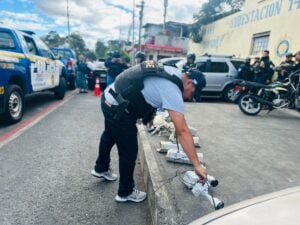
The sophistication of gangs is not limited to Honduras. In Guatemala, authorities face a parallel challenge: the use of clandestine cameras to monitor territory and warn of police operations. The National Civil Police dismantled 14 video surveillance systems installed in the Bethania, Sakerty, and Amparo neighborhoods, located in Zone 7 of Guatemala City in early 2026 operations, several news sources reported. The dismantling of these systems highlights the need for security forces to adapt to increasingly technology-enabled threats and to develop capabilities that counter criminal use of surveillance.
In the San Rafael II neighborhood, Zone 18 of Guatemala City, another network of clandestine cameras used by gangs to anticipate the arrival of police and military personnel was dismantled during operations carried out in late January. These devices also enabled them to identify potential victims, increasing the risk to civilians and security forces, according to the Guatemalan News Agency.
An evolving phenomenon
For Pineda, the findings in Guatemala and Honduras show that gangs have moved from using rudimentary methods, such as “banderitas” or “postes” (people who monitor access points), to far more advanced systems of extortion, surveillance, and territorial control. “This has been happening for several years in Honduras and other places where these criminal groups are present,” the expert said.
The growing sophistication of gangs in Central America presents a major challenge for authorities, who are confronting not only violence and drug trafficking but also criminal networks that continuously adapt and evolve, strategically using technology and resources to consolidate their power. These trends reinforce the need for sustained investment in intelligence, technology, and interagency coordination to effectively counter evolving criminal threats.