
Senior military leaders from the French Republic, Kingdom of the Netherlands, and the United States convened in Key West, Florida, April 28-29, 2026, to strengthen coordination against transnational criminal organizations (TCOs) operating across the Western Hemisphere. The allied forces reaffirmed their commitment to expanding partnerships, improving information sharing, and enhancing operational cooperation to counter regional TCO and counternarcotics threats.
The cornerstone of the biannual Trilateral talks (TRILAT), hosted at Joint Interagency Task Force South (JIATF-S), was the signing of both an operational charter and an intelligence working group (IWG) charter. France and the Netherlands, partners of JIATF-S for more than 30 years in countering drug trafficking, used the meeting to identify additional avenues for cooperation in support of the task force’s efforts to disrupt illicit narcotic flows in accordance with international law.
Discussions focused on refining deconfliction methodologies, updating Campaign MARTILLO (Hammer) — the allied multi-year counternarcotics strategy — and expanding integration in Trans-Atlantic combined operations aimed at degrading TCO networks that profit from drug sales in Europe to finance their destabilizing activities in the Western Hemisphere.
The signing of the IWG Charter is intended to improve the speed and precision with which French, Dutch, U.S., and partner forces share target data, enhancing the ability of participating nations to detect and disrupt illicit trafficking activity. Refined deconfliction methodologies will also maximize the effectiveness of combined allied fleets, ensuring sustained, overlapping pressure on both primary and secondary narcotics flows, while respecting the distinct legal authorities and operational frameworks of each allied country.
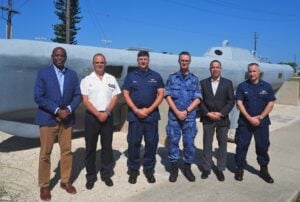
The French delegation was led by Rear Admiral Jean-Baptiste Soubrier, commander of French Armed Forces in the Caribbean, while the Dutch delegation was led by Rear Admiral Lower Half Walter Hansen, commander of Netherlands Forces in the Caribbean. The hosting U.S. delegation was led by Rear Admiral Jeffrey Randall, director of JIATF-S.
“Our French and Dutch allies, with additional support from British, Canadian, and RSS forces, are critical enablers of our joint effort to stop drug-trafficking organizations in the Western Hemisphere,” stated Rear Adm. Randall. “Together, we are creating a safer world for all.”
While the core interdiction framework outlined in the TRILAT Charter is led by the United States, France, and the Netherlands, officials emphasized that the effort also relies on the support of a growing network of partner nations. Observers from the United Kingdom, Canada, and the Regional Security System (RSS) participated in the discussions, shaping the unified strategy and bringing critical assets and expertise to the effort. Participating nations also agreed to invite the Caribbean Community Implementation Agency for Crime and Security (CARICOM IMPACS) as a future observer.
Following the charter signing, attendees participated in the U.S. 4th Fleet Experimentation event (FLEX), which showcased emerging naval autonomous vessel and aircraft technology. These technologies will soon be integrated into future allied patrols coordinated by JIATF-S to expand domain awareness and strengthen efforts to disrupt TCO routes.
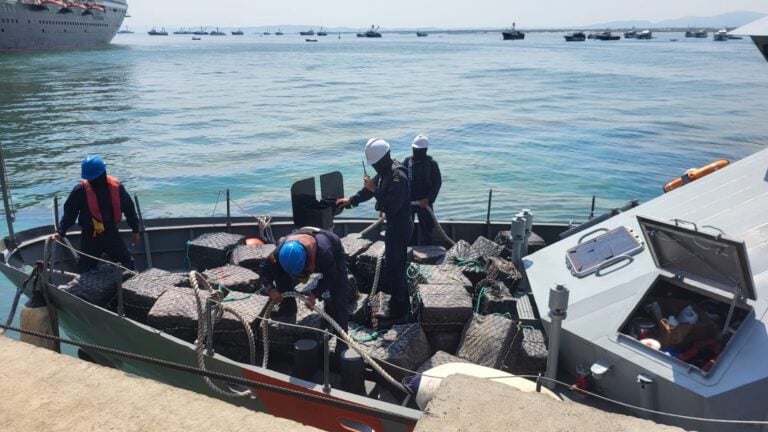
JIATF-S oversees Campaign MARTILLO, a multinational effort dedicated to disrupting maritime and aerial trafficking routes used by TCOs. Supported by an artificial intelligence and machine learning (AI/ML) joint operations center, the campaign brings together 21 allied and partner nations, yielding significant operational results against TCO trafficking networks. In 2025, JIATF-S-supported operations resulted in the seizure and disruption of a record 455.8 metric tons of cocaine — delivering a severe logistical and financial blow to TCOs, while 2026 is currently on track to surpass that figure.
As staff coordination continues following the conference, the message to TCOs is clear: The combined efforts of the French, Dutch, and U.S. allied forces will deny criminal networks safe haven across the Caribbean or Atlantic. The alliance will continue to adapt and innovate, detect and interdict, sustaining pressure on illicit trafficking networks in support of regional security and stability. The greater goal remains a safer world for all.