
A newly formalized intelligence-sharing agreement between Colombia and Brazil is already translating into operational gains across the Amazon, as both countries deepen coordination against narcotrafficking and illegal mining along their shared waterways.
Colombia and Brazil have formalized procedures for the exchange of intelligence information through a bilateral protocol supported by the United Nations Office on Drugs and Crime (UNODC). The agreement builds on years of cooperation and is designed to strengthen joint responses to transnational organized crime in the tri-border region.
“Cooperation between the Colombian Navy and the Brazilian Federal Police has established itself as a fundamental pillar of Amazonian security, aimed at addressing common threats that transcend borders and constantly challenge the capacity of states,” the Colombian Navy Press Office told Diálogo.
While the protocol formalizes the partnership, operations in recent months indicate that bilateral coordination is already producing tangible results.
According to the institution, this collaboration focuses on the timely exchange of intelligence, the execution of coordinated and simultaneous operations in border areas — particularly along Amazonian rivers — as well as support for judicial processes and participation in regional security mechanisms.
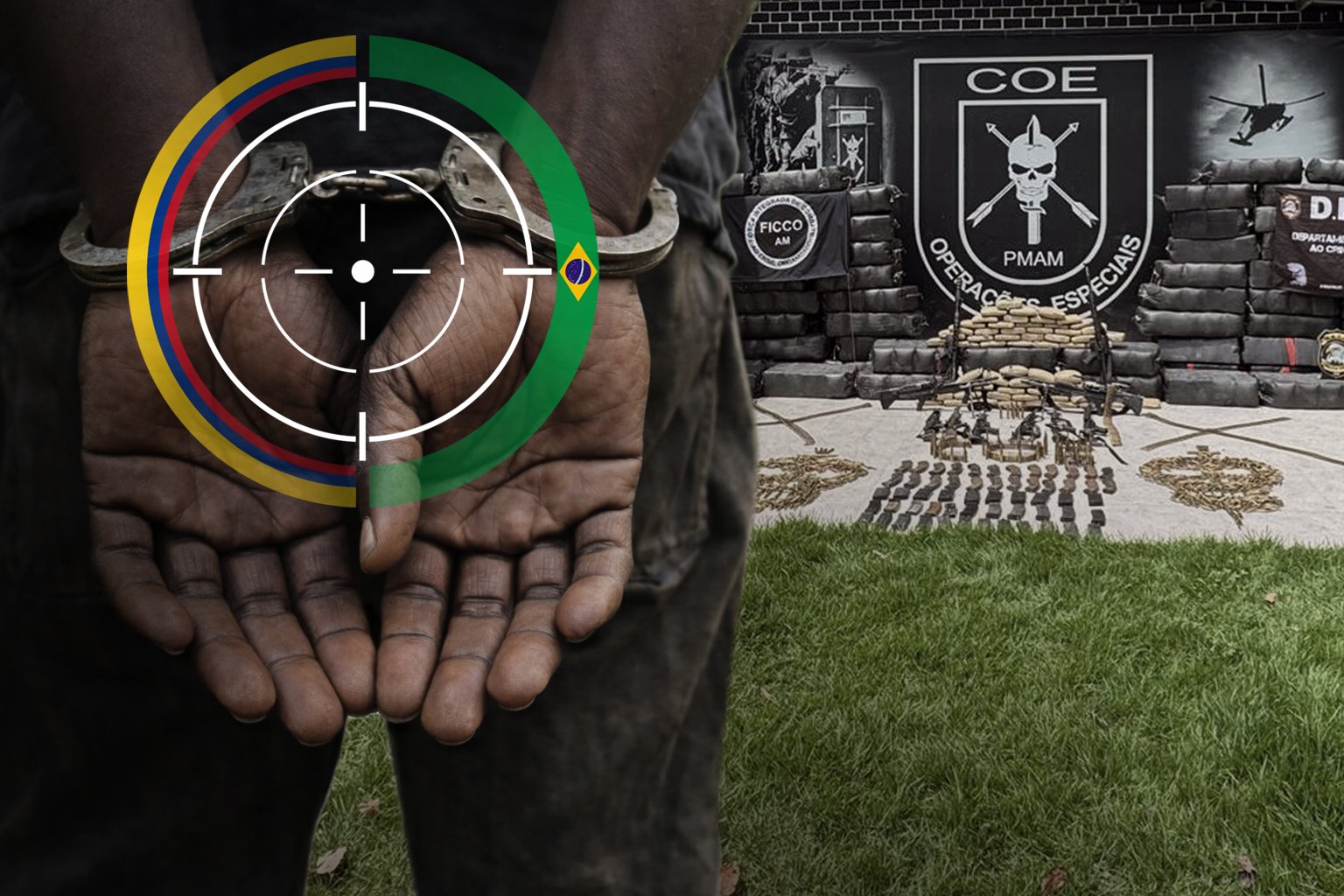
In one such case — marking one of the first operational outcomes following the formalization of the intelligence-sharing protocol — coordinated intelligence led to the interception of two vessels in February, on the Solimões River near Manaus, carrying approximately 4 metric tons of drugs, including cocaine and marijuana, and long-range firearms and satellite communications equipment, according to the Colombian Navy. The operation was carried out as a joint and combined effort, highlighting how real-time information sharing is enabling authorities to act more quickly and effectively in remote riverine environments.
From information sharing to joint action
Beyond individual interdictions, Colombia and Brazil have expanded their cooperation through synchronized riverine operations targeting criminal networks that operate across borders.
“Institutional synergy takes place at the Amazon Information Fusion Center […] where not only Brazil but also other Amazonian countries such as Ecuador and Peru participate in a multinational and interinstitutional effort,” the Colombian Navy noted.
Operation Frontera Dourada, carried out in November 2025, brought together Brazilian federal agencies with coordination from Colombian counterparts to combat illegal mining in the same region. The operation led to the dismantling of numerous dredging platforms and associated equipment, underscoring the effectiveness of sustained, multi-agency and cross-border collaboration.
Similarly, during Operation Ágata Amazônia 2025, conducted in mid-2025, Brazilian and Colombian forces carried out coordinated actions along the Puré River, a key border waterway. The operation involved approximately 200 personnel and resulted in the neutralization of multiple illegal mining structures on the Colombian side, which had been identified through satellite imagery from Brazil’s Amazon Protection System Management and Operations Center (CENSIPAM), with support from the Brazilian Air Force, disrupting operations that rely on cross-border mobility to evade enforcement.
These efforts reflect a shift toward coordinated action on both sides of shared waterways, reducing the ability of criminal groups to exploit jurisdictional gaps.
An evolving intelligence architecture
At the core of this cooperation is a growing intelligence-sharing framework that allows both countries to monitor illicit activity and coordinate responses across vast and difficult-to-access areas of the Amazon.
Colombia’s Amazon Information Fusion Center plays a central role by collecting and analyzing data on narcotrafficking, illegal mining, and related threats. This information is increasingly exchanged with Brazilian counterparts, enabling joint planning and more targeted operations.
The protocol — signed on January 14, 2026 — formalizes these exchanges, helping standardize procedures and ensure continuity in bilateral coordination. Rather than initiating cooperation, the agreement strengthens an existing system that is already supporting operational outcomes.
A shared challenge in a complex environment
The scale and geography of the Amazon basin continue to pose significant challenges for law enforcement and security forces. Remote border regions — particularly where Colombia, Brazil, and Peru converge — are frequently used by criminal organizations to move drugs, equipment, and personnel along extensive river networks.
The region has become increasingly contested, with the presence of Colombian dissident groups such as the Carolina Ramírez structure, the expansion of coca cultivation in Peru, and the growing influence of Brazilian criminal organizations such as the First Capital Command (PCC), which are expanding their reach along key river routes.
In this context, unilateral efforts have proven insufficient, reinforcing the importance of coordinated approaches that extend beyond national borders.
In March 2026, Colombia and Brazil announced new measures to further strengthen security cooperation in the Amazon. Both countries agreed to expand collaboration through new mechanisms for direct border coordination and continued joint initiatives focused on the region.
From agreement to impact
Taken together, recent interdictions, joint operations, and institutional developments point to a clear trend: Colombia–Brazil cooperation in the Amazon is becoming more structured, more consistent, and more effective.
By linking intelligence sharing with coordinated riverine operations, both countries are beginning to generate measurable impacts against transnational criminal networks — demonstrating that sustained partnership is essential to addressing security challenges in the region.