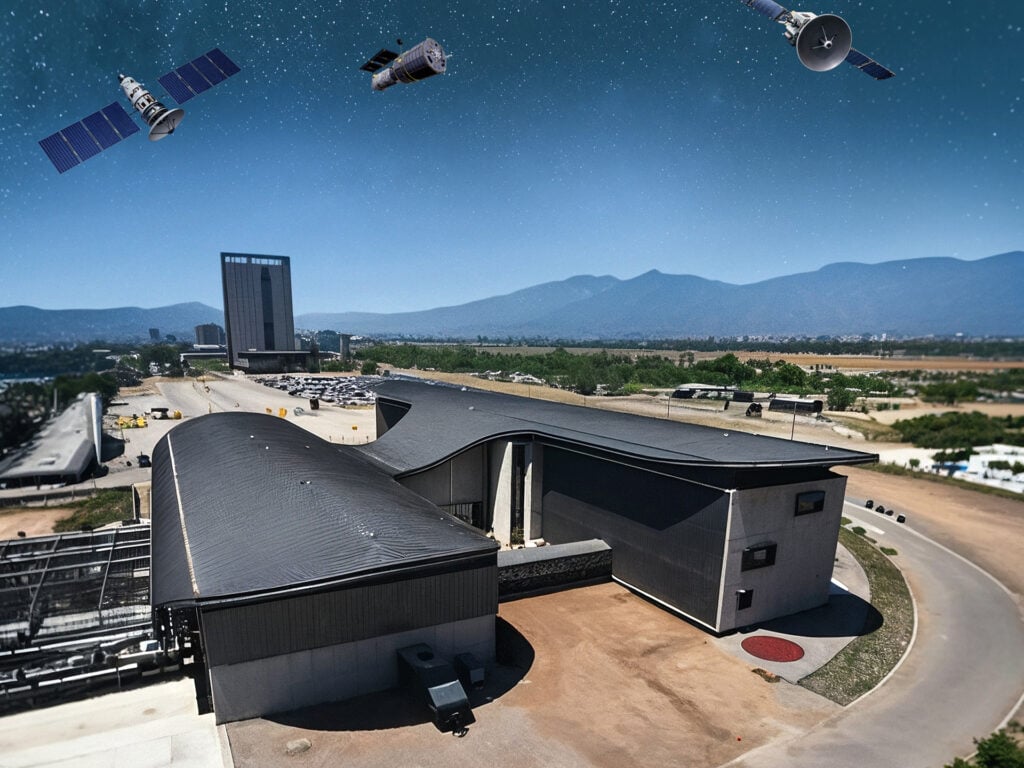

Chile marked a major milestone in late 2025 with the inauguration of its first National Space Center (CEN). The facility is designed to strengthen the country’s satellite and space support capabilities in the coming years and advance the development of its own systems in a field critical to national security and territorial management. This new step positions the country among a growing group of nations with an autonomous presence in space.
A strategic center in the heart of Santiago
Located at Los Cerrillos Air Base in Santiago, the CEN is administered by the Chilean Air Force (FACh) and features state-of-the-art infrastructure. Its capabilities include a mission control system for satellite operations; assembly, integration, and testing laboratories; as well as technology for geospatial data processing, the Chilean government indicated.
The information generated by the satellites will support decision-making in emergency management, environmental monitoring, and land-use planning. Additionally, it will have applications in strategic sectors such as defense, agriculture, and mining, while also supporting applied research.
According to Major General Christian Stuardo Núñez, FACh space director, “Chile is among the countries with an autonomous presence in space and has its own satellite, which has enabled it to provide information during disasters and participate in space debris monitoring.” Maj. Gen. Stuardo added that the CEN will enable progress toward satellite manufacturing, further strengthening the country’s presence in the space sector.
In this first phase, the CEN plans to build up to nine satellites: two weighing approximately 200 kilograms and seven smaller ones. These will be launched into orbit within four years to generate up-to-date data on Chilean territory.
Consolidating space capabilities: A comprehensive challenge
“The center is just one of several steps toward space development, but it must be complemented by talent development, sustained investment, and effective use of the systems developed,” Laura Delgado López, senior fellow at the Jack D. Gordon Institute for Public Policy at Florida International University, told Diálogo. “The CEN and the satellites launched from this center are merely ‘links’ in a broader chain.”
Delgado emphasized that space development requires sustained international integration, given the sector’s reliance on global supply chains, launch services, and cooperative frameworks. “Chile can move toward selective strategic autonomy that combines its own capabilities with technology from allies and the commercial sector,” she added.
She also underscored the importance of properly integrating and processing satellite data: “In early warning systems, the value of this information lies in its integration with existing institutional capabilities.”
Chile has also made progress in geospatial information at the institutional level. Initiatives such as IDE-Chile and the National Geospatial Information Policy launched in 2025 aim to prioritize access, interoperability, and coordination among institutions for more efficient data management, Delgado explained.
International cooperation: A fundamental pillar
The development of CEN is not occurring in isolation, but rather as part of a broader international cooperation agenda aimed at strengthening national satellite systems and promoting technical exchange with allied countries. As an example of this collaborative approach, on January 27, representatives from the Texas National Guard visited the CEN facilities and the FACh Aerial Photogrammetric Service to share experiences in the use of spatial data, according to the institution.
In the words of Major Greg Holman, a geospatial analysis specialist with the Texas Air National Guard, “the importance of these exchanges lies in strengthening cooperation and the flow of information in the future.” Likewise, in August 2025, during the annual meeting of the Chile-U.S. Space Subcommittee, the two countries agreed to move forward with joint projects under the agreement signed in 2021 between the Chilean Ministry of National Defense and the U.S. Department of Defense.
That same year, in April 2025, Chile participated for the first time in U.S. Space Command-sponsored Global Sentinel space exercise. This event, which brought together some 30 countries, more than 250 participants, and the North Atlantic Treaty Organization at Vandenberg Space Force Base, aimed to strengthen shared understanding of the space environment. During the exercise, Chile operated a Space Operations Center and carried out tasks such as sensor control, reentry monitoring, analysis of potential conjunctions, and processing of data from national and international sensors.
Talent development and sustainability in the space sector
According to Delgado, international cooperation also plays a key role in developing human talent. “Cooperation with the United States is relevant in this process. Agencies such as NASA provide technical capabilities and reference frameworks that help align programs with international standards,” she said. She also highlighted that the exchange of personnel and knowledge, along with access to data, strengthens Chile’s institutional capabilities.
Finally, Delgado emphasized that talent development must be comprehensive. “It is necessary to strengthen training in key areas and foster links with the private sector to consolidate a sustainable ecosystem,” she concluded. In this regard, the CEN represents not only a technological advancement but also a platform for the exchange of experience and the development of a solid foundation for the future of Chile’s space sector.
Space has become an increasingly competitive strategic domain, with direct implications for global security and international stability. With the creation of the CEN, Chile is positioning itself as an emerging actor with growing capabilities in this environment.