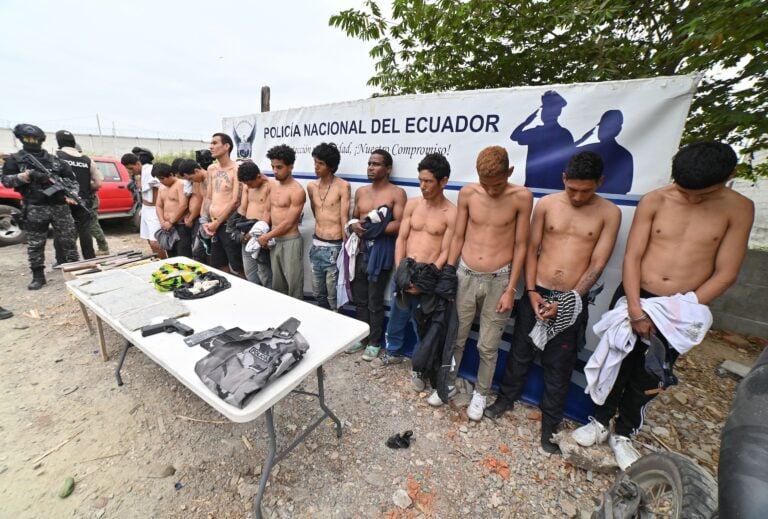


Recent maritime and investigative operations have highlighted a shift in how Ecuador is confronting transnational criminal organizations (TCOs), with authorities placing greater emphasis on coordinated efforts across national and international partners.
As criminal networks continue to operate across borders and domains, Ecuador has begun restructuring how it integrates military, police, and intelligence capabilities, moving beyond fragmented approaches toward a more coordinated operational model.
“The transnational nature of these organizations requires integrating capabilities and consolidating security cooperation frameworks with regional and extra-regional partners; only in this way can we directly confront the illicit economies plaguing the region, especially drug trafficking,” security and hemispheric relations expert Andrés Rugeles told Diálogo.
This approach emphasizes interoperability, intelligence sharing, and coordinated operations across multiple levels — bilateral and regional — as central elements in countering transnational organized crime.
Maritime interdiction: Coordinated operations in the Pacific
Recent operations illustrate how this approach is being applied in practice, particularly in the maritime domain, where major drug trafficking routes converge in the eastern Pacific.
In early 2026, Ecuadorian forces, in coordination with U.S. partners, conducted a series of operations on the high seas. One notable interdiction resulted in the seizure of about 2 tons of cocaine from three coordinated vessels.
That particular operation brought together the Ecuadorian Navy with the U.S. Coast Guard, Joint Interagency Task Force South (JIATF-S) and the DEA, leveraging the U.S. Ship Special Mission (SSM) capability, a cooperative model in which U.S. vessels, operating under JIATF-S, embark and deploy high-speed interceptor boats and partner nation crews.
“The SSM concept is a paradigm shift in the fight against narcoterrorism,” said a JIATF-S spokesperson. “It pairs the endurance and reach of U.S. naval assets with the specialized expertise of our highly skilled Ecuadorian partners, creating a potent and agile force multiplier.”
Expanding investigative and intelligence capabilities
Beyond maritime interdiction, Ecuador is also expanding how it conducts investigations across borders, strengthening coordination with international partners to target criminal networks along the entire trafficking chain.
In 2026, this effort advanced with the opening of the FBI’s first permanent office in Quito. The office enables direct coordination between FBI agents and specialized units of the National Police in investigations related to drug and arms trafficking, money laundering, terrorism, and transnational organized crime.
The measure institutionalizes long-term cooperation and supports more continuous investigative work, reducing reliance on temporary or case-by-case coordination mechanisms.
“Institutional strengthening cannot be limited to the domestic sphere. The nature of transnational organized crime demands a coordinated response, and without intelligence capabilities, adequate levels of sophistication in cooperation, and solid institutions throughout the region, it will be very difficult to confront these structures,” Rugeles said.
This expanded cooperation is also reflected in joint operations with European partners. In early 2026, a coordinated effort involving Ecuadorian authorities, the DEA, and Europol dismantled an international drug trafficking network linked to the criminal organization Los Lobos.
The operation resulted in 16 arrests — including a high-value target — as well as the seizure of cocaine and more than $800,000 in cash, according to official information. Investigators found that the network used fruit export companies to conceal cocaine shipments in refrigerated containers bound for European ports, primarily in the Netherlands.
Authorities said intelligence sharing and coordinated actions across jurisdictions were key to identifying the network’s structure, tracking shipments, and disrupting its financial components.
Former Colombian foreign minister Guillermo Fernández de Soto emphasized the importance of sustained international coordination: “No country can tackle alone problems whose solution requires coordinated international efforts against drugs and illicit cross-border activities.”
Extending coordination to border regions
Alongside international partnerships, Ecuador has strengthened coordination with neighboring countries to address criminal activity in border regions, where the movement of illicit goods and actors presents persistent challenges.
“We are facing highly porous borders that are permeated by transnational crime. Border coordination is a key element in curbing these illicit economies, which requires cooperation that transcends territorial boundaries,” Rugeles noted.
In March 2026, Ecuador and Colombia agreed to reinforce cooperation on border security, focusing on intelligence sharing and operational coordination against TCOs, according to official statements.
In the southern region, Ecuador and Peru have also expanded cooperation through binational mechanisms that include joint actions in security and territorial control, as well as coordinated efforts to address illegal mining.
Authorities have warned that illegal mining in border areas is increasingly linked to transnational criminal networks and associated violence, underscoring the need for sustained joint efforts between neighboring states.
Sustaining a coordinated response
While Ecuador continues to face high levels of violence linked to organized crime, recent operations and expanded cooperation frameworks reflect a shift toward more coordinated, multilevel responses.
“The results depend not only on operational capacity, but also on the continuity of cooperation frameworks over time,” Rugeles said, emphasizing that multilateral engagement will be key as criminal networks continue to adapt across borders and operational domains.