
In a relentless demonstration of multinational capability, the United States and Colombia executed Operation Tridente (Trident) in April, targeting key maritime smuggling routes in the Eastern Pacific and reinforcing a clear message: Narcoterrorist networks can no longer rely on maritime borders to escape justice. Coordinated by U.S. Southern Command’s (SOUTHCOM) Joint Interagency Task Force South (JIATF-S) which brings together a 21-nation partnership alongside multiple U.S. agencies, this operation highlighted how integrated action is choking off transnational criminal organizations (TCOs) across the region by systemically disrupting their networks.
The Eastern Pacific remains a primary corridor for trafficking cocaine and marijuana north from South America. These illicit revenues continue to finance a range of destabilizing activities, including terrorism, weapons trafficking, extortion, human trafficking, kidnapping, and murder. To move these shipments, traffickers rely on adaptive tactics — go-fast boats, low-profile vessels, semi-submersibles, and nighttime operations — leveraging the vastness of the maritime domain to avoid detection, believing the sheer scale of the ocean will protect them. Operation Tridente shattered that assumption.
A centerpiece of this success is the JIATF-S U.S. Ship Special Mission (SSM) capability. Operating hundreds of miles offshore, the SSM functions as a forward-deployed “mothership,” extending the operational reach of partner nation forces. By embarking Colombian Navy (Armada de Colombia) teams and high-speed interceptors, the SSM enables forces to position deep in the maritime environment and intercept traffickers before they detect enforcement presence.
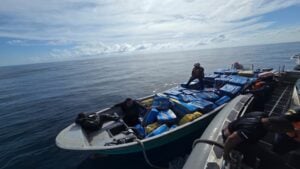
This forward-deployed model proved effective through successive interdictions. In one instance, a Colombian Navy team launched from the SSM intercepted a vessel, seizing 3,259 kilograms of marijuana and apprehending three traffickers. Shortly thereafter, the same team pursued a second vessel, whose crew attempted to discard its cargo during the chase. Colombian forces recovered 900 kg of cocaine and apprehended three additional individuals, including an Ecuadorian national — underscoring the transnational nature of these networks.
According to a Colombian official authorized to speak on behalf of the operation, seamless collaboration with JIATF-S helps remove funding pathways from entities working to destabilize the Western Hemisphere, by placing “maximum pressure on all illicit economies operating in our theater.”
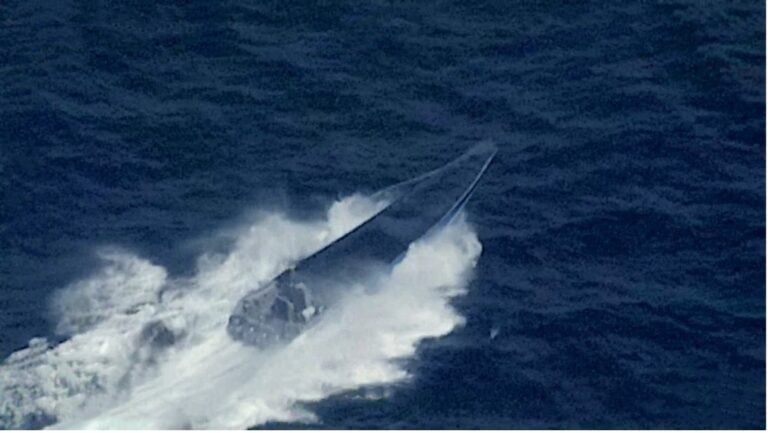
Perhaps the operation’s most illustrative moment came during a coordinated pursuit that spanned three national jurisdictions. The sequence began when U.S. Customs and Border Protection Air and Marine Operations (AMO) detected a go-fast vessel and maintained tracking. The Colombian Navy launched a high-speed interceptor from the SSM and moved to intercept.
As pressure mounted, the smugglers attempted to evade capture by crossing into Panama’s exclusive economic zone, assuming jurisdictional boundaries would disrupt pursuit. They were wrong. Instead, the operation transitioned seamlessly. As Colombian forces handed of pursuit to Panama’s National Air and Naval Service (Servicio Nacional Aeronaval – SENAN) who deployed interceptors augmented by maritime patrol aircraft.
Under continued pressure from SENAN, the crew began jettisoning their illicit cargo. Panamanian forces later recovered 49 bales. The smugglers then entered Costa Rican waters, only to be met by interceptors from the Costa Rican Coast Guard (Servicio Nacional de Guardacostas). After warning shots compelled compliance, the Guardacostas boarded the vessel and took control, concluding the multinational operation.
The coordinated effort resulted in the seizure of 173 packages of cocaine and 1,266 packages of marijuana.
In an unexpected detail, boarding teams also discovered a stowaway cat aboard the go-fast vessel — an unusual passenger amid a complex, multinational operation. While incidental, the discovery underscored the unpredictable nature of maritime interdictions, where alongside dismantling trafficking operations, forces often encounter unforeseen elements.
“The SSM concept fundamentally rewrites the rules of the counternarcotics mission,” said a spokesperson for SOUTHCOM’s JIATF-S. “We are no longer just patrolling the ocean; we are actively hunting these networks. By injecting artificial intelligence and machine learning into our intelligence pipeline, we can rapidly process millions of maritime data points to predict cartel movements and expose hidden routes. The SSM pairs this predictive, technological overmatch with the deep-water endurance of U.S. assets and the specialized tactical expertise of our Colombian partners. Operation Tridente is a testament to this inescapable net as we see the narcoterrorists before they know we are there and intercept them before they can react.”
This success in the Eastern Pacific is not an isolated victory, but part of a broader, relentless campaign led by Colombia to dismantle illicit networks across the hemisphere. The Colombian Aerospace Force’s (Fuerza Aeroespacial Colombiana – FAC) Zeus strategy — a multinational effort involving dozens of countries and agencies from the Americas and the Caribbean — serves as a powerful testament to this commitment.
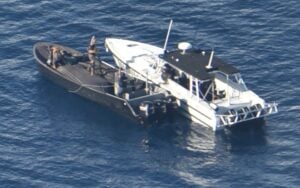
Since 2019, Operation Zeus has yielded significant results across multiple theaters. For example, during Zeus Caribbean, conducted with the Dominican Republic, Colombian forces interdicted go-fast vessels and seized over 1,600 kilograms of cocaine. In Zeus Central America, Colombian air assets deployed to Guatemala and Honduras to strengthen regional interdiction capabilities. Meanwhile Zeus Condor in South America led to the seizure of nearly 700 kilograms of cocaine and the immobilization of a trafficker aircraft in Belize.
But the FAC’s Zeus strategy is only one component of Colombia’s integrated framework. The Colombian Navy has also played a central role through Operation Orion, launched in 2018, which has contributed to sustained maritime interdiction efforts. Together, these initiatives form the backbone of Colombia’s Air and Sea Shield — a multinational framework that now brings together 42 nations across the Americas, Europe, Africa, and Oceania, along with 130 institutions and agencies, including 23 U.S. government entities.
Operation Tridente, and ongoing operations under Colombia’s Air and Sea Shield, send an unmistakable message to narcoterrorist networks: There are no safe routes, there is no sanctuary at sea, and our coalition is relentless. Through the integration of U.S. intelligence, air, and maritime capabilities with the operational expertise of partner nations such as Colombia, JIATF-S and its partners are systematically shutting down key trafficking routes in the Eastern Pacific.