
The expansion of Tren de Aragua (TdA), the Venezuelan criminal organization that consolidated in Tocorón prison during the 2010s, has now reached Brazil. Designated a transnational terrorist organization by several countries in the region, the group is currently present across much of the hemisphere, as well as in Europe.
Initially, the group established itself along the border in the state of Roraima, exploiting the vulnerability of parts of the migrant population through human trafficking, extortion, and sexual exploitation. At the same time, it became involved in the border’s illicit economies, cooperating with criminal networks already engaged in illegal mining, smuggling, and other unlawful activities.
In recent years, however, rather than replicate the Venezuelan model of territorial control, TdA has adapted to Brazil’s criminal ecosystem, favoring cooperation with major local factions over competition and confrontation. Recent investigations indicate that the group now operates a logistical, financial, and operational network across several states and acts as a strategic partner of the Red Command (CV).
“In Brazil, Tren de Aragua is now focused on business. Its alliance with Brazilian factions has opened new opportunities not only for arms sales and drug trafficking, but also for money laundering, including through cryptocurrencies, without having to bear the costs of a war for territorial control,” Carlos Eduardo da Silva, a former senior investigator with the São Paulo Civil Police and an expert in transnational organized crime, told Diálogo.
Rather than exporting its own criminal model, TdA shares a platform of criminal services with Brazilian groups, contributing to the growing integration of transnational criminal networks and local organizations.
From the border to money laundering
According to Brazilian authorities, TdA currently has between 150 and 250 members operating in the Amazonian states of Roraima and Amazonas, as well as in southern states, with support networks in São Paulo and Rio de Janeiro. Antonio José Cabrera Soterano, known as Tío Antonio and convicted of murder in Brazil, is among the leading TdA members identified by Brazilian authorities. Investigations link him to the trafficking of weapons brought through Roraima to supply primarily the CV.
This territorial expansion has been accompanied by an even deeper transformation: a financial one. According to investigators, the criminal structure linked to TdA moved more than $1.1 billion over the past two years. Authorities identified the use of shell companies, cryptocurrencies, and smurfing techniques — which involve breaking large sums into numerous small transactions to evade controls — to conceal and move those funds.
“Brazil has become a money-laundering platform for Tren de Aragua because the organization found financial operators and local criminal networks in the country capable of moving funds through accounts, companies, and crypto assets,” Da Silva said.
One emblematic case involves Brazilian businessman Gustavo Vieira Rufino, who was arrested in June and accused of participating in the laundering of more than $55 million in cryptocurrency for TdA. According to investigators, Rufino also operated on behalf of the CV, confirming the existence of a local network of financial facilitators shared by multiple criminal organizations.
This infrastructure is also poised to expand along one of the region’s main organized crime hubs. “The group has shown particular interest in the tri-border area between Brazil, Paraguay, and Argentina, a region conducive to numerous illicit transactions,” Roraima Civil Police Commissioner Wesley Costa de Oliveira told the Brazilian newspaper O Globo. The group’s interest in the area suggests that TdA is seeking not only to consolidate its presence in Brazil, but also to use the country as a logistical and financial platform for the Southern Cone.
An alliance based on complementary capabilities
Another distinctive feature of TdA’s Brazilian model is the nature of its alliance with the CV. Previous investigations have also identified links and forms of cooperation with members of the First Capital Command (PCC), although the relationship with the CV is more clearly documented. Rather than a simple collaboration, investigators describe a division of criminal labor in which each organization contributes specific capabilities.
“The adaptation was pragmatic,” Da Silva said. “TdA avoided directly challenging Brazilian factions for territorial control, focused on crimes against Venezuelan migrants, and became a bridge for routes, weapons, and contacts on the Venezuelan side.”
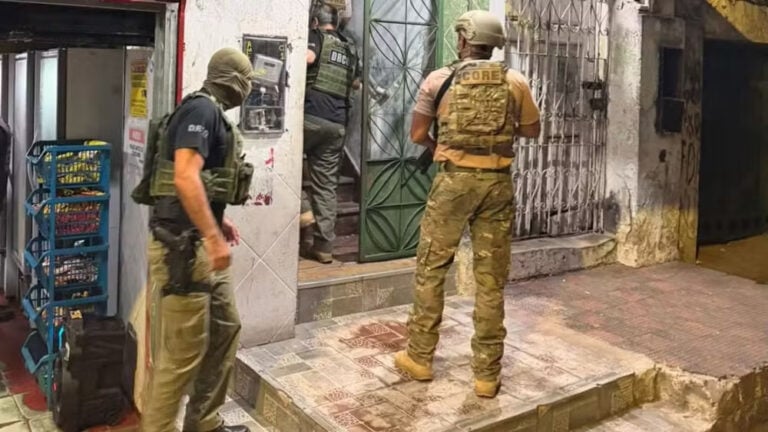
In June, Operation Rota do Norte dismantled a TdA network operating in six Brazilian states and involved in drug and arms trafficking and money laundering. The investigation revealed a model of cooperation with local organizations based on specialization. TdA provides cross-border routes, access to weapons, and criminal connections in Venezuela, while Brazilian factions provide capital, distribution networks, and control over local markets.
Civil Police Commissioner Hugo Cardias, who took part in the operation, summarized the arrangement this way: “The logic is simple: you have the money, I have the product and the distribution channel. We combine our resources to carry out financial transactions, traffic weapons and drugs, and engage in any other activity of mutual interest.”
According to Da Silva, this complementarity reduces the incentives for direct confrontation. “It is not a relationship between equals, but neither is it one of simple subordination. It is a commercial relationship that will last as long as cooperation remains more advantageous than going to war.”
Necessary measures
With extensive borders shared with Colombia, Peru, and Bolivia — the world’s three largest cocaine-producing countries — as well as Paraguay, one of the region’s leading marijuana producers, Brazil already serves as one of Latin America’s main drug-trafficking corridors. The alliance between TdA, the CV, and other local criminal groups threatens to further reinforce that role, transforming the country into a continental platform for organized crime.
The uncertainty following the death of TdA leader Héctor Niño Guerrero adds another layer of concern. Experts warn that the possible fragmentation of the organization could lead to a wider dispersal of its members and greater autonomy for cells already established in countries such as Brazil, increasing pressure on authorities.
Experts say the response should focus primarily on the economic infrastructure sustaining these networks. “The first step is to continue targeting the organization’s finances through more integrated action by state and federal authorities to monitor accounts, companies, and crypto assets linked to TdA. It is also necessary to strengthen control over border routes, clandestine airstrips, and mining areas in Roraima,” Da Silva said.
At the international level, the priority is to strengthen cooperation. “The Tren de Aragua case demonstrates that combating organized crime today requires a permanent regional strategy based on the integration of financial intelligence, international cooperation, and border control,” Da Silva concluded.