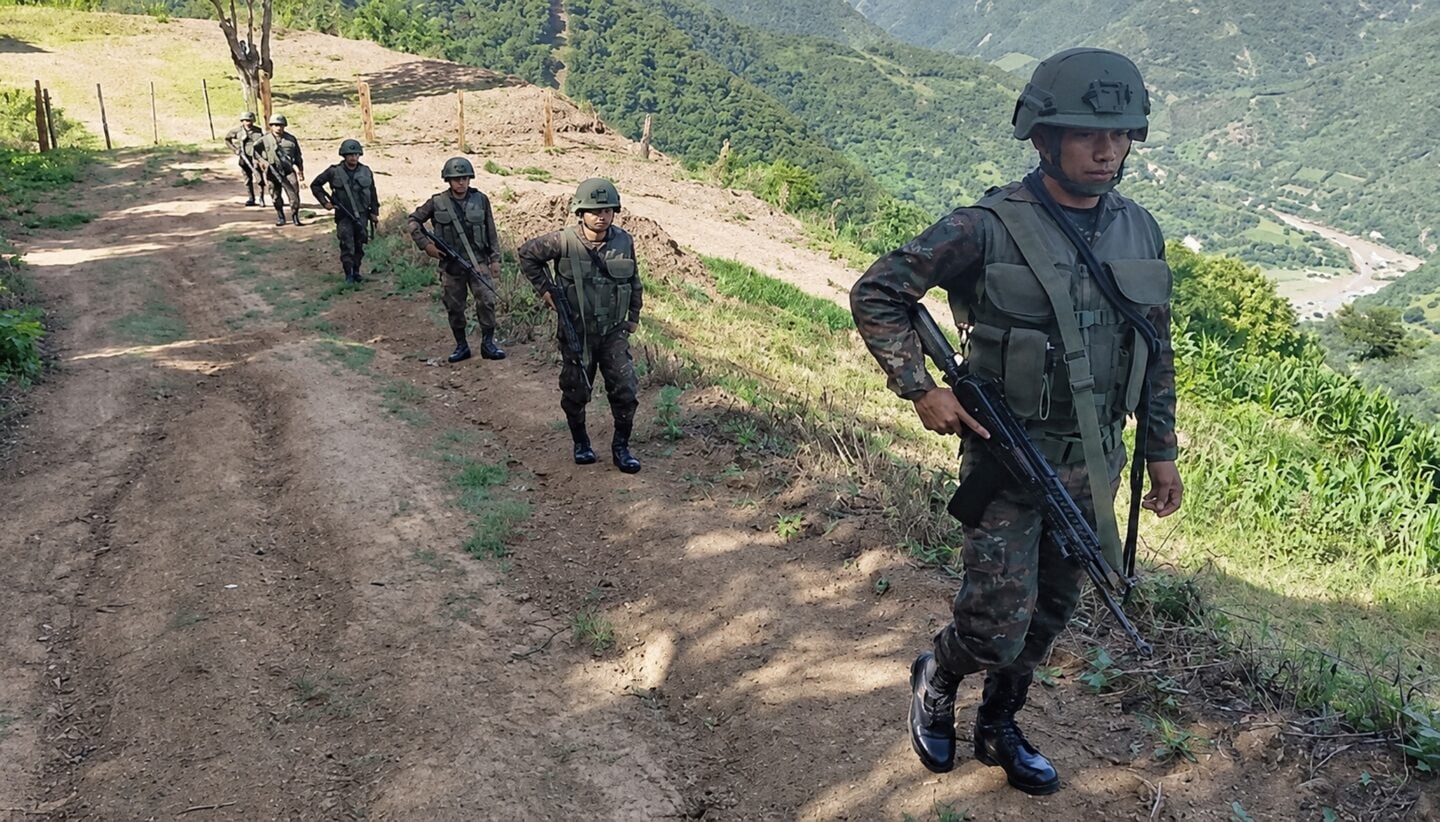

Guatemala is reshaping its border security approach, moving from broad-based controls toward a model driven by intelligence, risk management, and interagency coordination. The goal is to anticipate the operations of transnational criminal networks and stop them before they can establish new corridors in the country.
The strategy seeks to integrate government capabilities to share information, identify risk patterns, and direct resources toward individuals, cargo, and operations that present the greatest warning signs.
“Moving toward an intelligence-based model gives us a broader perspective. It allows us to better understand importers and exporters, understand the phenomena affecting us nationally, and focus our efforts where the greatest risks exist,” Víctor Hugo Cruz, Guatemala’s vice minister for Counternarcotics and Border Security, told Diálogo.
The shift reflects a reality in which threats are no longer confined to one side of a border. Criminal organizations are dynamic and operate through flexible networks, capable of changing routes and methods when authorities disrupt a corridor or tighten security in a particular area.
The challenge, therefore, is to turn information into an operational advantage that enables authorities to detect those shifts and respond before criminal organizations expand their activities. “Intelligence helps us avoid unnecessary inspections and focus our efforts on those seeking to exploit and contaminate supply chains with illicit goods,” Cruz added.
From border presence to intelligence and coordination
The security architecture relies on integrating the capabilities of the National Civil Police (PNC), the Armed Forces, the Superintendency of Tax Administration (SAT), and other institutions involved in border control. The goal is to reduce the gaps between institutions, jurisdictions, and points of entry that criminal organizations can exploit.
Information sharing is a central component. In February 2026, the Ministry of the Interior brought several institutions together to strengthen border coordination and establish more agile mechanisms for information exchange. “Our goal is to coordinate joint responses to transnational criminal organizations involved in drug trafficking, human trafficking, smuggling, and other crimes,” Cruz said.
One such mechanism is the Trade Facilitation Task Force (FTFC), created in 2024 through an interagency agreement among the SAT and the ministries of the Interior, Agriculture, and Defense. According to Cruz, depending on the point of entry, other institutions, such as the Guatemalan Migration Institute, also participate in coordination. The framework enables agencies to share information, issue alerts, profile containers, and coordinate inspections based on risk levels.
Santo Tomás de Castilla, one of the country’s main ports, illustrates this approach. There, institutions coordinate risk analysis and inspections to identify cargo requiring greater scrutiny while reducing duplicate inspections of legitimate trade.
Previously, a container could be inspected two or three times by different institutions. Now, agencies share information and coordinate a single inspection when necessary. “Each institution retains its authority and responsibilities, but at the operational level we work through communication mechanisms that allow us to act jointly,” Cruz explained.
The strategy also extends to land border crossings. In March 2026, the Ministry of the Interior and SAT inaugurated an office of the Counternarcotics and Border Security Directorate (DASF) in Tecún Umán, San Marcos, one of the main commercial gateways between Guatemala and Mexico, to strengthen border controls and combat drug trafficking, smuggling, and other transnational crimes.
The technology factor
Technology expands these capabilities by allowing authorities to inspect cargo, analyze risks, and detect threats with greater precision.
Guatemala has incorporated portable X-ray equipment and nonintrusive inspection systems at maritime and air customs facilities and road checkpoints. These tools allow authorities to examine cargo and containers without opening them and, when combined with risk analysis and intelligence, direct resources toward higher-priority targets.
“Images are analyzed by teams from different institutions, allowing us to determine whether cargo requires a physical inspection and to conduct inspections more efficiently, quickly, and objectively,” Cruz explained.
Artificial intelligence is also beginning to be incorporated into these processes. According to the Ministry of the Interior, some ports already use these tools to optimize logistics processes. These capabilities are complemented by specialized analysis to centralize information and identify illicit substances and precursor chemicals.
From November 2024 to April 2025, Guatemala reported the seizure of more than 1 metric ton of fentanyl precursors, an indication that border controls must detect not only finished drugs but also the materials used to produce them.
Intelligence beyond borders
Guatemala’s model also extends to the regional security environment through intelligence, early warning, and coordination mechanisms with neighboring countries.
“Guatemala cannot view itself as an isolated actor in regional security,” Cruz said, noting that in recent years the country has strengthened bilateral agreements to expedite information sharing among security agencies.
Along the border with Mexico, the Suchiate River is a focus of some of these efforts. Deteriorating security conditions have prompted increased surveillance and information sharing to anticipate criminal movements, with support from the High-Level Security Group, which brings together authorities from both countries.
The same approach applies along the borders with Honduras and El Salvador, where Guatemala operates a task force coordinated by the ministries of Defense and the Interior.
Coordination with Honduras intensified in 2026 following reports of armed clashes in Trujillo, Corinto, and Omoa, prompting greater information sharing and joint operations to anticipate potential movements of criminal groups into Guatemalan territory.
These mechanisms are complemented by Guatemala’s participation in the Central American Integration System (SICA) and other regional forums, where countries exchange information, strategies, and best practices to address transnational threats.
The result points toward a model focused less on borders in isolation and more on a regional perimeter of information, coordination, and response.
Cooperation with the United States
The United States plays an important role in strengthening these capabilities. “The United States has been a very important partner, and its presence in different countries throughout the region also helps facilitate that communication. This allows us to maintain exchanges not only with our neighbors, such as Mexico, Honduras, and El Salvador, but also with important partners such as Colombia and Panama,” Cruz said.
At the operational level, cooperation has resulted in a Joint Security Program to detect and prevent transnational threats, initially at La Aurora International Airport, with plans to expand it to other border points. The program seeks to strengthen identification, control, and response capabilities against transnational threats through information sharing and cooperation between Guatemalan authorities and U.S. Customs and Border Protection (CBP).
Support also extends to ports. In May 2026, Guatemala and the United States inaugurated new facilities for K-9 units at Puerto Quetzal with support from the U.S. Department of State’s Bureau of International Narcotics and Law Enforcement Affairs (INL). According to official figures, the initiative, coordinated with the FTFC, had contributed to the seizure of 5,200 kilograms of cocaine so far in 2026 at Puerto Quetzal.
In June 2026, President Bernardo Arévalo and U.S. Marine Corps General Francis L. Donovan, commander of U.S. Southern Command (SOUTHCOM), discussed strengthening bilateral cooperation against drug trafficking and transnational organized crime, as well as shared commitments under the Americas Counter Cartel Coalition.
“Our country has demonstrated that it is not willing to surrender its borders, its institutions, or its future to organized crime,” Arévalo said, thanking the United States for its support of Guatemala’s security efforts.
Toward a connected regional security system
Guatemala’s transformation reflects a broader trend in border security across the hemisphere, in which intelligence, technology, and operations are integrated to counter criminal organizations that operate transnationally.
The challenge is to turn that integration into an operational advantage. Criminal organizations can rapidly move their operations and illicit resources between countries, while authorities must be able to share information just as quickly.
“In our region, we have flights of 30 minutes, 45 minutes, or just a few hours between countries. If we know there is a person of interest, we need to have the ability to communicate that information in a timely manner,” Cruz explained.
As transnational crime adapts, border security will depend less on the isolated deployment of personnel and more on the ability to connect intelligence, technology, and operations. Guatemala seeks to turn regional cooperation into tools for sharing alerts, anticipating criminal movements, and accelerating response.
Under this approach, borders cease to function as independent checkpoints and instead become part of a connected regional security system, in which information obtained at a port, airport, land crossing, or in a neighboring country can help guide an operation elsewhere.
“Criminal networks are dynamic and agile in the way they communicate; governments must be as well,” Cruz concluded.