
The vast river network linking Brazil, Colombia, and Peru is vital to transportation, trade, and daily life across the Amazon. But its immense scale and the remoteness of much of the region also create major security challenges. The same waterways that connect isolated communities and territories can be exploited by transnational criminal organizations to move cocaine, illegally mined gold, timber, and other illicit goods, as well as people and resources across borders.
According to the United Nations Office on Drugs and Crime (UNODC), border areas across the Amazon Basin have become convergence points for drug trafficking, environmental crimes, and other illicit activities. The tri-border area shared by Brazil, Colombia, and Peru is crossed by major waterways exploited for trafficking drugs, gold, and timber, including the Caquetá, Putumayo, and Amazon rivers. This makes riverine surveillance and the ability of armed forces to coordinate operations across borders increasingly important to regional security.
Riverine cooperation among the three countries’ armed forces responds to this reality. For more than five decades, Brazil, Colombia, and Peru have used BRACOLPER to develop common procedures, improve interoperability, and share information and intelligence. Launched in 1974, BRACOLPER has become one of the longest-running forms of military cooperation in the Amazon region.
“BRACOLPER is a necessity, more than an option,” Juan Belikow, a professor of International Relations at the University of Buenos Aires and a security and defense specialist, told Diálogo.
For Belikow, “military cooperation and joint and combined operations are the most effective tools available and, for now, the only viable means of countering transnational organized crime.” Cooperation enables the three navies to coordinate their capabilities in an operational environment where criminal networks exploit the geographic continuity of the rivers and the fragmentation of national jurisdictions.
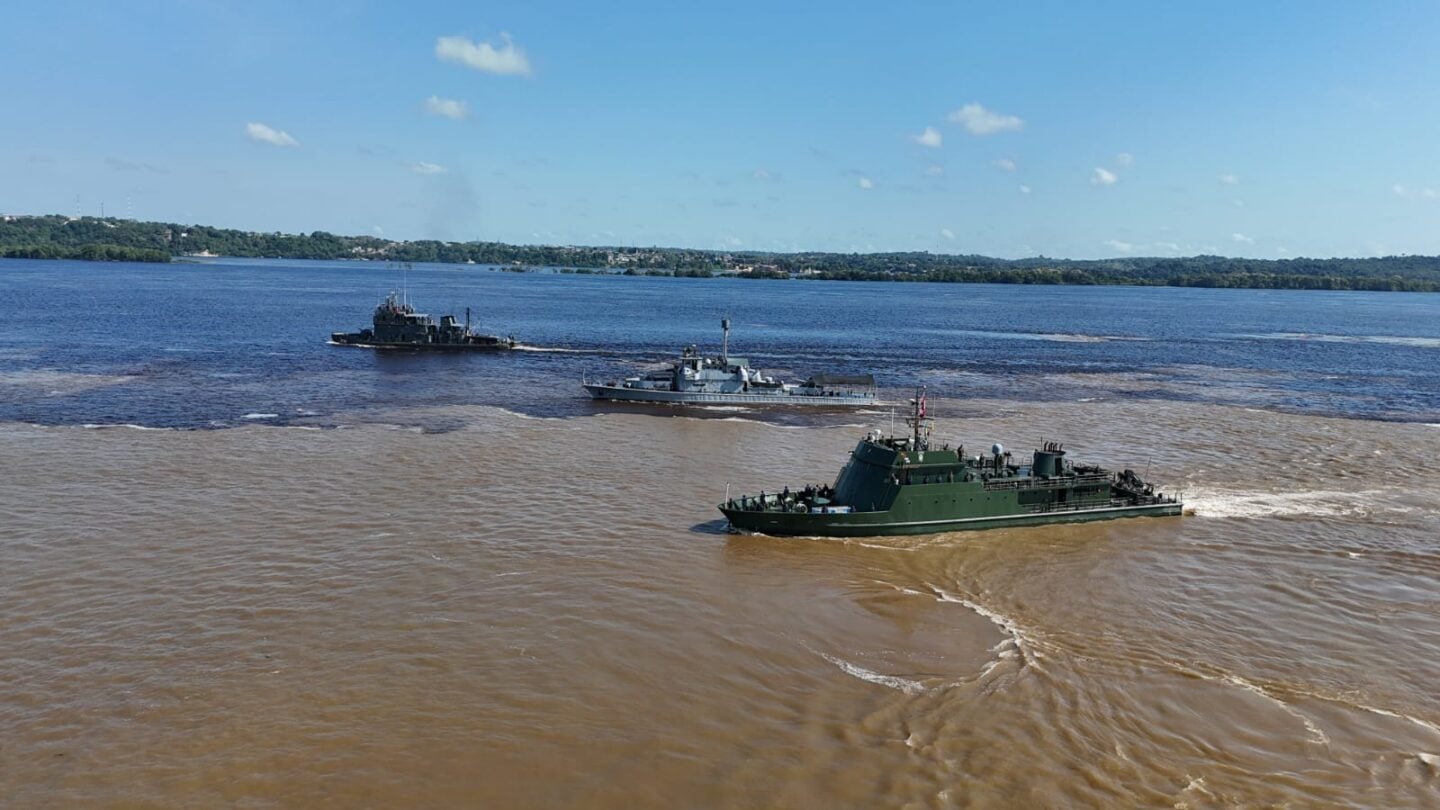
The 52nd edition of BRACOLPER, held from July to September, brought forces for the three countries together for a 5,563-kilometer deployment along the Amazon, Putumayo, Solimões, Negro, and Nanay rivers. Their navies deployed riverine units and Marine Corps elements to strengthen capabilities in interoperability, command and control, tactical communications, and their ability to respond to transnational threats. The exercise enhanced their ability to operate together across the vast and challenging riverine environment of the Amazon.
The river as a criminal corridor
The tri-border area around Leticia, Colombia; Tabatinga, Brazil; and Peru’s Santa Rosa Island is a strategic junction in the Amazon’s river network and a key corridor for cross-border criminal activity. Belikow described it as the “backbone of the drug trafficking world in South America.”
“[The region] is organized crime’s bi-oceanic corridor: drug trafficking, every environmental crime imaginable, illegal fishing, poaching, criminal deforestation, unrestricted exploitation of natural resources, smuggling of all kinds, migrant smuggling and human trafficking, extortion, child exploitation, and illegal mining,” he said.
The region’s geography allows criminal organizations to exploit the river network as a flexible cross-border transportation system. Cocaine can be produced in one country, moved through another, and shipped to international markets from a third. The same routes and logistical networks can support a range of illicit activities, from smuggling and illegal mining to environmental crimes.
An InSight Crime investigation into the border region shared by Peru, Colombia, and Brazil describes a drug trafficking chain that begins in Peru’s coca-growing areas and exploits the dense jungle and extensive Amazon river system to move illicit shipments. The sheer number of rivers and waterways makes trafficking routes particularly difficult to monitor.
“It is an endless river, with countless tributaries surrounded by forests that make it possible to evade any checkpoint established by security forces,” Belikow said.
The same vulnerability affects illegal mining, an activity that crosses borders and depends on a complex logistics chain. Dredges, fuel, transportation, labor, and protection systems sustain networks that can overlap with those used for drug trafficking and smuggling.
According to an analysis by the Monitoring of the Andean Amazon Project (MAAP), based on satellite imagery, illegal gold mining caused the deforestation of 506 hectares in Río Puré National Natural Park, along Colombia’s border with Brazil, between June 2024 and May 2026.
In this environment, military cooperation plays a role that extends beyond direct interdiction. Armed forces contribute surveillance, mobility, logistical support, and the ability to operate in remote areas where a sustained state presence can be difficult to maintain.
“Military capabilities make it possible to confront increasingly sophisticated firepower and provide a second line of logistical and operational support,” Belikow said.
A network of riverine cooperation
Cooperation among Brazil, Colombia, and Peru includes trilateral exercises, bilateral operations, and joint campaigns. Together, these efforts strengthen interoperability and develop common procedures for detecting, tracking, and intercepting threats that move between jurisdictions. A suspicious vessel detected along one stretch of river can quickly change course or cross a border, placing under another country’s jurisdiction.
In September, for example, intelligence capabilities from the Colombian Navy and Colombian Air Force, in coordination with Brazil’s Federal Police, helped locate a vessel that Brazilian authorities intercepted near Codajás, within Brazilian jurisdiction. The operation resulted in the seizure of some 4.5 metric tons of marijuana, as well as heavy-caliber weapons and ammunition.
Bilateral exercises, such as COLPER between Colombia and Peru, allow units operating along a shared border to practice common procedures for navigation, communications, patrols, vessel boarding and inspection, traffic control, and interdiction. If a patrol detects a suspicious vessel near the border, the rapid transmission of information allows authorities in the neighboring country to maintain surveillance or intervene once the vessel enters their jurisdiction.
Binational campaigns also incorporate a dimension of state presence and assistance to isolated communities. In 2026, for example, Colombia and Peru traveled some 2,400 kilometers along the Putumayo and Amazon rivers to deliver services and assistance to riverine communities. These operations help maintain institutional ties with communities far from major urban centers and expand state presence in territories where criminal organizations can exploit its absence or limited response capacity.
The trilateral component is represented by BRACOLPER. “In this edition, we focused on interoperability, with the goal of improving our ability to act as a unified force against cross-border threats,” Brazilian Navy Vice Admiral André Luiz de Andrade Felix, commander of the 9th Naval District, said in a statement.
The exercise’s continuity since 1974 provides operational advantages, particularly in response times. Crews and commanders who have worked together before are familiar with their partners’ procedures, communications systems, and coordination mechanisms. In a real-world operation, this familiarity reduces the need to establish from scratch how tasks will be divided and facilitates coordination among units. One unit can focus on interdiction and another on protection, while other elements provide communications, transportation, or air support. Interoperability, therefore, is not simply about forces being able to operate together; it allows capabilities to be deployed more rapidly when a threat crosses a border.
A second component is intelligence. In a territory crisscrossed by thousands of kilometers of rivers and tributaries, physically monitoring every vessel or route is not feasible. Effective patrolling therefore depends on the ability developed over the years to concentrate resources at the places and times where illegal activity is most likely to be intercepted. Information sharing can turn intelligence obtained in one country into an operationally useful alert for forces on the other side of the border. This is particularly important when a vessel crosses into another jurisdiction during an operation: The information can follow the threat rather than remain confined to the territory where it was obtained.
Cooperation also integrates riverine capabilities with air and ground components. The river is only one segment of the criminal logistics chain: Drugs, gold, fuel, or weapons can move from a vessel onto land and return to the water at another point. The coordinated use of patrol vessels, fast boats, helicopters, Marine Corps units, and other security forces helps maintain surveillance of a threat after it leaves the waterway.
The experience Brazil, Colombia, and Peru have accumulated through more than five decades of riverine cooperation takes on particular relevance as the region strengthens coordination against transnational criminal organizations, including through initiatives such as the Americas Counter-Cartel Coalition, in which Colombia and Peru participate.
In the Amazon, where criminal networks exploit the geographic continuity of rivers to move across countries and illicit activities, BRACOLPER connects intelligence, communications, and operational capabilities across borders. This coordination helps forces maintain pressure on threats even as they change routes, territory, or jurisdiction.