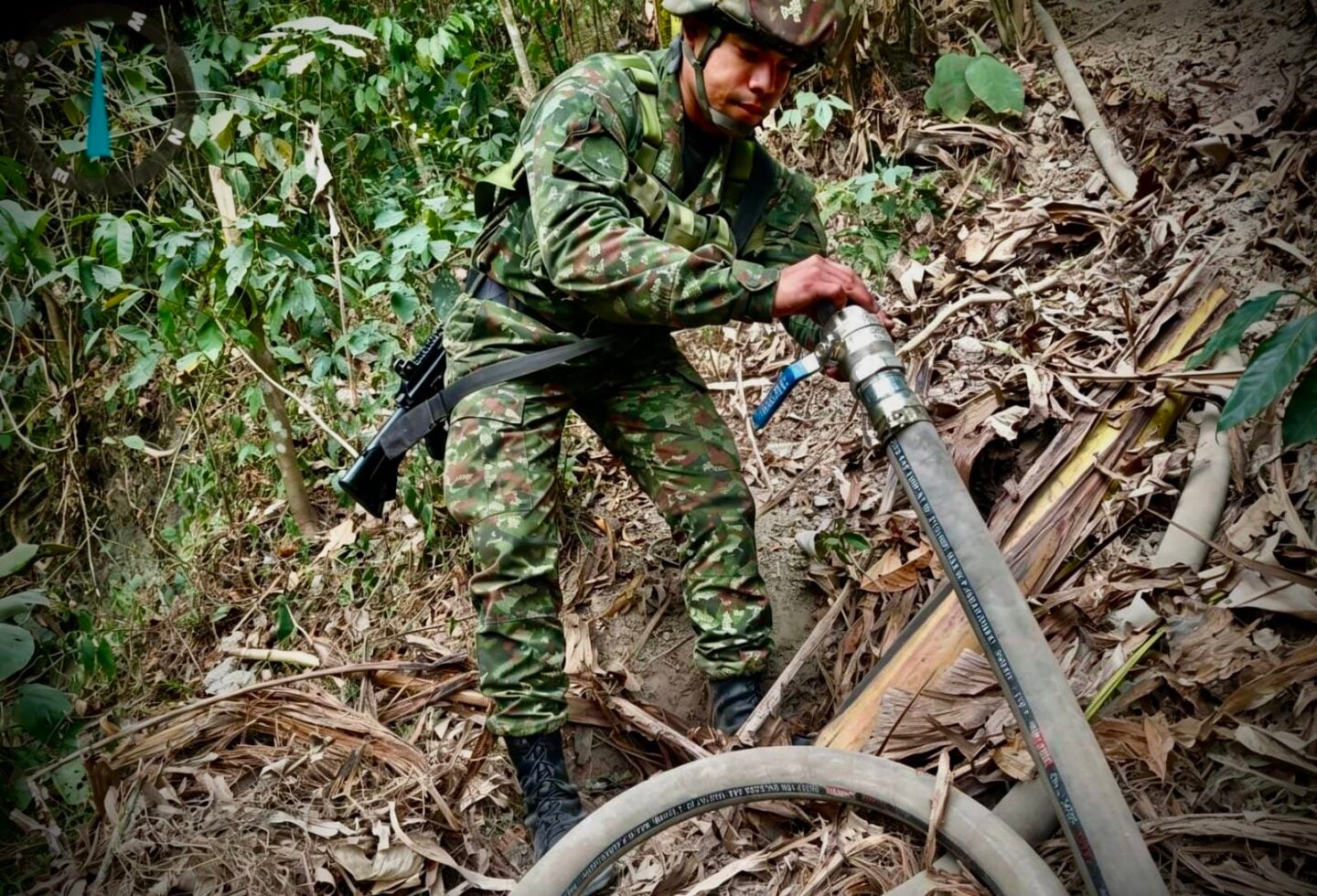

Criminal organizations in Colombia are exploiting the country’s hydrocarbon infrastructure to generate illicit revenue and sustain activities ranging from cocaine production to illegal mining. With crude oil and fuel theft causing substantial losses for the energy industry, the Colombian government has launched a renewed offensive targeting the networks responsible for stealing, transporting, and commercializing hydrocarbons.
Colombia’s national oil company Ecopetrol and its hydrocarbon transportation subsidiary CENIT have been particularly affected. CENIT told Diálogo that by the end of September 2026, the volume of hydrocarbons stolen from the company’s systems had exceeded 1.2 million barrels.
CENIT added that stolen crude rose by 75 percent and stolen fuel by 163 percent in the first half of 2026 compared to the same period in 2025.
Geography of fuel theft
Armed groups steal hydrocarbons by installing illegal valves along pipelines to siphon off crude oil and refined products. “These are devices installed illegally on the infrastructure to extract the hydrocarbons, their derivatives, biofuels, or blends transported through pipelines,” CENIT says.
One of the areas most affected has been southwestern Colombia, near the border with Ecuador. The Oleoducto Trasandino pipeline was tapped nearly 1,600 times between 2022 and 2024, with losses equivalent to an average of 15 percent of the crude transported in 2023.
Ecopetrol suspended the pipeline in late 2023, citing security conditions. Across the border, Ecuador faces similar challenges protecting its hydrocarbon infrastructure, with reported annual losses exceeding $110 million.
In April 2026, Ecuadorian authorities arrested police officers, military personnel, and civilians suspected of participating in a fuel-trafficking network. According to investigators cited by Ecuadorian media, some of the stolen fuel, including a petroleum-based solvent locally known as gasolina blanca, was trafficked into Colombia for use in cocaine processing. The case illustrated how illicit fuel networks can connect corruption, cross-border smuggling, and drug production.
Farther northeast, along Colombia’s border with Venezuela, Ecopetrol has also been forced to suspend operations at facilities in Norte de Santander, where the Caño Limón-Coveñas pipeline passes through territory contested by the National Liberation Army (ELN) and the 33rd Front of Revolutionary Armed Forces of Colombia (FARC) dissidents.
In 2024, attacks on the Caño Limón-Coveñas and Bicentenario pipelines disrupted operations, prompting authorities to implement contingency measures, including preparations to reroute crude through the Bicentenario pipeline. Crude theft continued in the Tibú oil fields, with Ecopetrol recording losses of more than 39,000 barrels and the discovery or removal of more than 150 illegal valves across Catatumbo in 2025. Security conditions also led Ecopetrol to suspend operations at the Tibú field’s Estación Norte, although the suspension did not affect the entire field.
Illegal pipeline connections also carry environmental consequences. In Catatumbo, fuel theft has contributed to hydrocarbon contamination in waterways, including the Catatumbo River, creating additional risks for communities already affected by insecurity.
In September 2026, a joint operation involving the Colombian Army and the Attorney General’s Technical Investigation Corps (CTI) led to the arrest of four alleged members of the ELN’s Juan Fernando Porras Martínez Front. They were accused of stealing hydrocarbons from the Pozos Colorados–Galán pipeline and transporting them to Norte de Santander. According to the Army, the suspects were associated with the group’s financial network, and the stolen hydrocarbons were destined for illegal commercialization and cocaine processing.
The resale market
Illegal fuel is sold at discounted prices by so-called pimpineros, named after the pimpinas, plastic containers used to sell fuel stolen from pipelines or smuggled from Venezuela. These individual operators can be found on street corners in Cúcuta and other cities selling at much lower prices than local stations. CENIT told Diálogo that stolen fuel was “used for illicit sale at service stations.”
In February 2026, Cúcuta’s government issued Decree 0049 to crack down on illegal fuel sales, authorizing action against those who facilitate the black market and the impounding of related vehicles. Unauthorized fuel sellers compete with legitimate businesses and undermine fuel-tax revenues, a major revenue source for local governments in Norte de Santander.
Speaking to La Opinión, the executive director of the Association of Service Stations of Norte de Santander (Asesnort), María Eugenia Martínez, said that “the collection of the gasoline surcharge has dropped to less than half of what they were collecting.”
Some stolen crude is even sold internationally. A 2023 National Police investigation uncovered a suspected international network in which crude oil allegedly stolen by the ELN was sold alongside smuggled Venezuelan crude to buyers in Singapore and Amsterdam. The investigation, dubbed Bunkering Imperio, involved 17 people and approximately 40 companies. Ecopetrol, CENIT, and Oleoducto de Colombia cooperated with investigators and were recognized as victims in the criminal proceedings.
The case illustrated the international reach of hydrocarbon trafficking, which can involve commercial intermediaries and overseas markets far beyond the areas where the crude is stolen.
Fuel for criminal industry
Criminal organizations in Colombia also use stolen fuel for cocaine production and illegal mining. Gasoline is an important chemical input in the initial stages of cocaine production, and the substantial quantities required create demand for illicit fuel supplies.
Regulations make purchasing large quantities of gasoline difficult. Criminal groups unable to steal refined fuel sometimes process crude oil into a low-grade fuel called pategrillo, “which replaces gasoline as an essential chemical precursor in drug processing. In addition, it is sold as fuel for running boilers and engines,” according to CENIT.
In June 2026, Colombian Army personnel discovered an illegal valve connected to the Caño Limón-Coveñas pipeline in Agua Clara, a rural area of Cúcuta. According to the Army, the connection was attributed to the ELN, and the extracted hydrocarbons were allegedly intended for cocaine production.
Stolen fuel also powers the extractors, dredges, motor pumps, and generators used in illegal mining. In July 2026, the Colombian Army intercepted two tanker trucks carrying nearly 7,500 gallons of undocumented diesel reportedly intended to supply heavy machinery used for gold mining in Ataco, southern Tolima department.
These cases illustrate how hydrocarbon theft can generate revenue through resale while supplying essential resources for other illicit economies.
A renewed push against fuel and crude theft
CENIT stresses that fuel theft is being tackled as a priority by the national government and that progress is being made. The company reported a 48 percent decrease in the volume of refined products stolen in September 2026 compared to August, attributing the reduction to countermeasures.
President Abelardo de la Espriella has said publicly that “anyone who steals hydrocarbons is part of the terrorist chain,” because the fuel is used to make cocaine, and that those involved “will be treated as what they are: terrorists.”
On October 5, 2026, the government formally reactivated Joint Task Force Urano, building on an offensive against hydrocarbon theft underway since September 1. The Army, Navy, Air Force, and Police deployed approximately 1,200 personnel, working with intelligence, criminal investigations, and judicial authorities. Headquartered in Aguachica, Cesar, the task force initially focused on southern Cesar and the Magdalena Medio region, including critical routes used to transport stolen crude and fuel.
The operation targets routes used by the ELN and Clan del Golfo. According to government figures released during the task force’s activation, operations conducted since September 1 had resulted in the recovery of more than 100,000 gallons of hydrocarbons, the seizure of 22 vehicles, the removal of 46 illegal valves, and 21 arrests.
In an October 27 interview with Diálogo during the third Americas Counter-Cartel Coalition (ACCC) conference in the Dominican Republic, Colombian Defense Minister retired Major General Jorge Eduardo Mora López reported further progress under the Urano Campaign. “The Urano Campaign against hydrocarbon theft, which brings together security forces and judicial authorities, reduced that crime by 44 percent in September and October,” he said. The minister also emphasized that the government’s approach measures success through judicial outcomes and the disruption of criminal assets, rather than seizures alone.
Rather than concentrating exclusively on protecting pipelines, Urano seeks to disrupt the entire criminal supply chain, from illegal extraction and storage to transportation, commercialization, and the financial networks behind these activities.
The cross-border dimensions of hydrocarbon trafficking also underscore the importance of regional cooperation. Colombia and Ecuador participate in the ACCC, which seeks to strengthen coordination against transnational criminal organizations. The links between illicit fuel networks, cocaine production, and organized crime illustrate the interconnected threats that coalition members are working to address.
By combining operations against illegal pipeline connections with investigations into transportation corridors, distribution networks, and criminal finances, Colombia’s security forces are seeking to move beyond individual seizures and disrupt the systems that allow stolen hydrocarbons to sustain organized crime.