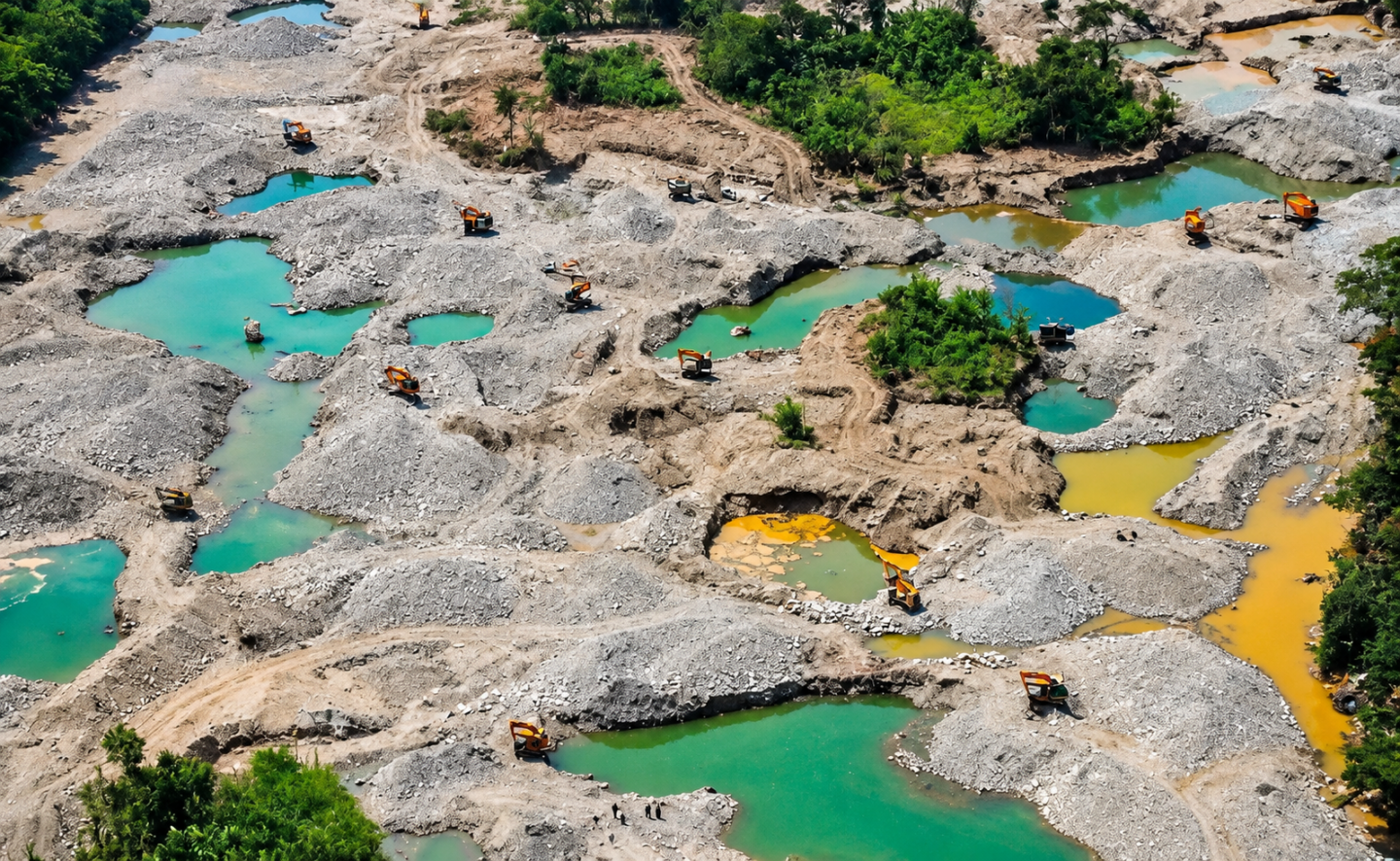

Illegal gold mining has become part of broader extraction, logistics, commercialization, and financing networks linked to organized crime in Ecuador. Authorities are responding with operations against infrastructure, criminal investigations, financial tracking, and regional cooperation aimed at targeting not only extraction sites but also the networks that supply, transport, and commercialize the mineral.
A report by the Pan American Development Foundation (PADF) ranks illegal mining as the country’s second-most lucrative illicit market after narcotrafficking, with estimated annual profits of nearly $1.3 billion. The report identifies the presence of criminal organizations in extraction areas and other links in the gold supply chain.
Daniel Pontón, dean of the School of Security and Defense at Ecuador’s Institute of Advanced National Studies (IAEN), told Diálogo that “illegal mining is an extremely strategic activity for the proliferation, growth, and reproduction of criminal structures.” He describes it as a “criminal system” in which criminal organizations can exploit informality to establish mechanisms of control.
This illicit economy has grown primarily since 2020. PADF identifies extraction, refining, logistics, and distribution hubs in Orellana, Napo, Zamora Chinchipe, Azuay, and El Oro, demonstrating the reach of these networks from the Amazon to southern Ecuador.
“It is increasingly becoming a more autonomous activity,” Pontón said. Its profitability, he said, allows it to develop its own dynamics and connect with money laundering, weapons purchases, and other criminal activities.
PADF warns that disputes over mining territory resemble those associated with narcotrafficking and links this expansion to rising crime in parts of the Amazon, where some provinces have recorded increases in homicides and extortion complaints.
The criminal chain
The expansion of illegal mining has generated its own supply networks. In April, Ecuador’s National Police dismantled a network dedicated to the illicit trafficking of explosives during a simultaneous operation in Imbabura, Carchi, Loja, and El Oro. According to police, the material was smuggled into Ecuador from Peru, stored in El Oro, and subsequently distributed to other provinces to supply illegal mining activities.
A month later, Ecuador’s National Police and Attorney General’s Office, together with the Peruvian National Police, targeted another alleged transnational network dedicated to trafficking weapons, ammunition, and explosives. The operation was carried out in seven Ecuadorian provinces and resulted in 23 arrests. Investigators identified a route crossing Ecuador from the Peruvian border toward the Colombian border, illustrating how supplies used by illicit economies move through networks that extend well beyond mining areas.
Weapons are another part of the criminal machinery. In July, authorities arrested alias Gordo in Santa Rosa, El Oro, an alleged member of Los Lobos and weapons supplier for the organization. Police linked him to the storage and movement of weapons from Piñas, Portovelo, and Zaruma toward El Guayabo, as well as to activities associated with illegal mining, extortion, robbery, and violent deaths.
The Global Initiative Against Transnational Organized Crime (GI-TOC) reports that Los Lobos, in addition to narcotrafficking, participates in various stages of the gold supply chain, including moving the mineral to processing plants in Portovelo and Zaruma and subsequently transporting it to Guayaquil for export.
Processing and commercialization are critical points in that chain. Processing plants in southern Ecuador receive material from different parts of the country and, according to GI-TOC investigations, from Peru as well. Informality and traceability gaps can allow illegally sourced gold to enter formal commercial channels, making its origin difficult to determine once it has been processed and sold.
For Pontón, extraction is only one part of the business. “Commercialization is the most profitable part now,” he said. “Illegal mining is an excellent mechanism for laundering assets. It allows resources of illegal origin to be transformed and reproduced through illicit proceeds. That commercialization scheme does not involve only illicit actors.”
Operational pressure
Between January and August 2026, the Ecuadorian Armed Forces destroyed 1,101 camps and 1,680 mine entrances and put 520 classifiers, 568 excavators, and 297 dredges out of operation, according to Ministry of National Defense data. The operations also recovered more than 53,000 sacks of gold-bearing material.
The figures reflect the scale of military pressure on infrastructure used for illegal mining, but also the challenge of preventing criminal organizations from replacing machinery and relocating their operations.
Pontón warns that the impact depends on criminal organizations’ ability to rebuild. “You destroy a piece of machinery, you confiscate it; but tomorrow five more will appear somewhere else,” he said. “If that commercialization scheme is not targeted, the effect will be limited. If this activity is not viewed more systemically, there will be little that can be done.”
That broader response also incorporates judicial and financial tools. In March, the Attorney General’s Office charged 60 people with alleged illicit mining activity in a case involving operations detected in 2022 in Yutzupino, Napo. The investigation included drone overflights and 72 other pieces of evidence, while prosecutors requested measures involving machinery linked to the case.
In July, Ecuador’s Financial and Economic Analysis Unit (UAFE) reported that a Suspicious and Unjustified Transactions Report provided specialized information for an investigation into an alleged money laundering network linked to illegal mining and Los Lobos. The analysis identified financial movements and suspicious transactions involving individuals under investigation, including an alleged financier of activities associated with the criminal organization.
Financial tracking thus expands the authorities’ reach beyond extraction sites. Identifying financiers, buyers, processors, transporters, and other actors in the supply chain can help authorities locate resources, connections, and movements that remain active even after an illegal mining camp is destroyed.
Regional cooperation
The transnational nature of these networks is also driving greater regional coordination. Ecuador and Peru have strengthened their bilateral security and defense agenda throughout 2026, including efforts against illegal mining and other forms of transnational organized crime. In July, Ecuador also led an Andean Community meeting in Quito, where it proposed prioritizing illegal mining and illicit arms trafficking as part of the regional response to organized crime.
In September, U.S. Homeland Security Investigations (HSI) brought together specialized units from Peru, Ecuador, Colombia, Bolivia, and Brazil in Cusco to strengthen investigations into transnational organized crime. The meeting included information sharing and training in tools for investigating money laundering, cryptocurrency, digital evidence, and cross-border movements — capabilities applicable to criminal networks operating around illicit economies such as illegal mining.
A 2023 agreement between HSI and the Peruvian National Police established the Transnational Criminal Investigations Division, strengthening capabilities to conduct joint investigations and share intelligence on organizations operating across borders.
For Pontón, deepening that intelligence is essential to understanding the full structure of the problem. Some of the available information, he said, may still be based on assumptions. “More in-depth information is needed about what to do and how to do it,” he said, requiring an intelligence model capable of understanding how the problem is organized.
Along the border with Colombia, cooperation also involves the military. Ecuadorian and Colombian defense authorities moved forward in August with coordination on a possible binational base to strengthen the response to narcotrafficking, illegal mining, and other transnational crimes. The discussions coincided with meetings between senior military leaders from both countries and U.S. Marine Corps General Francis L. Donovan, commander of U.S. Southern Command (SOUTHCOM), aimed at strengthening cooperation against cross-border threats.
The combination of military operations, police and prosecutorial investigations, financial intelligence, and international cooperation expands the tools available to confront a criminal economy that connects extraction areas with supply routes, processing plants, financial networks, and export markets.
For security forces, following those connections makes it possible to identify not only where gold is illegally extracted, but also who supplies the explosives and weapons, who finances the operations, who transports and processes the mineral, and how the proceeds flow back to criminal organizations. This whole-of-network approach creates more points where authorities can intervene and strengthens the ability of Ecuador and its regional partners to dismantle the networks sustaining illegal mining and reduce the resources fueling transnational organized crime.