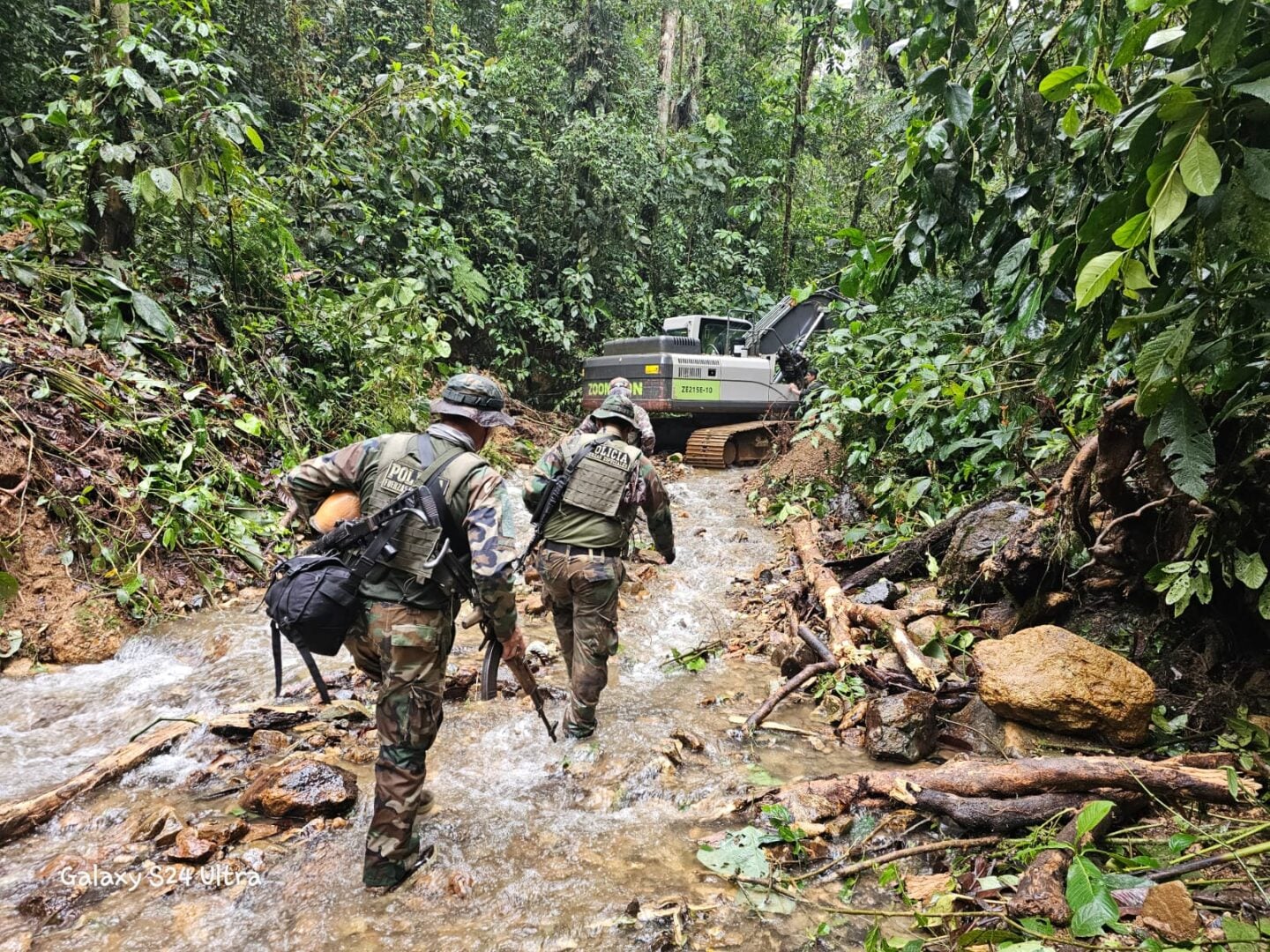

Peru and Ecuador are coordinating their security forces against illegal mining and logging along their shared border with a clear objective: preventing criminal networks from shifting their operations across the border when pressure increases in either country.
In May 2026, the countries’ defense ministers met in Arenillas, Ecuador, and agreed to strengthen cooperation against transnational organized crime, illegal mining, and illegal logging. According to Peru’s Ministry of Defense, the agreement provides for information and intelligence sharing, coordinated operations, and follow-up on commitments. In 2025, the two countries had already signed the 2025-2026 Work Plan, which calls for joint operations, investigations, and international cooperation from northern Cajamarca to Condorcanqui, in Amazonas, Peru’s Public Prosecutor’s Office indicated.
Pedro Yaranga, a comprehensive security and risk management expert and a professor at Ricardo Palma University in Peru, told Diálogo that gaps in border surveillance remain the central challenge. In August 2026, Ecuadorian authorities intercepted a shipment containing more than 18,600 units of explosive material in Zamora Chinchipe and arrested two people, Infobae reported. One line of investigation is whether the material was intended for use in illegal mining.
Relocation as a survival strategy for criminal networks
Organizations exploiting Amazonian gold respond to enforcement operations by relocating rather than disbanding. An investigation by Código Vidrio and Ojo Público, published in March 2026, documented their movement into the Ecuadorian provinces of Zamora Chinchipe and Morona Santiago following an increase in military and police operations elsewhere in the country. Groups from Ecuador, Peru, and Colombia are competing for control of illegal mining areas in the Cordillera del Cóndor.
Authorities continued applying pressure in August, when Ecuadorian forces intervened at new illegal extraction sites in Zamora Chinchipe and Morona Santiago, disabling machinery, camps, and equipment used to process gold-bearing material. On the Peruvian side, environmental prosecutors reported in April that heavy machinery used for illegal mineral extraction in San Ignacio, near the border, had been destroyed and eight people — Peruvians, Ecuadorians, and Colombians — allegedly linked to the activity had been detained.
Infrastructure sustains the network
The ability of these criminal networks to shift operations across the border depends in part on the infrastructure that connects extraction sites, processing areas, and supply routes in both countries. Clandestine roads allow miners and criminal groups to move ore, equipment, chemicals, explosives, and other supplies outside official border crossings.
“It is the only road that exists in this part of the Ecuadorian side, but it was built by the criminals themselves. All the mining material extracted in Peru is transported in hundreds of trucks to the Ecuadorian side to process the gold, which then comes out as Ecuadorian gold,” Yaranga said. Código Vidrio also documented “Paso Tres,” a clandestine road about 3 kilometers long that illegal miners and criminal organizations use to transport gold-bearing ore, weapons, chemicals, and explosives, according to military reports cited by the outlet. Construction of the road began in December 2024, outside authorized border crossings.
Yaranga warned about the effects of uneven pressure. “When there is pressure in one country, they immediately move to the neighboring country. The best outcome would be to consolidate that alliance at the regional level: sustained pressure and simultaneous cooperation among international agents and allied forces,” he said.
Mirror operations, real-time intelligence, and targeting financial flows
Coordination has also moved toward operational planning. Following the May meeting, the two countries agreed to prepare and implement plans for mirror military operations in five areas of binational interest, while strengthening military intelligence sharing. “Operations have already been carried out with Peruvian and Ecuadorian participation, primarily involving the Armed Forces, with excellent results. Those types of operations should continue,” Yaranga said. He also stressed the need for real-time intelligence: “Above all, to track the movements of these criminals; otherwise, it’s impossible. Human intelligence must be complemented by state-of-the-art equipment.”
Pressure on logistical networks is also producing results. In April 2026, Ecuadorian forces dismantled a network that, according to daily La Hora, smuggled explosives from Peru, stored them in El Oro, and distributed them to illegal mining areas in Imbabura, Carchi, and El Oro. Six simultaneous raids in Imbabura, Carchi, Loja, and El Oro resulted in the seizure of emulsion explosives, detonators, ammonium nitrate, cash, and mobile devices.
For Yaranga, efforts must also target the money. “Targeting only the leaders sometimes does not produce the expected results. We have to attack the financial support network of these organizations: through the same alliance and in real time, blocking accounts and identifying who receives those transfers,” he said. He estimated that each organization handles “at least about $2 million” annually and called for tracking transfers abroad. “Those types of actions are much more effective than simply making arrests.”
Cooperation strengthens institutional capabilities
U.S. cooperation is also helping Ecuador and Peru strengthen the investigative and technical capabilities needed to disrupt illegal mining and the illicit financial networks that support it. Examples of this support can be seen in both countries. In Ecuador, U.S. cooperation has included technical assistance, equipment, and training for personnel involved in investigations and operations, as well as support for financial information sharing. In Peru, one recent example came in May, when the Public Prosecutor’s Office received a portable X-ray spectrometer and accompanying training to strengthen investigations into illegal mining and money laundering.
Support also extends to intelligence and criminal investigations. In March 2026, Ecuador and the United States formalized the establishment of an FBI office in Quito, with a permanently assigned agent working alongside a specialized National Police team. In Peru, the FBI and the National Police signed an agreement in June to create a special investigative team to combat transnational organized crime, with U.S. support in technology, logistics, specialized training, and professional assistance. In August, the addition of new members strengthened the joint team and its intelligence and investigative capabilities.
For Yaranga, sustained professional development for the Police and Armed Forces would further strengthen these capabilities, pointing to the value of longer-term training programs that could extend over several years. “A trained police force, a professional police force, becomes incorruptible, knows how to manage all its sources, and is reliable,” he said.
The value of this convergence lies in Peru and Ecuador’s ability to reduce the room for maneuver that criminal networks find between neighboring jurisdictions. Coordinated operations, intelligence sharing, and the tracking of routes, explosives, and financial flows allow authorities to apply simultaneous pressure to different components of these organizations and make it more difficult for them to shift their activities from one side of the border to the other.
This bilateral approach is also part of a broader regional effort: the Americas Counter-Cartel Coalition seeks to strengthen cooperation among countries across the hemisphere against transnational criminal networks and the illicit economies that sustain them.
The mirror operations agreed upon by both countries reinforce that approach by combining each country’s capabilities against a shared threat. Together with criminal investigations, financial tracking, and specialized training, this coordination strengthens Peru and Ecuador’s ability to protect their territories, dismantle the networks that sustain illegal mining, and consolidate a more integrated binational response to transnational organized crime.