

Illegal mining has consolidated into a critical challenge for Peru’s national security and territorial sovereignty. Beyond its devastating environmental impact, this phenomenon also fuels criminal economies, incites violence, and erodes the country’s institutional foundations.
In response to this growing complexity, the Peruvian government has intensified its crackdown, intervening across the entire illicit supply chain while strengthening ties with international allies such as the United States. This cooperation aims to bolster the state’s ability to detect, investigate, and dismantle these networks.
Impact of illegal mining in Peru: Violence, economy, and territorial control
Illegal mining has evolved into the primary financial engine for organized crime in Peru. Various news reports indicate that criminal syndicates have exploited the sector to establish territorial control, intertwining illicit extraction with money laundering and systemic violence.
The 2025 National Survey on Perceptions of Corruption by nongovernmental organization Proética reveals a stark public consensus: 94 percent of Peruvians identify a direct link between drug trafficking, illegal logging, corruption, and illegal mining — with the latter perceived as the most lucrative enterprise for criminal networks.
The numbers are staggering. Over the past year, illegal mining generated approximately $12 billion, tripling in scale since 2023 and accounting for 66 percent of the nation’s total illicit economy. According to Peruvian news agency Andina, the financial flow from gold now exceeds that of drug trafficking. This shift was underscored by Peru’s former Foreign Minister Elmer Schialer who in July 2025 said that illegal gold economy in Peru was seven times bigger than the cocaine trade.
By early 2026, the crisis has expanded far beyond the traditional borders of Madre de Dios. Illegal mining operations have now been confirmed in nine regions, including Amazonas, Cajamarca, Loreto, Huánuco, Pasco, Ucayali, Cusco, and Puno, turning these areas into zones of criminal dispute. Major organizations such as La Gota Norteña, La Gran Alianza Los Parqueros, Los Pulpos, and El Tren de Aragua, are fighting for strategic control. These conflicts have resulted in high death tolls, the seizure of military-grade weapons, and the co-opting of state infrastructure by criminal networks.
The geopolitical nexus: Brazilian syndicates and external state actors
The involvement of external actors has transformed a domestic issue into a regional security crisis. Intelligence reports from late 2025 confirm that Brazil’s most powerful criminal organizations — the First Capital Command (PCC) and the Red Command (CV) — have integrated the Peruvian Amazon into their logistics corridors. These groups use illegal gold to wash cocaine profits, providing miners with firearms and high-tech equipment, such as Starlink systems, to bypass state detection.
Furthermore, a significant strategic threat stems from “opaque demand” linked to external state interests. Reports from the Latin American Mining Conflict Observatory (OCMAL) indicate that exports of gold concentrates to China have skyrocketed, reaching nearly $1 billion in early 2025 alone. Analysts warn that Chinese criminal networks, including the Fujian Mafia, facilitate the industrialization of illegal pits, using local ports as logistics hub to move untraceable gold into Asian markets.
“These actors […] have pivoted toward extortion and control of gold-associated economic chains,” academic Juan Liendo of the Peruvian Army War College told Diálogo. “In some cases, they link mining with other illicit activities such as drug trafficking, consolidating complex structures that transcend borders and reshape local production and trade dynamics.”
Liendo further warned that these dynamics are reconfiguring organized crime leadership and smuggling routes, adapting gold export and marketing chains to both regional and global factors.
State response: Operations, legislation, and sanctions
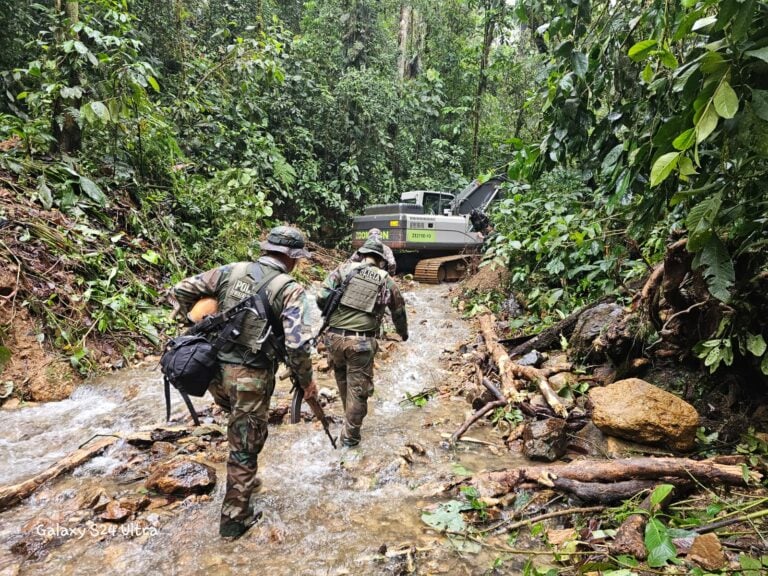
The Peruvian state has intensified its response through interdiction operations and legal reforms. Between 2024 and 2025, authorities seized numerous camps, machinery, and engines used in illegal mining. Meanwhile, the Specialized Environmental Prosecutor’s Office secured convictions for crimes such as aggravated illegal mining and trafficking of illicit supplies, Andina reported.
A key development was the enactment of Legislative Decree No. 1695 in January 2025. This regulation toughens penalties, increasing prison sentences from six to nine years, and introduces new measures against the trafficking and commercialization of illicit minerals. It also expands investigative powers regarding money laundering and organized crime, incorporates specific fines for those who traffic chemical supplies and machinery and restricts access to mining concessions for individuals linked to illegal activities.
According to Liendo, “for a regulatory framework to have real and sustained effects, institutional capacity must be strengthened. Peru requires robust judicial, police, and military capabilities. Currently, key organizations are ill-equipped to deal with this phenomenon, which severely limits the deterrent effect of any regulation.”
For its part, the Peruvian Navy has intensified its presence in the Amazon, carrying out interdiction operations on rivers such as Madre de Dios, Tambopata, and Urubamba. During these actions, dredgers, engines, and other equipment used in illegal activities were destroyed.
International cooperation: A joint effort against organized crime
International cooperation has become a fundamental pillar of Peru’s strategy against illegal mining. According to Infobae, collaboration with the United States has focused on information sharing, technical assistance, and coordinated actions to weaken critical points of this illicit economy, such as the control of chemical inputs and financial flows.
An example of this joint effort was the seizure of nearly 4 tons of mercury intended for illegal mining, achieved in 2025 through coordination between Peruvian and U.S. agencies, Noticias Ambientales reported.
In addition, bilateral instruments such as the Memorandum of Understanding (MoU) on critical minerals, signed on February 4, 2026, have prioritized technology transfer, exploration, and the strengthening of governance in the mining sector. While the MoU focuses on minerals essential for the energy transition, it explicitly includes gold as a “critical” focus for supply chain security and traceability, aiming to decouple illegal gold from the global market.
At the same time, Peru participates in the SERVIR-Amazonia platform, a joint initiative with NASA that uses satellite data to detect illegal activities and associated deforestation in real time. This tool allows authorities to prioritize interventions and improve coordination between institutions.
Liendo noted that, in the context of the 200th anniversary of diplomatic relations between the two countries, “although Washington supports Peru, in order to maximize that cooperation, the Peruvian state must ensure efficient political leadership and solid institutions.”
“No other country maintains this type of relationship or offers comparable support to Peru on this issue,” Liendo added. “The Armed Forces, due to their hierarchical structure and international training, can contribute effectively if they have political support and an adequate legal framework.”
Simultaneously, Peru’s response is also coordinated with Andean neighbors through regional mechanisms that strengthen information exchange and cross-border investigation. In October 2025, Bolivia, Colombia, Ecuador, and Peru advanced a 2025-2030 Action Plan to coordinate technical analysis and joint responses in border areas affected by illegal mining, the Peruvian Foreign Ministry indicated.
Formalization: A path to sustainability
The formalization of mining in Peru appears to be a long-term solution to eradicating the illegal gold market. According to Liendo, all mining activity must be legal and under state control, from extraction to processing in regulated plants. This does not imply state ownership, but rather that the state works with strategic allies to ensure traceability.
Liendo stressed that if legal miners have access to secure markets and regulated prices, it will be possible to implement formalization programs that include labor, safety, and environmental standards. Otherwise, much of the gold will continue to be channeled into illicit international markets, perpetuating smuggling and the influence of criminal networks.
The challenge for Peru is monumental, but coordinated action between the state, international partners, and regional actors represents a crucial step toward dismantling the criminal networks surrounding illegal mining and returning control of the territory to the nation.