

Ecuador is ramping up military offensives against illegal mining, which in recent years has expanded into the country’s national parks and protected areas.
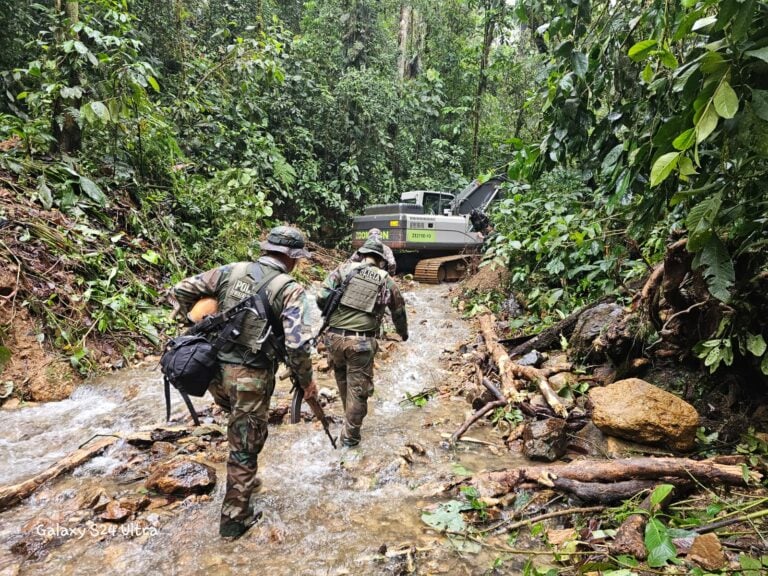
In late October 2025, a major deployment took place in the northern province of Imbabura. A detachment of some 500 soldiers, supported by heavy artillery and coordinated air and ground attacks, struck clandestine camps and illegal entrances in areas known as Mina Vieja, Mina Nueva, and El Olivo. The affected area covered roughly 187 hectares, with more than 720 mine entrances destroyed, according to figures from the Ecuadorian Army. On his social media accounts, President Daniel Noboa declared that illegal mining in the area had been eradicated and promised a permanent presence of the Armed Forces, along with similar actions in other regions.
Following through on this promise, the military offensive was immediately extended to the northern border. In a more recent operation in late November, Ecuadorian forces targeted the cantons of San Lorenzo and Eloy Alfaro in the province of Esmeraldas, a crucial logistics area bordering Colombia. The operation focused on dismantling the financial and logistical backbone of the illicit networks, destroying up to 25 illegal mining camps and platforms.
This action caused a major financial blow, with the seizure of excavators, processing equipment, and large quantities of fuel. Military officials confirmed the infrastructure was controlled by the Oliver Sinisterra Front, a dissident group of the Revolutionary Armed Forces of Colombia (FARC), who are actively allied with Ecuadorian cartels, like Los Lobos, to exploit mining zones.
Organized crime and terrorist designation
What began as an informal activity in Ecuador, has rapidly attracted sophisticated criminal networks, operating with heavy machinery, explosives, and complex logistics.
The scope of this illicit activity is massive. According to data cited by the business intelligence platform Bnamericas, which referenced the Mining Regulation and Control Agency (ARCOM), there are more than 387 illegal mines scattered across 16 provinces. Forty of these are controlled by organized armed groups, with experts estimating at least 30 located in protected areas, including Podocarpus National Park in the Amazon.
Among the organized crime groups violently disputing mining areas are Los Lobos and Los Choneros.
Los Lobos, a group that maintains ties with the Mexican Jalisco New Generation Cartel (CJNG), reportedly controls 20 gold mines and 40 illegal mining groups. It is also known for extorting companies holding concessions for another 30 mines.
Los Choneros allegedly use illegal mining as a front for other major criminal activities, including arms smuggling, extortion, and drug trafficking.
Significantly, these groups have been officially designated as threats in both Ecuador and the United States. In Ecuador, the Presidency of the Republic, through Executive Decree No. 111, has designated them as terrorist groups. This status was echoed internationally when the United States also designated Los Choneros and Los Lobos as Foreign Terrorist Organizations (FTOs).
High-profile arrest
In a major victory against the criminal networks, President Noboa and Ecuadorian Interior Minister John Reimberg announced the arrest of Los Lobos leader Wilmer Chavarría Barré, alias Pipo, in Málaga, Spain, in mid-November 2025. On the X platform, Reimberg and Ecuadorian National Police Commander Pablo Maldonado confirmed the arrest resulted from “coordinated work” between the authorities of both countries.
“The criminal who faked his death, changed his identity, and hid in Europe, while ordering murders in Ecuador, controlled illegal mining operations, and coordinated drug routes alongside the Jalisco New Generation Cartel,” Noboa said.
The fight has been met with reprisal. In October, shortly after the major military offensive against illegal mining, explosive attacks damaged bridges and were followed by a car bomb in Guayaquil, killing one person and injuring others. President Noboa and other authorities attributed these acts directly to the “illegal mining mafias.”
Luis Alejandro Vázquez Reina, a lawyer specializing in constitutional and criminal law based in Ibarra, Imbabura province, pointed out that illegal mining not only destroys the environment but also brings severe consequences for local communities, including insecurity, forced prostitution, and increased violence, preventing citizens from enjoying natural spaces.
For María Eulalia Silva, executive president of the Ecuadorian Chamber of Mining, illegal mining must be addressed regionally, as organized crime operates without borders, she told Bnamericas. She stressed the need for joint actions to standardize regulations, strengthen territorial control, and encourage industrial mining that generates legal jobs. Without a comprehensive response, she warned, illegal miners could return to areas affected, jeopardizing concession projects and strategic ecosystems.
“Interinstitutional coordination is essential, involving not only the executive branch, but also the judiciary, regulatory agencies, and local authorities,” Silva said.
International support and cooperation
The fight against organized crime and illegal mining has drawn significant international backing, particularly from the United States. In recent months, U.S. officials committed nearly $20 million in aid, including technological equipment such as drones for the Ecuadorian Navy, to help monitor drug routes and other illegal activity. The support is also focused on providing technical assistance for law enforcement, strengthening anti-corruption efforts, and combating money laundering — a key mechanism for processing illegal gold proceeds.
Additionally, the Inter-American Development Bank (IDB) approved a large loan to support Ecuador’s security initiatives, with a focus on strengthening financial transparency and targeting high-crime and illegal mining-affected areas.
The success of the military offensives, experts contend, will depend heavily on the sustained coordination of the executive branch, the judiciary, regulatory agencies, and continued international partnership.