
When ABC News reported the rescue of a dog and her puppies from the rubble of the earthquake that devastated Venezuela, the story seemed like one of many moving accounts to emerge from the tragedy. But the dog did more than lead rescuers to her puppies. Her persistent barking drew their attention to a section of the rubble, where they discovered and rescued a woman trapped beneath the debris.
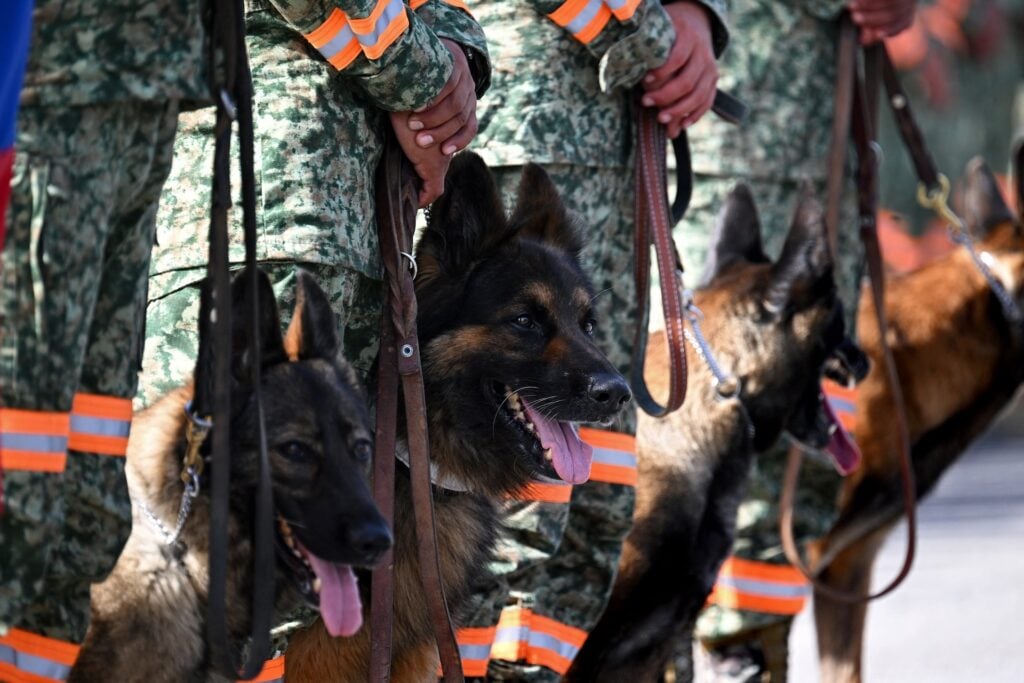
The incident underscored a fact well known to search and rescue professionals: When it comes to finding people trapped beneath collapsed buildings, trained dogs remain one of the most effective tools available. Their extraordinary sense of smell and agility allow them to navigate unstable structures and piles of rubble that are often inaccessible to people or heavy equipment, despite the constant hazards posed by twisted metal, broken glass, and exposed steel.
Since the June 24 earthquake, more than 2,000 rescuers and 137 search and rescue dogs from different countries have taken part in emergency operations. Among them were Tsunami, Blade, Kayra, Dastan, Bart, and Atenea — names that, for thousands of Venezuelan families, became synonymous with hope. Alongside their handlers, firefighters, military personnel, and civil protection specialists, they formed part of one of the largest multinational search and rescue mobilizations ever recorded in the region.
No machine can match a search dog’s nose
In the aftermath of a major earthquake, time is the greatest enemy. During the first 72 hours, known as the rescue “golden window,” every minute can mean the difference between life and death.
“To this day, humans have not been able to create a tool equal to or more efficient than a dog’s sense of smell and senses,” Jorge Beens, founder and director of Venezuela’s Center for the Training of Disaster Intervention Canine Teams (K-SAR ECID) and Tsunami’s handler, told Univisión. “The dog builds a kind of catalog of smells, but the main reference it uses is the carbon dioxide produced by breathing.”
For that reason, K9 units are an essential component of urban search and rescue (USAR) teams. “Once the dogs locate this scent, rescue teams can intervene using cameras and other equipment to determine the best access point to the victim and begin extraction operations,” Denise Sanders, senior director of communications and search-team operations at the Search Dog Foundation (SDF), told Diálogo. The California-based nonprofit selects and trains search dogs for U.S. rescuers, six of which were deployed to Venezuela.
The dogs do not work in isolation. Their role is to narrow the search area so structural engineers, rescue specialists, medical personnel, and other members of the USAR team can focus their efforts where survivors are most likely to be found.
Not all dogs perform the same function. Some are trained to locate live victims, while others detect human remains. In the Argentine contingent, for example, Gino and Brooklyn were used to locate people who had died, while Bart and Frida took part in the search for survivors. More than 96 hours after the earthquake, Bart, a Belgian Malinois, identified the exact spot where rescuers needed to dig to reach two minors trapped under the rubble.
“Bart marked the target and, above all, indicated the direction in which we needed to work. This is very important because time is gold,” said Colonel Miguel Ángel Wissinger, commander of the Argentine contingent.
Years of training
Behind every successful intervention are years of selection, training, and teamwork between the dog and its handler.
“The bond between the handler and the dog is what holds together all the capabilities of an operational team,” Sanders said. “The skills we teach the dogs — rubble search, agility, and response to directional commands — are fundamental, but the relationship between the dog and its handler continues to develop throughout their entire career together and allows the team to face any challenge, both during training and during a real mission.”
Selected dogs spend months training in simulated collapsed structures, tunnels, and unstable surfaces. They are then assigned to their future handlers, forming what is known as a K9 team, and continue training throughout their operational life.
There is no single ideal breed for this work, but some characteristics are essential: courage, physical endurance, agility, energy, and the ability to concentrate. Labrador retrievers, German shepherds, golden retrievers, border collies, and especially Belgian Malinois often have these qualities. Malinois, in particular, are valued for their speed, strength, and ability to move through confined spaces, as Dastan, from the Bogotá Fire Department, demonstrated in Venezuela. Dastan had already taken part in rescue operations following Haiti’s 2021 earthquake.
A strategic resource for the Americas
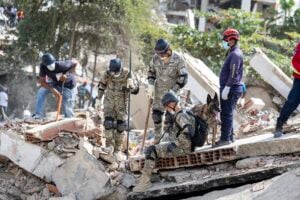
The Venezuela earthquake highlighted not only the effectiveness of K9 units, but also the importance of having enough trained teams before an emergency occurs. In the United States, experts estimate that about 450 certified teams would be needed to respond adequately to large-scale disasters, but only about half that number currently exists. In Latin America, the number of certified K9 teams also remains limited compared to the frequency of earthquakes, hurricanes, floods, landslides, volcanic eruptions, and wildfires.
At the same time, the region has developed significant operational experience. Many of the dogs deployed to Venezuela had already taken part in international missions in Haiti, Mexico, Chile, Ecuador, and Türkiye, demonstrating the value of years of training, certification, and cooperation among countries.
Tsunami is one example. Rescued years ago from abandonment and abuse, the Venezuelan border collie had already worked in Türkiye after the 2023 earthquake. During the emergency in his own country, he helped locate more than 20 survivors.
“Venezuela needs more dogs specialized in search and rescue. The private sector and the state need to help us create this first training center for K9 teams, so that there are not only Jorge Beens and Tsunami, but many more K9 teams prepared to respond when necessary,” Beens said.
Many of the dogs now working among the rubble were themselves rescued from abandonment.
“To see a dog that had a difficult start, that perhaps did not trust human beings, gain confidence through the search game and end up saving lives after a disaster is extraordinary,” Sanders concluded.
On July 3, as international search and rescue operations drew to a close, Venezuelan authorities awarded the “Canine Heroes of Venezuela” medal to 36 dogs from 12 countries, recognizing their role in locating survivors during the multinational response.
In earthquake-stricken Venezuela, rescue dogs did more than help locate survivors. Integrated into search and rescue teams from across the continent, they showed how years of training, together with international cooperation, can make a difference when every minute counts. Among the rubble, these four-legged first responders became one of the most visible symbols of the shared commitment to saving lives.