
As Venezuela transitions from the search and rescue phase to the long process of recovery following the devastating June earthquake, one of the greatest challenges is no longer delivering aid but coordinating the reconstruction effort effectively. The scale of the disaster underscores the magnitude of the task. The United Nations Development Programme (UNDP) estimates direct physical damage at approximately $6.7 billion — roughly 6 percent of Venezuela’s GDP. The agency noted that this figure does not include infrastructure damage, indirect economic losses, or reconstruction costs, and that the overall impact of a disaster of this scale is typically estimated at 1.5 to 3 times the direct damage, meaning the total cost could exceed $20 billion.
In a crisis of this magnitude, international assistance has been indispensable. “International capabilities and support are essential in disaster response operations when local teams or expertise are unavailable or insufficient,” Ilan Kelman, professor of Disasters and Health at University College London, told Diálogo.
That assessment is shared by Venezuelan first responders working on the ground. “We don’t have the techniques or the technology. Thank God the foreign rescuers arrived,” Lieutenant Colonel Leonardo Acevedo of the Caracas Fire Department said on social media.
Within this international effort, the United States plays a central role by supporting United Nations coordination mechanisms, deploying specialized search and rescue teams, providing logistics and communications capabilities, and working alongside regional partners and humanitarian organizations.
International coordination mechanisms
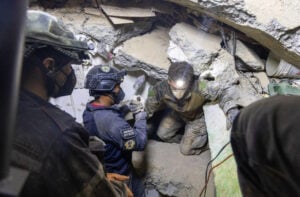
In a disaster marked by thousands of collapsed buildings, damaged infrastructure, and disrupted communications, the ability to rapidly organize the arrival and employment of international resources can mean the difference between an effective response and operational chaos.
According to Juan Pablo Sarmiento, honorary research professor at the Kimberly Green Latin American and Caribbean Center at Florida International University and a disaster management expert, “much of the international disaster response system is built on established mechanisms designed to enable governments and humanitarian organizations to work together in a coordinated manner during emergencies.”
Among the most important are the United Nations Disaster Assessment and Coordination (UNDAC) system, responsible for rapidly assessing the impact of disasters, and the International Search and Rescue Advisory Group (INSARAG), the global network that coordinates urban search-and-rescue teams. Both operate under the coordination of the United Nations Office for the Coordination of Humanitarian Affairs (OCHA), which also receives financial support from the United States.
The U.S. contribution extends beyond funding. For years, Washington has helped develop the international certification standards, operational procedures, and coordination systems that now enable teams from dozens of countries to work together under common guidelines. This framework facilitates information sharing, prevents duplication of effort, and accelerates decision-making during emergencies.
Cooperation on the ground
If international coordination provides the backbone of the response, operational capabilities on the ground are its driving force. In Venezuela, the United States is supporting relief efforts through the State Department’s Bureau of Disaster and Humanitarian Response (DHR) and its Disaster Assistance Response Team (DART), backed by logistical support from the Department of War. Through U.S. Southern Command (SOUTHCOM), Washington is providing airlift, communications support, logistics coordination, and humanitarian aid distribution. Among the deployed assets are four of the United States’ premier Urban Search and Rescue (USAR) teams — Fairfax County, Los Angeles County, Miami-Dade County, and the City of Miami — highly specialized units trained to locate and rescue victims trapped beneath collapsed structures.
For Sarmiento, the participation of Miami-Dade Fire Rescue carries particular significance. “It is a pioneering organization in the development of search-and-rescue capabilities.” For decades, the department has helped train emergency response teams and promote procedures that are now standard in international disaster operations.
This coordination structure quickly translated into operational decisions. According to Sarmiento, in a situation where damage is spread across more than seven states and hundreds of buildings have collapsed, the greatest challenge was establishing priorities and making the most effective use of available resources.
Information gathered by residents, emergency services, and local authorities has enabled responders to rapidly identify the hardest-hit areas and focus efforts where the chances of finding survivors were greatest. “When local capabilities are insufficient, external assistance must be closely coordinated with those already operating on the ground,” Kelman said.
The response has also highlighted the value of cooperation between the United States and its partners. Search-and-rescue teams, humanitarian organizations, and civilian and military capabilities from multiple countries are operating within a common framework, sharing information, damage assessments, and logistical resources. This interoperability has accelerated the delivery of assistance while maximizing each participant’s specialized capabilities.
One example took place in Caraballeda, La Guaira state, where French rescuers and members of the U.S. Fairfax County USAR team, with the assistance of local residents, rescued a father and his son after they had been trapped beneath the rubble for four days.
Strategic capabilities
Beyond search-and-rescue operations, one of the United States’ most important contributions has been the deployment of logistics, technology, and communications capabilities that sustain the broader international humanitarian response.
Under the leadership of the State Department, SOUTHCOM is providing critical operational infrastructure to ensure the continuity of relief operations at a time when much of Venezuela’s transportation and communications networks remain disrupted. Among the deployed capabilities are a U.S. Marine Corps Combat Logistics Company equipped with water purification systems; the Humanitarian Assistance Coordination Center (HACC), which centralizes coordination between civilian and military organizations; the amphibious transport dock USS Fort Lauderdale, serving as a logistics and medical support hub; and a Forward Arming and Refueling Point (FARP), which has increased the tempo of helicopter operations to isolated communities.
Communications have also become a decisive element of the response. Following the earthquake, the collapse of telephone networks and widespread power outages continue to complicate relief operations. “During the first 48 hours, communications were nonexistent. Everything depended on satellites,” Sarmiento told Diálogo.
Under these conditions, satellite communications and geospatial intelligence have become indispensable strategic tools. They allow authorities to maintain the flow of information between Venezuelan officials, international organizations, and response teams on the ground, while helping identify the hardest-hit areas and direct resources to communities with the greatest needs.
NASA has supported damage assessments and operational planning through satellite imagery analysis. The United States has also deployed MQ-9 Reaper drones which, together with an information fusion cell in Miami, are enhancing Venezuelan authorities’ situational awareness by helping identify damaged buildings, assess road conditions, and support the distribution of humanitarian assistance.
In this effort, the USS Fort Lauderdale continues to play a key role. In addition to transporting humanitarian aid and providing additional medical capabilities, the ship serves as a floating communications and coordination hub. From aboard the vessel, secure communications links facilitate information sharing among Venezuelan authorities, international rescue teams, and humanitarian organizations, accelerating the delivery of assistance to the hardest-hit communities.
Amid longstanding vulnerabilities, the value of these capabilities extends well beyond the immediate emergency. As Venezuela transitions from emergency response to recovery, continued coordination among national authorities, international organizations, and partner countries will remain essential to restoring critical services, supporting affected communities, and strengthening resilience against future disasters.