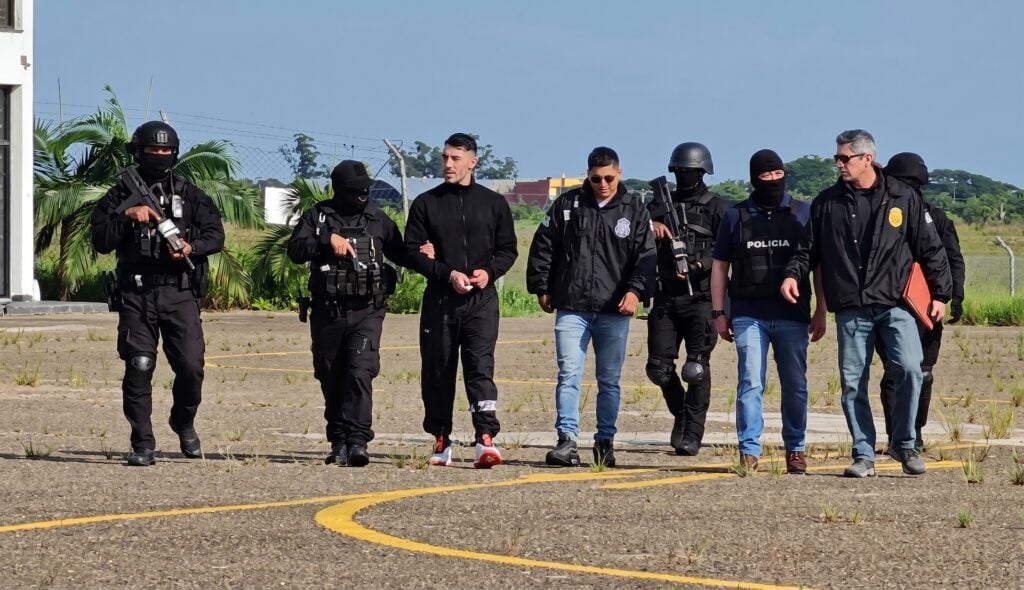

In the early hours of March 13, 2026, a small team of counternarcotics agents entered a residence in the Las Palmas neighborhood of Santa Cruz de la Sierra, Bolivia. The operation, the result of weeks of coordination and intelligence sharing between Bolivian authorities and international partners, had been prepared under strict information compartmentalization. Only a limited number of officials knew the true objective: to capture Sebastián Enrique Marset Cabrera, a Uruguayan drug trafficker and one of South America’s most wanted criminals, sought by authorities in Bolivia, Paraguay, the United States, and Interpol.
The man known as the “King of the South,” a high-priority target of the DEA who for years appeared beyond the reach of law enforcement, had finally been captured.
His downfall was not a matter of luck, but rather the validation of an approach that, according to regional analysts and authorities, reflects an evolution in how states confront transnational organized crime. What some experts have begun informally describing as the “Marset Model” points to a framework in which states no longer operate as isolated compartments, but as an interoperable network built on intelligence sharing, multinational coordination, and more disciplined operations.
For security authorities and analysts across Latin America, the operation has become a case study in how regional coordination, intelligence control, and disciplined execution can change the outcome when confronting transnational criminal networks.
“This is a visible example of a broader shift in Latin America: the gradual transition from fragmented national responses toward cooperation models based on interoperability, intelligence sharing, and multinational coordination against transnational criminal organizations,” Bolivia’s Vice Minister of Social Defense Ernesto Justiniano, told Diálogo.
The operation also coincided with the resumption of cooperation mechanisms between Bolivia and the DEA, which had been interrupted for nearly two decades.
2023 to 2026: From operational collapse to intelligence control
The contrast with 2023 illustrates the significance of that change.
That year, under the administration of President Luis Arce, Bolivian forces attempted to capture Marset in Santa Cruz. The operation failed, and the trafficker escaped. Subsequent investigations and press reports pointed to possible internal leaks that may have compromised the operation.
At the time, then-Minister of Government Eduardo del Castillo publicly acknowledged failures in both execution and information management, while the case generated domestic concerns regarding corruption and institutional vulnerabilities.
Three years later, under the new administration of Rodrigo Paz, which pledged to break any pact with drug trafficking, authorities adopted a different approach.
According to current Minister of Government Marco Oviedo, the 2026 operation relied on much stricter information management, coordination limited to small teams, and a compartmentalized structure designed to reduce the risk of leaks, as well as the political will of the new government.
In statements to Bolivian state media, Oviedo said that “absolutely nobody knew the timing or location of the operation.”
This type of approach aligns with what regional analysts describe as key operational lessons from previous cases. Numerous specialized studies on organized crime operations in Latin America highlight information leaks as one of the factors most frequently responsible for compromising security operations. The specialized literature consistently emphasizes that protecting sensitive information and intelligence processes is just as important as gathering strategic information itself.
A key figure in fragmented networks
The Marset case also illustrates how drug trafficking structures have evolved.
Unlike traditional criminal figures, Marset did not operate as a conventional territorial leader. According to Uruguayan organized crime analyst Edgardo Buscaglia, these types of actors function as coordinating nodes capable of connecting criminal organizations across different countries and markets.
Marset was not a traditional territorial trafficker; his value lay in his role as a logistical broker.
According to Edgardo Glavinich, director of the Sherman Kent Foundation, Marset served as a bridge between organizations operating in different geographic areas, from Brazil’s First Capital Command (PCC) and Paraguay’s Insfrán Clan to Italy’s ‘Ndrangheta and criminal groups in the Balkans.
Security sources in Paraguay and Brazil have described his role as that of an intermediary facilitating production in Bolivia, transportation by truck or aircraft through Paraguay, connections with the PCC in Brazil, and links to European criminal networks, including the ‘Ndrangheta.
Within that framework, his capture affects the network but does not necessarily dismantle it, Vice Minister Justiniano explained.
Numerous studies on transnational organized crime indicate that criminal networks possess a high degree of operational adaptability. When a structure or leadership figure is disrupted by state action, criminal groups often reorganize functions, redistribute responsibilities, and restore activities through internal replacement and reconfiguration mechanisms.
International dimension: Extradition and judicial capacity
Following his capture, Marset was transferred to U.S. custody to face money laundering charges linked to international drug trafficking.
The use of such mechanisms reflects an increasingly common strategy in the region: combining local operations with international prosecutions and transnational financial cooperation.
Experts in international cooperation against organized crime argue that judicial and law enforcement coordination mechanisms strengthen the ability to investigate complex criminal structures, particularly in areas related to money laundering, transnational financial movements, and international logistics networks. This approach is based on the premise that transnational threats require coordinated responses that go beyond the capabilities of a single jurisdiction.
On March 16, 2026, just three days after his arrest, Marset appeared before a federal court in Alexandria, Virginia, facing conspiracy charges related to money laundering connected to international drug trafficking.
The DEA maintains that his organization was responsible for moving tons of cocaine to Europe, generating tens of millions of dollars in profits. If convicted, Marset could face up to 20 years in prison, a sentence similar to that already being served by his close associate Federico Ezequiel Santoro Vassallo, who was sentenced in the same jurisdiction in 2025.
A regional trend
Elements of this approach can also be observed, with different variations, in other countries across the region.
In Ecuador, authorities have strengthened coordinated maritime operations and intelligence sharing to intercept shipments before they enter international trafficking routes. Analysts from InSight Crime argue that the growing role of drug trafficking in Pacific ports has forced the development of closer cooperation mechanisms between local agencies and international partners.
In Guatemala, recent investigations targeting money laundering structures have involved judicial cooperation and information sharing with foreign entities to trace illicit financial flows across multiple jurisdictions.
In the Caribbean, organizations such as CARICOM and CARICOM IMPACS have expanded regional coordination in maritime surveillance and information sharing to monitor routes used by drug trafficking and smuggling networks.
For experts, these efforts reflect a gradual shift in how the region confronts transnational organized crime.
In several recent cases, security, intelligence, and justice agencies have strengthened information-sharing mechanisms and the coordinated execution of concrete actions.
The Marset case does not represent a definitive solution to criminal structures that continue to adapt and reorganize. However, it did leave a clear operational lesson: States are more likely to succeed when they combine protected intelligence, real-time information sharing, judicial coordination, and multinational operations.
More than the capture of a fugitive, the so-called “Marset Model” highlights an emerging trend in Latin America: When confronted with criminal organizations that operate as flexible transnational networks, states are increasingly responding through regional coordination mechanisms, intelligence sharing, and judicial cooperation.
“The capture of Marset is not the end. It is the beginning of our way of fighting transnational crime,” Justiniano said during his brief visit to Washington in mid-May.