Central American security forces are incorporating unmanned aerial systems and intelligence, surveillance, and reconnaissance (ISR) capabilities to counter increasingly mobile and technologically sophisticated criminal organizations. These tools expand surveillance over borders, coastlines, and remote forested areas, at a time when criminal networks themselves are also using drones to monitor their surroundings, transport illicit goods, and support other illegal activities.
Situational awareness moves beyond physical patrols
“Drones, combined with intelligence, surveillance, and reconnaissance capabilities, represent a significant shift in how security forces achieve situational awareness,” Víctor Ruiz, director of SILIKN, a Mexican cybersecurity consulting firm, told Diálogo. “They no longer rely solely on physical patrols or human intelligence, but can integrate data from sensors, aerial imagery, open-source intelligence, and automated analysis to detect patterns and anomalies.”
The use of these platforms is changing the way security forces monitor the operating environment. While a ground patrol focuses on a specific corridor, an aerial platform equipped with the appropriate sensors can observe a much larger area and generate data that allows movements and activities to be compared over time.
“The combination of drones, ground sensors, radars, geographic information systems, and intelligence platforms makes it possible to monitor large areas more efficiently than relying exclusively on human resources,” Ruiz added. “Artificial intelligence and analytical platforms can identify patterns that would be difficult to detect manually, improving the ability to prioritize investigations and optimize resources.”
The value of these platforms, however, extends beyond their ability to fly. Their effectiveness also depends on secure communications, trained personnel, maintenance, data processing, and mechanisms that enable information sharing among military, law enforcement, border security, and judicial authorities.
Honduras and Guatemala expand capabilities
Honduras has announced plans to acquire drones to strengthen border surveillance and support counternarcotics operations. The country remains a major transit route for cocaine shipments originating in South America, while authorities have also identified coca cultivation and drug-processing infrastructure within its territory, according to Euronews.
The acquisition is intended to address both the flow of narcotics moving through the country and the illicit infrastructure established in remote areas.
Guatemala is also evaluating the procurement of a new batch of drones, night-vision sensors, and other surveillance equipment to strengthen National Civil Police operations against narcotics trafficking networks, local newspaper Prensa Libre reported.
Night-vision sensors would help maintain surveillance during periods of reduced visibility, expand coverage in remote areas, and support nighttime operations. Combined with drones, radar systems, and geographic information systems, these technologies could help identify clandestine airstrips, illicit crops, suspicious activity, and routes used by criminal organizations.
Panama institutionalizes unmanned aerial operations
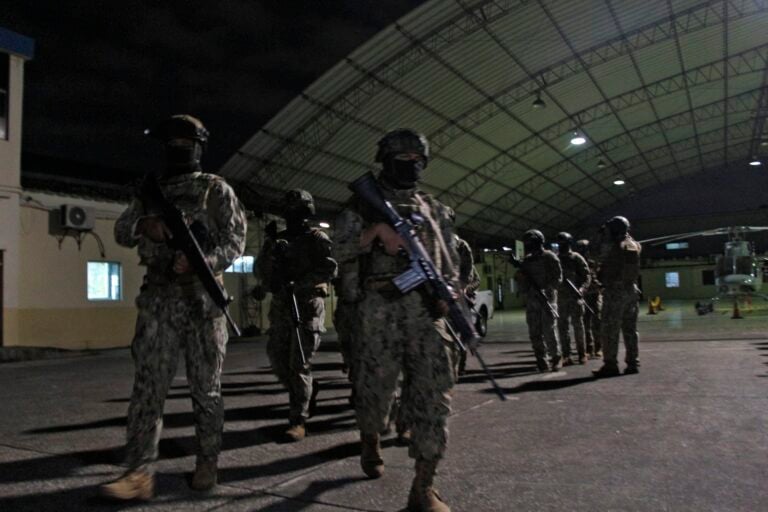
Panama has moved beyond the limited use of drones by establishing permanent structures with the creation of the National Border Service (SENAFRONT) Unmanned Aerial Operations Company.
The Ministry of Public Security announced in July that the new unit will employ real-time aerial intelligence to anticipate threats, detect illicit activity, and support operations in border regions and other hard-to-reach areas used by criminal organizations to traffic drugs, weapons, and other illicit goods.
Meanwhile, the National Air and Naval Service (SENAN) also announced in July the acquisition of four K1000ULE unmanned aerial systems through U.S. security cooperation. The systems, which include ultra-long-endurance aircraft and ground control stations, will be assigned to SENAN’s Unmanned Aerial Systems Squadron within its Air Command.
The initiatives undertaken by SENAFRONT and SENAN serve different but complementary missions. While SENAFRONT focuses on monitoring and securing Panama’s land borders, SENAN integrates air and maritime capabilities to monitor the country’s jurisdictional waters and support operations against drug trafficking and other transnational threats.
Criminal organizations also use drones
As security forces adopt new technologies, criminal organizations are also exploiting commercial drones and other low-cost systems for surveillance, transporting illicit goods, intimidation, and, in some parts of the region, to support attacks. These developments demonstrate the criminal networks’ ability to adapt, according to Uruguay’s Center for the Study of Economic and Social Reality (CERES).
Costa Rica recently provided a clear example of their operational impact. Alejandro Arias Monge, alias Diablo, considered one of the country’s most dangerous criminals, was hiding in a residence in the forested Sarapiquí canton, where his organization used drones to monitor the perimeter and detect approaching law enforcement.
During the July 24 operation, tactical teams from the Judicial Investigation Agency took advantage of the moment when one of the drones was no longer monitoring the area to approach the property, Costa Rican news outlet AmeliaRueda reported. The operation ended with the capture of Arias Monge and other members of the organization.
The arrest dealt a significant blow to a criminal organization linked by Costa Rican authorities to drug trafficking, money laundering, and numerous homicides. The DEA and the U.S. Department of State had offered a reward of up to $500,000 for information to assist Costa Rican authorities with Arias Monge’s arrest or conviction tied to Costa Rican charges.
The case demonstrated both the operational value drones can provide criminal organizations and the importance of understanding their limitations.
“The advantage is not the drone itself as a platform, but the integration of information. When collected data is combined with intelligence and analytical systems, it becomes possible to identify trends, correlate events, and prioritize risks much more quickly,” Ruiz emphasized. “This makes it possible to move from a reactive model, where responses come after an incident, to an intelligence-driven preventive model.”
Turning aerial imagery into actionable intelligence
Central American security forces continue integrating communications, sensors, data analysis, and intelligence to anticipate the activities of criminal networks. As Honduras, Guatemala, and Panama strengthen these capabilities, unmanned aerial systems are becoming force multipliers that expand surveillance, improve coordination, and support faster operational decision-making.
As Ruiz concludes, the effectiveness of these tools will depend on prevention, interagency coordination, and intelligence-driven decision-making. In that process, the combination of technology, specialized personnel, and cooperation among institutions will enable the information collected to be transformed into an operational advantage against transnational organized crime.