Transnational organized crime networks increasingly operate through logistics, financial, and commercial chains that span multiple countries and jurisdictions. In response, Brazil and the United States, which have a long-standing partnership in the fight against transnational crime, have deepened intelligence sharing, risk analysis, and operational coordination to anticipate threats and strengthen their ability to respond across borders.
As part of these efforts, in April, Brazil and the United States launched the Mutual Interdiction Team (MIT), a cooperation mechanism between Brazil’s Federal Revenue Service (RFB), the country’s tax and customs authority, and U.S. Customs and Border Protection (CBP). The initiative seeks to integrate intelligence efforts and coordinated actions to identify and intercept illicit shipments of weapons and drugs while strengthening information sharing and risk analysis between the two countries.
By sharing information on cargo, routes, operators, and other risk indicators, authorities can identify suspicious patterns, connect seemingly unrelated shipments, and focus inspections on higher-risk cargo. The objective is not only to intercept illicit shipments, but also to help identify the organizations that finance and move them and connect them to international routes.
According to Roberto Uchôa, a public security expert and member of the Executive Board of the Brazilian Forum on Public Safety (FBSP), this approach reduces the advantage enjoyed by criminal organizations. “Without a continuous flow of international data, controls become blind and purely reactive. Data management and interoperability between countries are indispensable because they eliminate crime’s logistical advantage,” Uchôa told Diálogo.
From intelligence sharing to coordinated action
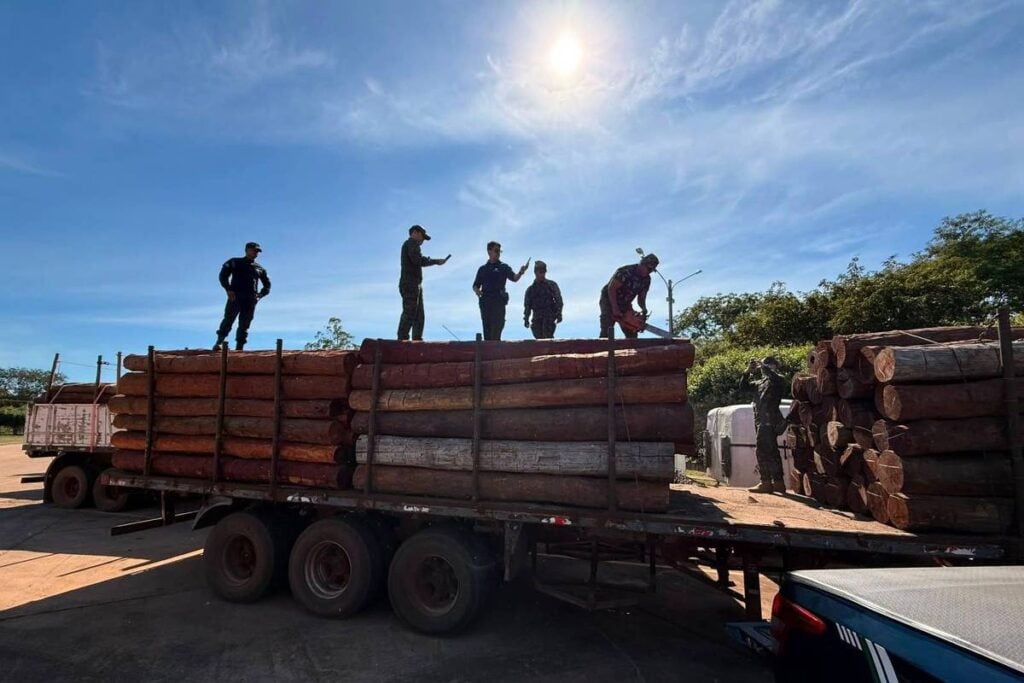
One of the first operations to highlight intelligence sharing between Brazil and international partners was Operation Timber Shield, carried out in late June by the Federal Revenue Service with the participation of the Federal Police, the Brazilian Army, and authorities from the United States, Bolivia, and Chile.
The operation stemmed from information shared among the countries indicating the possible presence of narcotics in a shipment of timber from Bolivia. Based on those alerts, Brazilian authorities stepped up inspections of the cargo and detained eight trucks carrying approximately 260 tons of timber in border areas of Mato Grosso and Mato Grosso do Sul.
Authorities suspected a particularly difficult-to-detect concealment method: the possible incorporation of cocaine or other substances into the timber itself. During the initial inspections, preliminary tests conducted by Brazilian and Bolivian authorities indicated the possible presence of narcotics, prompting additional inspection, investigative, and forensic procedures.
The case came shortly after Chilean authorities announced an operation involving another timber shipment from Bolivia. In June, Chile’s National Customs Service reported the seizure of more than 1,080 tons of timber contaminated with illicit substances in 45 containers. According to Chilean authorities, approximately 100 tons consisted of drugs, primarily cocaine hydrochloride and ketamine.
“This operation demonstrated the level of maturity achieved by the interconnected intelligence architecture among the countries. The most positive aspect was the ability to respond immediately and coordinate across borders to identify and intercept a complex shipment before it reached the market,” Uchôa said.
Subsequent forensic analyses conducted by Brazil’s Federal Police did not confirm the presence of narcotics in the samples examined. “From an institutional and analytical standpoint, this demonstrates the rigor and importance of proper scientific forensic procedures, which prevent false positives while also consolidating a permanent channel for international data sharing,” Uchôa said. According to the expert, “the knowledge acquired will help refine operational alert mechanisms, preventing unnecessary logistical delays to legitimate trade.”
Data, technology, and risk analysis: A new frontier for cooperation
While Timber Shield demonstrated both the potential of intelligence sharing and the need for rigorous verification, the broader change introduced by the MIT lies primarily in establishing permanent mechanisms to identify patterns and risks throughout international supply chains.
One of the main tools in this system is Desarma, a Federal Revenue Service digital platform dedicated to the international tracing of weapons, ammunition, parts, components, explosives, and other sensitive materials.
The program enables structured, real-time information sharing when Brazilian and U.S. authorities identify materials linked to the other country. Records may include the type of material, declared origin, cargo logistics information, serial numbers or other identifiers, as well as information on exporters, senders, and other operators involved.
The consolidated information enables authorities to identify patterns, connections between senders and recipients, and recurring routes, facilitating the exchange of alerts and the mapping of international arms trafficking networks.
One example of this approach was the May 2026 seizure of weapons components concealed in an international shipment at Viracopos International Airport in Campinas, São Paulo state. Through shared intelligence, investigators went beyond intercepting the material and were able to reconstruct the logistics chain to the final recipients, demonstrating how cooperation can help target the organizations behind the trafficking rather than just the illicit shipment itself.
In this context, customs agencies no longer serve solely to inspect goods entering and leaving a country; they also function as nodes in a broader risk-analysis network. Each suspicious shipment can contribute to a shared body of information that helps identify links among criminal organizations operating across borders and anticipate their activities.
Adding to this capability is “remote targeting,” which allows authorities to analyze cargo information and images before shipments arrive in the destination country. By sharing scanner images, customs information, and other risk indicators, authorities can assess certain shipments in advance and direct inspection resources toward cargo considered higher risk.
In this way, customs enforcement is increasingly becoming a continuous risk-analysis process that begins before cargo reaches the border. For security and border control authorities, this capability can improve targeting, facilitate coordination among countries, and reduce the impact of inspections on legitimate trade.
According to Uchôa, this evolution also requires new professional capabilities. “Specialization in financial intelligence and forensic chemistry is required, as well as continuous training that enables operators to interpret complex logistics networks and sophisticated chemical alterations even before physical inspection.”
In a hemisphere where criminal organizations use the same commercial supply chains and international routes to traffic drugs, weapons, and chemical precursors and move illicit proceeds, cooperation between Brazil and the United States offers an example of how customs information sharing, risk analysis, and operational coordination can strengthen the response to transnational organized crime.
For countries across the region, the experience also highlights a shared challenge: developing interoperable systems that enable authorities to share information rapidly, verify it rigorously, and turn it into coordinated action against criminal networks operating across multiple jurisdictions.