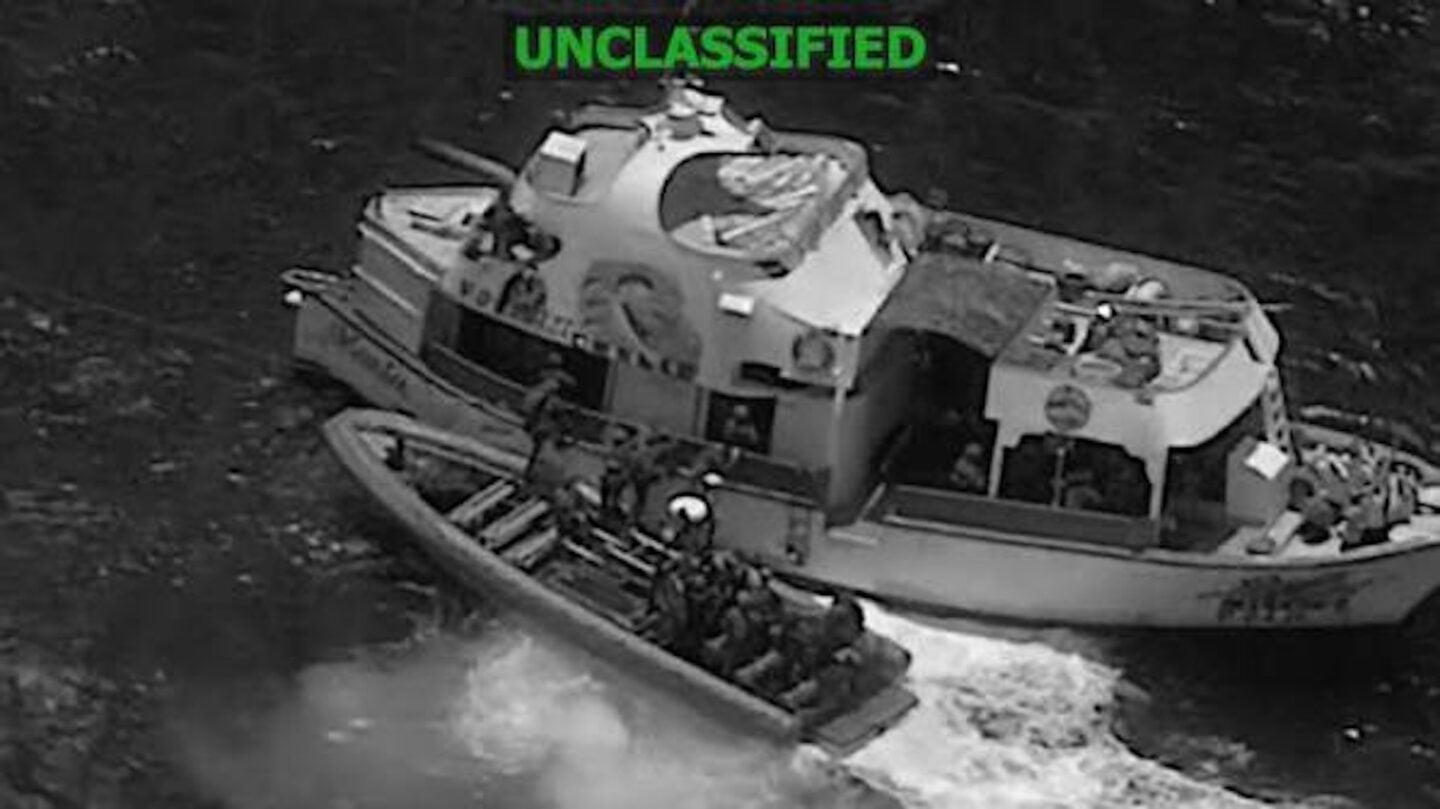

Six maritime interdictions in less than two weeks in the Eastern Pacific are putting the spotlight on a critical part of Los Choneros’ drug trafficking infrastructure: the vessels that supply criminal networks at sea and allow them to operate across vast stretches of ocean.
On August 28 and September 2, 3, 5, 7, and 8, U.S. forces interdicted Ecuadorian vessels in international waters that intelligence identified as floating refueling stations operating in support of terrorist group Los Choneros. U.S. and Ecuadorian authorities said the operations were conducted jointly as part of ongoing counternarcotics cooperation between the two countries.
Ecuadorian sources and media identified five of the main vessels as Los Tres Hermanos, Conquista 2, OM2, María Candelaria, and Montecristi.
Ecuador’s Ministry of National Defense linked the vessels to the maritime infrastructure of Los Choneros. It said the vessel interdicted on August 28 belonged to the terrorist organization and had operated as a refueling station for drug trafficking activities, while the vessel targeted on September 2 “was used to sustain criminal operations at sea.” The Ministry later identified María Candelaria, interdicted on September 5, as another suspected Los Choneros-linked floating refueling station for smaller vessels engaged in illicit drug trafficking. It credited the actions against the vessels in international waters to its “co-ally,” U.S. Southern Command (SOUTHCOM).
The interdictions came amid an intensified Ecuadorian-U.S. campaign against the infrastructure, finances, leadership, and logistical networks that sustain transnational criminal organizations. Days before the first vessel was interdicted, Ecuadorian police and military forces carried out simultaneous operations against Los Choneros and Los Lobos in five coastal provinces, with support from SOUTHCOM and the DEA.
The actions also follow months of maritime operations between Ecuador and the United States and come as countries participating in the Americas Counter-Cartel Coalition (ACCC) move toward greater coordinated action against transnational criminal networks.
Hitting the logistics
The focus extends beyond seizing individual cocaine shipments.
On August 20, the U.S. Department of the Treasury’s Office of Foreign Assets Control (OFAC) sanctioned 15 Ecuador-based targets and identified 10 vessels as blocked property in connection with a cocaine trafficking network whose members were affiliated with Los Choneros and Los Lobos.
According to Treasury, a fleet operating near Manta under the guise of legitimate fishing businesses supported cocaine trafficking through the Eastern Pacific. The vessels supplied cocaine-laden go-fast boats with fuel, food, and medical assistance at coordinated points at sea, while some monitored law enforcement activity. At least one vessel also transported multi-ton quantities of cocaine.
Treasury said the network covertly moved thousands of kilograms of cocaine each month from South America toward Mexico, where Mexican criminal organizations such as the Sinaloa Cartel and the Jalisco New Generation Cartel (CJNG) moved it onward for distribution in the United States.
The sanctions were part of what Treasury described as a network-based approach designed to target not only criminal leadership but also the facilitators and infrastructure that enable trafficking operations.
Identifying those support networks at sea depends heavily on intelligence. Ecuadorian Defense Minister Gian Carlo Loffredo said joint maritime operations begin before forces act.
“Joint operations begin, first, with prior intelligence, and second, the vessel is inspected,” Loffredo told Ecuadorian television on August 28.
Pressure on criminal networks
The maritime actions are part of wider pressure on the criminal infrastructure supporting Los Choneros and other transnational criminal organizations in Ecuador.
That pressure has extended beyond Los Choneros. On September 9, U.S. Secretary of State Marco Rubio announced the designation of Ecuador-based Los Tiguerones as a Foreign Terrorist Organization and Specially Designated Global Terrorist. The State Department linked the group to narcotrafficking and other illicit activity, as well as attacks against civilians, law enforcement officers, and journalists. The designations adds Los Tiguerones to the Ecuadorian criminal organizations already designated by the United States, including Los Choneros, Los Lobos, and Chone Killers.
On August 26, Ecuador’s National Police, in coordination with the Attorney General’s Office, with support from the DEA and SOUTHCOM, carried out operations Jericó and Factoría against Los Choneros and Los Lobos in Guayas, Manabí, Santo Domingo de los Tsáchilas, El Oro, and Esmeraldas. The operations followed investigations lasting more than a year.
Authorities detained 43 people and seized 2.5 metric tons of drugs, more than $1 million in cash, 21 vehicles, an aircraft, and firearms. They also identified two clandestine airstrips and seized fuel and other logistical material.
Ecuador’s National Police described the operations as “a direct blow to the economies of organized crime” through the intervention of assets, resources, weapons, vehicles, money, controlled substances, and logistical means allegedly used to sustain criminal activities.
“DEA is proud to support this effort alongside the U.S. military, working shoulder to shoulder with Ecuadorian law enforcement to disrupt the criminal networks, resources, and infrastructure that fuel international drug trafficking,” DEA Administrator Terry Cole said. “This operation demonstrates what our nations can achieve through strong and sustained cooperation against narcoterrorism.”
U.S. Marine Corps General Francis L. Donovan, SOUTHCOM commander, placed the operations in the context of their wider impact on the criminal organizations. “These operations deal a severe blow to the logistics, finances, and leadership of a regional illicit network that has spread corruption and violence across the Western Hemisphere,” Gen. Donovan said.
Two days later, the campaign moved offshore with the interdiction of Los Tres Hermanos.
Cooperation at sea
Ecuadorian-U.S. maritime operations have expanded significantly in 2026. Loffredo said in August that cooperation with the United States had tripled Ecuador’s maritime interdiction capacity.
Earlier in the year, Operation Pulpo used a U.S. maritime platform, the U.S. Ship Special Mission (SSM), a cooperative model under the tactical control of Joint Interagency Task Force South (JIATF-S), to embark and deploy Ecuadorian teams hundreds of miles into the Eastern Pacific. Intelligence from U.S., Ecuadorian, and other partner assets supported the mission, while Ecuadorian personnel conducted boardings and inspections under Ecuadorian legal authority.
In one interdiction approximately 180 nautical miles off Ecuador, Ecuadorian forces seized three coordinated vessels carrying 2,062 kilograms of cocaine.
“The SSM enables Ecuadorian forces to project their operational impact more than 200 nautical miles from the coast,” a senior Ecuadorian official said following the operation.
That maritime cooperation has continued in the latest operations. In each of the recent interdictions, the people aboard were removed before the vessels were sunk. SOUTHCOM said those aboard the vessel interdicted on August 28 were safely escorted to Ecuador, while those removed during the September 2, 3, 5, 7, and 8 interdictions were safely transferred to Ecuadorian authorities.
The Ecuadorian Navy subsequently confirmed the return of crew members from the operations. Twenty-eight crew members from Conquista 2 and OM2 arrived in Manta aboard an Ecuadorian Coast Guard vessel on September 4. Following the September 5 operation, the Navy confirmed that a Coast Guard unit received the 26 crew members from María Candelaria and transported them toward Manta. Eight additional crew members from Conquista 2, who had left the vessel aboard four small boats, were located by an Ecuadorian Coast Guard unit on September 5 and taken toward a safe port.
From bilateral operations to regional action
The campaign against maritime logistics comes as Ecuador and its partners are expanding their focus from bilateral operations to coordinated regional action through ACCC.
At the coalition’s second meeting in Panama in August, defense and security leaders examined the routes, logistics, actors, and methods used by transnational criminal organizations.
“We identified the threats we are confronting as a region, the actors behind those threats, the routes and logistics they use, and their modus operandi,” Loffredo told Diálogo following the meeting. “We also identified the critical nodes where we will target each of these structures throughout their drug trafficking supply chains.”
That approach is now visible in the Eastern Pacific.
SOUTHCOM said the recent interdictions “cuts off a critical node” in traffickers’ logistics chain and advances the goals of ACCC and Joint Task Force Western Hemisphere (JTF-WHEM).
“We are taking decisive action to dismantle and destroy sophisticated logistics networks used by narcoterrorists to traffic drugs and spread violence throughout the Western Hemisphere,” Gen. Donovan said following the September 2 operation. “This operation demonstrated the elite capabilities and precision of Joint Task Force Western Hemisphere, which is on watch in the region to apply total systemic friction on these networks.”
For Ecuador, the Coalition expands an approach already being used with the United States to a wider group of regional partners.
“We have already been carrying out joint operations with the United States, but now we will be doing so as a regional team confronting the threat,” Loffredo told Diálogo.
The recent operations illustrate the breadth of the infrastructure now being targeted. Within weeks, authorities have acted against financial networks, companies, and vessels linked to trafficking; seized drugs, weapons, cash, vehicles, fuel, an aircraft, and other logistical assets; and removed vessels that authorities said were supplying trafficking operations at sea.
As Loffredo told Diálogo following the ACCC meeting, the objective is to act across the networks that sustain organized crime.
“This is the time to put an end to this evil once and for all,” he said.