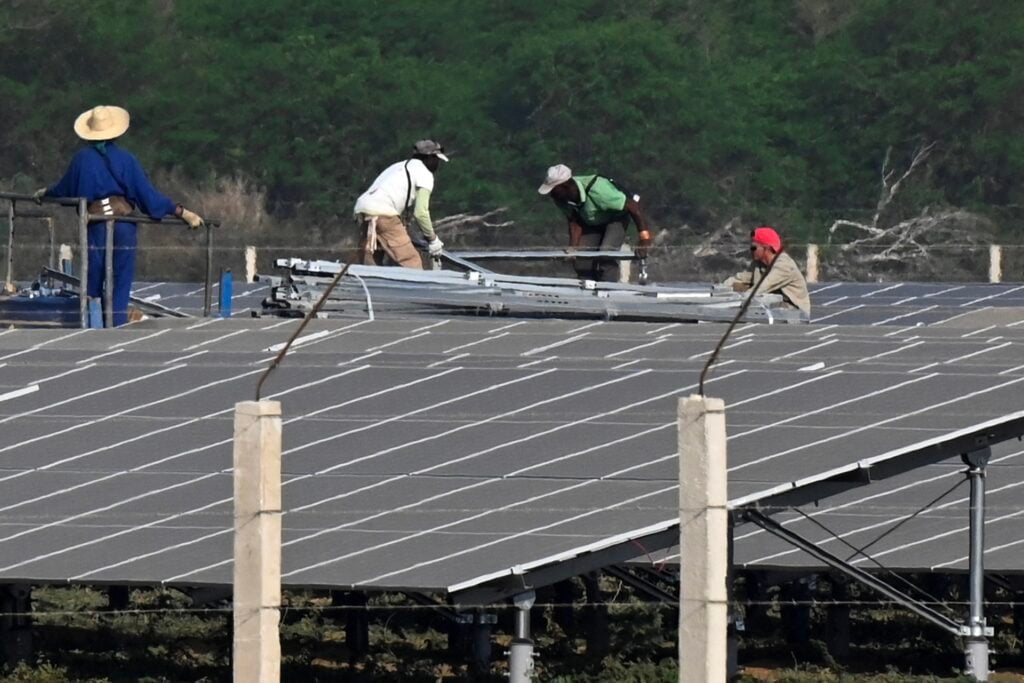

As blackouts continue to cripple Cuba and fuel growing public discontent, China is leveraging the island’s worst energy crisis in decades to deepen its dependence on Chinese-made solar technology. By supplying photovoltaic panels, inverters, specialized equipment, and technical assistance, Beijing is establishing an increasingly important position in a sector critical to restoring Cuba’s electrical system while expanding its strategic influence in the Caribbean.
Over the past five years, Cuban imports of Chinese photovoltaic panels have increased by more than 1,800 percent, while Beijing has supported the construction of dozens of new solar parks, making Cuba one of the leading showcases of China’s energy expansion in the Caribbean.
“The risk lies in excessive dependence on a single supplier. If China comes to dominate panels, inverters, spare parts, financing, and eventually energy storage, Cuba could replace its dependence on oil with technological and financial dependence on Beijing,” Cuban economist Ricardo Torres, a visiting scholar at American University in Washington, told Diálogo.
China, which controls nearly 80 percent of the global solar supply chain, has found a dual benefit in Cuba: absorbing part of its industrial overcapacity while strengthening its technological presence on the island. The impact of this technology on Cuba’s energy crisis, however, remains limited because the country’s aging power grid is unable to efficiently integrate the new generating capacity.
Beijing’s strategy
According to research organization Ember, China has cemented its role as Cuba’s leading partner in renewable energy development. In recent years, solar panel supplies have grown from $16.6 million in 2019 to $117 million in 2025, while at least 34 solar parks now operating across the island, built with Chinese technology, have reached a combined capacity of nearly 1.2 gigawatts — a 350 percent increase over 2024. In addition to commercial sales, Beijing has expanded its support by donating thousands of photovoltaic systems for isolated communities and equipment to boost solar power generation.
Despite these figures, solar energy still accounts for only about 9 percent of Cuba’s electricity generation. According to Torres, “solar energy is useful during the day, but it does not meet demand during the evening peak hours. In Cuba, another limitation to expanding solar power is the absence of Battery Energy Storage Systems (BESS).” He added that “without storage, and with a weak grid, the installed capacity cannot be fully utilized because the system is not prepared to reliably integrate an intermittent energy source such as solar.”
Moreover, the impact of China’s strategy on Cuba’s energy crisis appears limited and far removed from the everyday needs of the population. As Diario de Cuba reported, the least expensive residential solar panel available on the island costs roughly 100 times the official minimum monthly salary, making it unaffordable for most Cubans.
Behind the rhetoric of cooperation, economic dynamics have emerged that primarily benefit Beijing. Aside from a joint venture between China’s Shanghai Electric and a British company involving a $60 million investment in the Mariel Solar Park, “the use of Chinese technology does not stem from investments by Chinese companies. China acts as a supplier, and the Cuban side must pay for the equipment and technical assistance,” Torres said. Cuban Prime Minister Manuel Marrero Cruz has acknowledged that part of the Chinese equipment was paid for with nickel produced on the island.
The requirement to compensate for energy technology with critical minerals underscores the highly asymmetric nature of Sino-Cuban cooperation. Nickel is a strategic resource used in batteries, electric vehicles, and advanced technologies — industries in which China seeks to strengthen its global dominance. Not coincidentally, Beijing is already the leading buyer of Cuban nickel. In practice, by selling photovoltaic technology, China gains privileged access to a critical raw material while offloading part of its photovoltaic manufacturing overcapacity, turning Cuba’s energy dependence into another instrument of economic influence.
An aging power grid
Cuba’s energy crisis continues to worsen because of structural problems that extend far beyond the shortage of generating capacity that China is attempting to address through its technology.
“It is necessary to modernize transmission and distribution systems, substations, control systems, and energy storage. Without batteries and a stronger grid, the expansion of solar power will have only a limited impact,” Torres said.
According to the expert, Cuba must confront the broader deterioration of its energy system: aging thermoelectric plants, weakened distributed generation, fuel shortages, high transmission losses, voltage instability, and a limited ability to integrate renewable energy. Power disruptions in recent weeks clearly illustrate these vulnerabilities. The Felton thermoelectric plant, in the northeastern province of Holguín, was forced to suspend operations because of a malfunction in its automatic water pump system. Almost simultaneously, the Antonio Guiteras Thermoelectric Plant in Matanzas province — one of the country’s principal sources of electricity — also went offline. Located about 100 kilometers east of Havana, the plant is essential to the stability of Cuba’s national grid and has experienced multiple outages throughout 2026.
“Cuba must quickly restore its energy capacity by repairing thermoelectric plants, replacing spare parts, restoring distributed generation, and guaranteeing fuel supplies,” Torres said.
The urgent need to address the energy crisis, however, could come at a strategic cost. China’s expanding role in Cuba’s electricity sector is increasing the island’s dependence on technologies, software, electronic components, and maintenance services controlled by Beijing. In recent years, investigations have identified undocumented communication modules and unspecified remote data transmission capabilities in some Chinese-manufactured energy equipment, raising concerns about cybersecurity risks and the potential dual-use nature of these systems.
In this context, experts say China’s expansion into Cuba’s energy sector goes well beyond economic cooperation. Beijing is establishing an increasingly important position in the development of Cuba’s solar infrastructure, a critical component of restoring the country’s electrical system.
“For Cuba, the greatest risk is negotiating from a position of bankruptcy and extreme necessity,” Torres said, warning that China’s growing involvement could make the energy sector another venue for expanding Beijing’s strategic influence in the Caribbean.