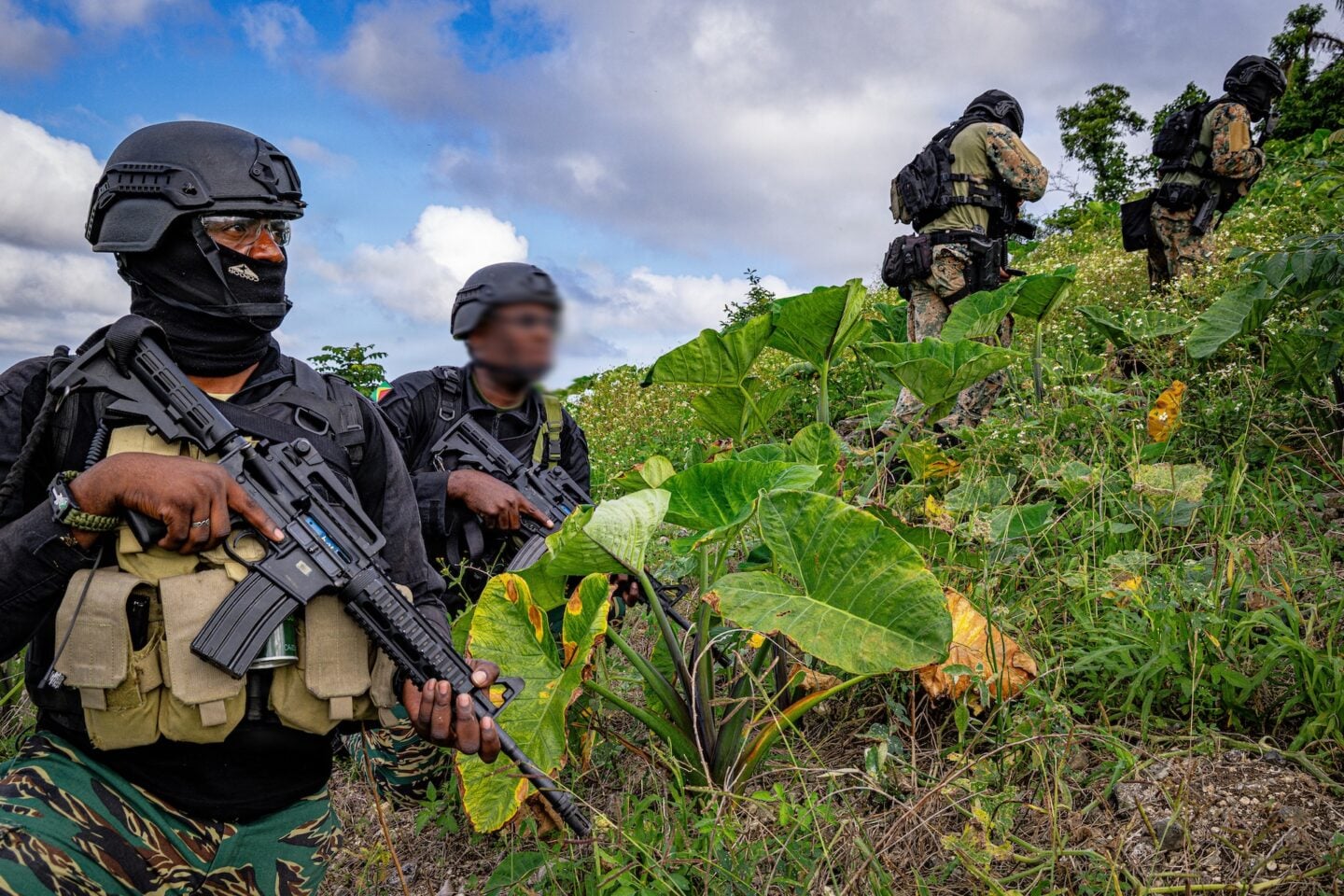

Criminal networks operating between South America and the Caribbean exploit maritime routes, financial systems, and digital spaces that span national borders. To counter these threats, Guyana and Jamaica are deepening defense and security cooperation to expand information sharing and strengthen their ability to counter transnational crime across the region.
This cooperation gained new momentum with the defense and security agreement signed during Jamaican Prime Minister Andrew Holness’s visit to Georgetown on June 25-26, 2026. The agreement establishes a framework for intelligence sharing, cybersecurity, defense training, capacity building, and strategic dialogue. It also encompasses the protection of financial systems and critical infrastructure.
Complementary capabilities
Bilateral cooperation allows both countries to exchange expertise in addressing different security challenges linked by transnational criminal networks across the Caribbean.
“There is an emerging criminal economy that affects both countries in this Caribbean basin, and this cooperation helps impose what U.S. Marine Corps General Francis Donovan, commander of U.S. Southern Command (SOUTHCOM), calls friction on these groups,” Dr. Evan Ellis, research professor of Latin American Studies at the U.S. Army War College Strategic Studies Institute, told Diálogo.
The agreement, he added, supports SOUTHCOM and the region “in acting not only against drug trafficking flows, but also against criminal and even terrorist organizations.”
Jamaica brings decades of experience confronting gang violence and using intelligence to support security operations. Between January 1 and August 22, 2026, police recorded 349 murders, 20 percent fewer than during the same period in 2025. Police Commissioner Kevin Blake attributed the recent progress to disciplined police work, better intelligence, and stronger partnerships, while urging that operations continue to be conducted within the law.
“Jamaica has good, although imperfect, experience deploying the armed forces in neighborhoods through its Zones of Special Operations [ZOSOs],” Ellis said. “There are opportunities to share not only intelligence but also lessons on the role of the armed forces in supporting the police.”
Those experiences offer lessons on how to integrate intelligence, planning, and military support into operations led by civilian authorities, while respecting the roles and legal frameworks of each institution.
Criminal routes and networks
Guyana brings a different operational environment. Its location on the northern coast of South America, extensive waterways, and access to the Atlantic place it along routes connecting the South American continent with the Caribbean and transatlantic markets. Its security forces have also expanded regional and international cooperation to strengthen maritime surveillance, information sharing, and the response to transnational organized crime.
The criminal landscapes in the two countries are not identical. “Guyana does not have as many gang problems as Jamaica, and the groups are a little different,” Ellis said. “In Jamaica, international ties have more to do with Colombian and Mexican groups, while in Guyana, Europeans and Brazilians also play a role, such as the PCC [First Capital Command] and Red Command, which maintain a small presence of representatives to facilitate drug flows to Europe.”
Those differences reinforce the value of intelligence sharing: Information collected on individuals, vessels, routes, communications, or financial movements in one jurisdiction can help identify other parts of the same network elsewhere.
The financial component is equally important because criminal organizations need to move and conceal the proceeds generated by illicit trafficking. By including financial systems among the security areas requiring protection, cooperation between Guyana and Jamaica provides another avenue for linking operational intelligence with investigations targeting the structures that sustain transnational trafficking.
Regional security architecture
Bilateral cooperation is part of a Caribbean security architecture that already enables shared information to be translated into coordinated operations. One example is Operation Eclipse, an intelligence-led maritime operation coordinated by the Caribbean Community Implementation Agency for Crime and Security (CARICOM IMPACS) in May 2026.
The operation brought together forces from 14 CARICOM member states, seven associate members, and international partners. Working from a central fusion cell at CARICOM IMPACS’ Joint Regional Communications Centre, authorities generated 82 active intelligence cases, monitored 59 vessels of interest, and carried out 24 successful seizure operations.
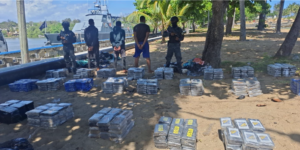
Authorities seized more than 5.2 metric tons of cocaine, 1.8 metric tons of marijuana, weapons, vessels, and other illicit goods. CARICOM IMPACS estimated the total value of the illicit assets and contraband seized at $54.5 million. The operation was supported by the U.S. Department of State’s Bureau of International Narcotics and Law Enforcement Affairs (INL).
Operation Eclipse demonstrated the operational value of connecting national capabilities through regional mechanisms: Intelligence gathered by different countries can contribute to a common threat picture, guide vessel tracking, and support interdiction operations across jurisdictions.
Cooperation with the United States
Guyana and Jamaica also have bilateral mechanisms with the United States that strengthen their capabilities and expand regional defense and security cooperation.
In August, the Guyana Defence Force and the U.S. Department of State signed a memorandum establishing a framework for assigning liaison officers between the Guyanese force and SOUTHCOM in support of Joint Interagency Task Force South (JIATF-S). The mechanism seeks to facilitate closer coordination and communication and strengthen bilateral defense and security cooperation.
Jamaica, meanwhile, signed a Status of Forces Agreement (SOFA) with the United States that establishes the conditions for the temporary presence of U.S. military personnel during mutually agreed activities, including training exercises and joint operations. The agreement also provides a framework for deepening cooperation in regional security, defense, and disaster response.
Other mechanisms expand information sharing. In July, CARICOM IMPACS and the U.S. Department of Homeland Security signed an agreement establishing a framework for the secure exchange of biometric and biographical data to strengthen identity verification, risk assessment, border security, and criminal investigations.
Training reinforces these efforts. Through the Border Security Operational Law Enforcement Training (BOLT) project, supported by the INL, the World Customs Organization trained more than 1,500 customs officers across the Caribbean. Guyana and Jamaica received country-specific training to strengthen capabilities in intelligence-led targeting, risk management, X-ray image analysis, and real-time information sharing.
A connected security network
The agreement between Guyana and Jamaica adds a bilateral link to a cooperation network that already connects military forces, law enforcement agencies, customs authorities, border agencies, and regional intelligence centers. For both countries, this architecture enables them to leverage different capabilities against threats that use the same maritime, financial, and digital routes to cross jurisdictions.
Operation Eclipse offers an example of the reach of this model: Information shared among countries and international partners translated into vessel tracking, intelligence cases, and coordinated interdictions. By deepening their own channels for information sharing, training, and planning, Guyana and Jamaica are strengthening the region’s capacity to detect criminal networks, connect information across jurisdictions, and act against them beyond individual seizures.