
The Port of Chancay has become one of the most visible examples of the growing role of Chinese state-owned enterprises in Latin America’s strategic infrastructure. But while COSCO Shipping Ports operates one of the largest logistics hubs on South America’s Pacific coast, Peru has made clear that foreign investment does not diminish the state’s authority over critical infrastructure.
That authority is at the center of a dispute between COSCO and Peru’s Supervisory Agency for Investment in Public Transport Infrastructure (OSITRAN). In July, the Superior Court of Justice of Lima overturned a lower court ruling that had restricted the regulator’s authority and dismissed the Chinese company’s constitutional claim.
The ruling established that Chancay constitutes public-use transportation infrastructure. Although privately owned, the operator is subject to the regulatory, supervisory, oversight, and enforcement powers granted to OSITRAN by law. The ruling overturned a January 2026 decision that had ordered the agency to refrain from exercising its authority over the terminal.
OSITRAN President Verónica Zambrano clarified that the agency is not seeking comprehensive oversight of the port, but rather to exercise the powers assigned to it under Peruvian law, including “tariffs, dispute resolution, regulatory contributions, and obligations to users.”
COSCO continued to challenge the decision. On July 24, the Second Constitutional Chamber granted the company’s appeal and referred the case to the Constitutional Court.
Beyond the legal proceedings, the case brings a broader issue into focus: how Latin American states preserve sovereign control over strategic infrastructure as Chinese companies, including major state-owned enterprises, expand their presence in ports and other critical sectors across the region.
State authority over Chinese-operated infrastructure
Evan Ellis, research professor of Latin American studies at the Strategic Studies Institute of the U.S. Army War College, believes the case exposes a deeper problem. “The problem is not COSCO’s ability to challenge the port authority, but rather its ability, at least initially, to obtain a ruling that excluded the Peruvian state’s ability to provide the necessary oversight of port operations,” he told Diálogo.
State oversight at Chancay does not depend on a single institution. While OSITRAN exercises the regulatory powers assigned to it by law, other Peruvian agencies retain responsibilities for port security, customs enforcement, counternarcotics, and other sovereign functions within the terminal.
The National Port Authority, the Peruvian Navy’s Directorate General of Captaincies and Coast Guard, the National Superintendency of Customs and Tax Administration (SUNAT), the National Police’s Counternarcotics Directorate, and other agencies maintain a presence and retain oversight and enforcement authority at Chancay.
Peru has also strengthened its own ability to inspect cargo passing through the terminal. In June, SUNAT put into operation two high-tech container scanners donated by the United States. The equipment enables authorities to inspect cargo without physically opening containers and is intended to strengthen supply chain security and customs enforcement.
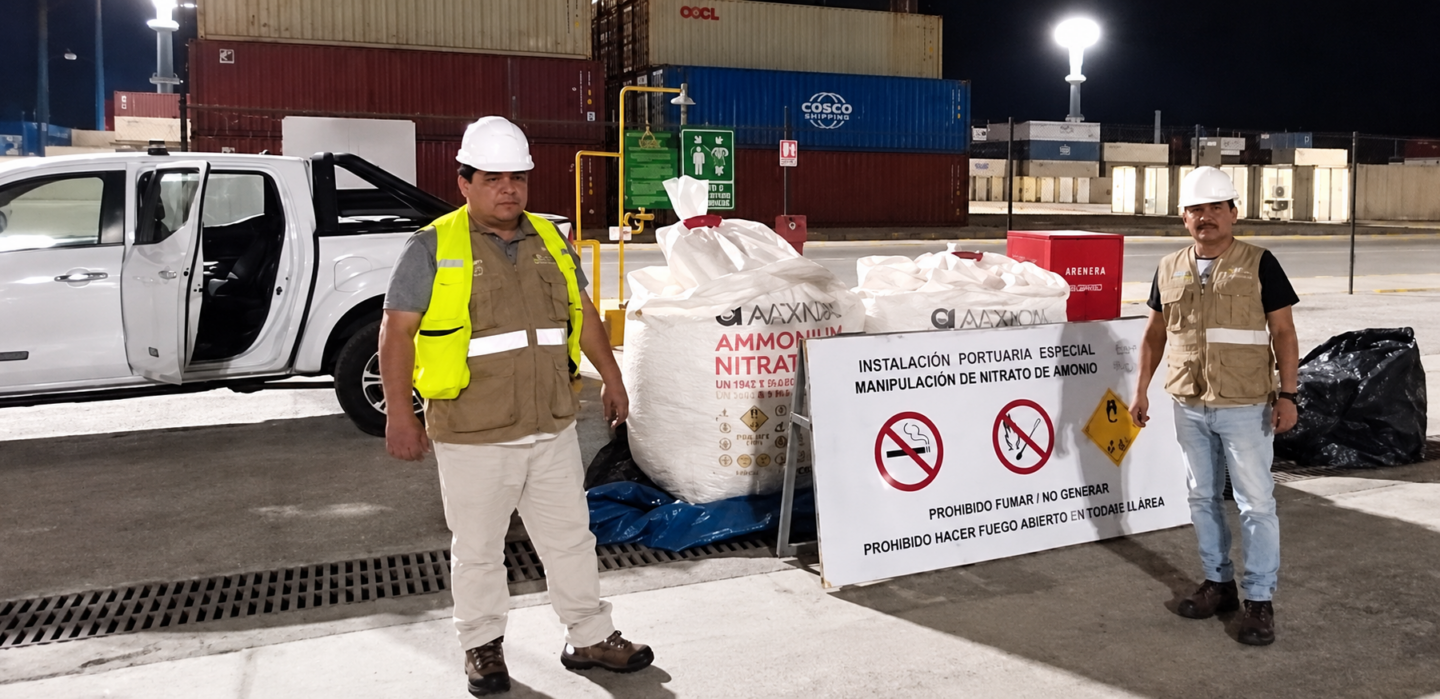
The importance of maintaining those capabilities became evident on August 15, when SUNAT and the National Superintendency for the Control of Security Services, Firearms, Ammunition, and Explosives for Civilian Use seized 2.5 metric tons of ammonium nitrate from Russia at Chancay. The controlled substance can be used to manufacture explosives, and authorities opened investigations to determine its logistics trail and final destination.
The Organisation for Economic Co-operation and Development (OECD) has highlighted the importance of having independent regulators capable of enforcing the rules. In its 2026 review of Peru’s regulatory policy, the OECD said OSITRAN and the country’s other economic regulators have governance structures aligned with the organization’s principles, while identifying greater autonomy, data-driven enforcement, and institutional coordination as priorities.
Former Foreign Minister Miguel Ángel Rodríguez Mackay backed state oversight in comments reported by Infobae on August 21. He said foreign companies must comply with national laws. “China should immediately weigh this situation and not resort to these legalistic maneuvers,” he said.
Ellis warned that effective oversight requires “institutional capacity to conduct a technical evaluation of the contract,” as well as transparency and a relative absence of corruption. “Chinese companies frequently take advantage of contractual complexity and personal benefits that can lead to corruption to secure advantages,” he said.
Panama and Chile reflect a shift in response to China’s advance
Chancay is not an isolated case. Across Latin America, governments and state institutions have reviewed agreements, tightened controls, or reversed decisions related to China’s growing presence in strategic infrastructure. Although each case involves different legal circumstances, Panama and Chile illustrate how countries in the region are subjecting that presence to greater scrutiny when sovereignty, security, and control of critical assets are at stake.
In January 2026, Panama’s Supreme Court declared unconstitutional the law approving the concession contract for the ports of Balboa and Cristóbal, along with its amendments and extensions. Both terminals, located at opposite ends of the Panama Canal, were operated by Panama Ports Company, a subsidiary of Hong Kong-based conglomerate CK Hutchison. The court concluded that the agreement violated constitutional provisions, while analysts interpreted the decision as a setback for Chinese influence over strategic infrastructure in the hemisphere.
The decision did not remain solely a judicial matter. The Panama Maritime Authority began implementing the ruling and working to ensure the continuity of port operations under state control. In March, the authority said the ruling was final and binding and rejected challenges from Panama Ports Company and Hutchison concerning the transition.
Chile faced another controversy involving China and critical infrastructure that same year. In January, the Chilean government approved a concession allowing China Mobile to install, operate, and manage a fiber-optic submarine cable between Hong Kong and Concón, in the Valparaíso region. Two days later, the government revoked the concession amid concerns about security risks associated with the project.
The cases differ, but they point to increased regional scrutiny of the conditions under which China-linked actors gain access to and operate strategic infrastructure. Ports, telecommunications, and other critical networks are not merely commercial assets: They also concentrate information, technology, logistics chains, and capabilities essential to the functioning and security of states.
That scrutiny becomes increasingly important as Chinese state-owned enterprises expand their presence in strategic sectors. Analyses by the Center for Strategic and International Studies (CSIS) have identified Chancay and ports near the Panama Canal among the key areas of concern surrounding China’s port expansion in the region and have warned of the growing role of Chinese state-owned enterprises in acquiring and operating terminals.
Transparency and institutional capacity
Chancay’s ongoing operations pose risks different from those associated with its construction. Ellis said physical control of a port can provide “enormous leverage and the potential ability to collect information,” which “creates serious and ongoing risks.” He also warned that once a company is established, “it becomes much more difficult to pressure it to leave.”
In response to those risks, Ellis identified three areas that Peru and other Latin American governments need to strengthen: transparency, institutional capacity, and a relative absence of corruption. These capabilities enable governments to rigorously evaluate contracts, enforce national laws, and preserve room to maneuver as Chinese companies expand their presence in strategic sectors.
Ellis also stressed the importance of keeping options open and having “a range of different partners to make effective sovereign decisions.” Governments, he said, should look beyond financial returns and seek “the greatest prospect for the long-term health, sovereignty, and well-being of the state signing that agreement.”
The Chancay case shows that a state’s ability to limit the influence a Chinese state-owned enterprise can exert through strategic infrastructure does not end when construction is completed or commercial operations begin. It requires national authorities with clearly defined powers, access to the terminal, independent inspection capabilities, and effective mechanisms to enforce national laws.
Chancay, together with the decisions taken in Panama and increased scrutiny of China-linked digital infrastructure in Chile, reflects a regional trend toward tighter controls over Chinese participation in critical sectors. These cases illustrate the tools states have to protect their autonomy: effective regulation, contractual transparency, independent inspection and security capabilities, and diversification of partners.
Peru’s experience offers a broader lesson for the region: Investment by a Chinese state-owned enterprise in strategic infrastructure does not eliminate the host country’s authority over that asset. Maintaining institutions capable of enforcing national rules and preserving independent oversight and security capabilities enables states to retain sovereign control over infrastructure essential to their economic and strategic interests.