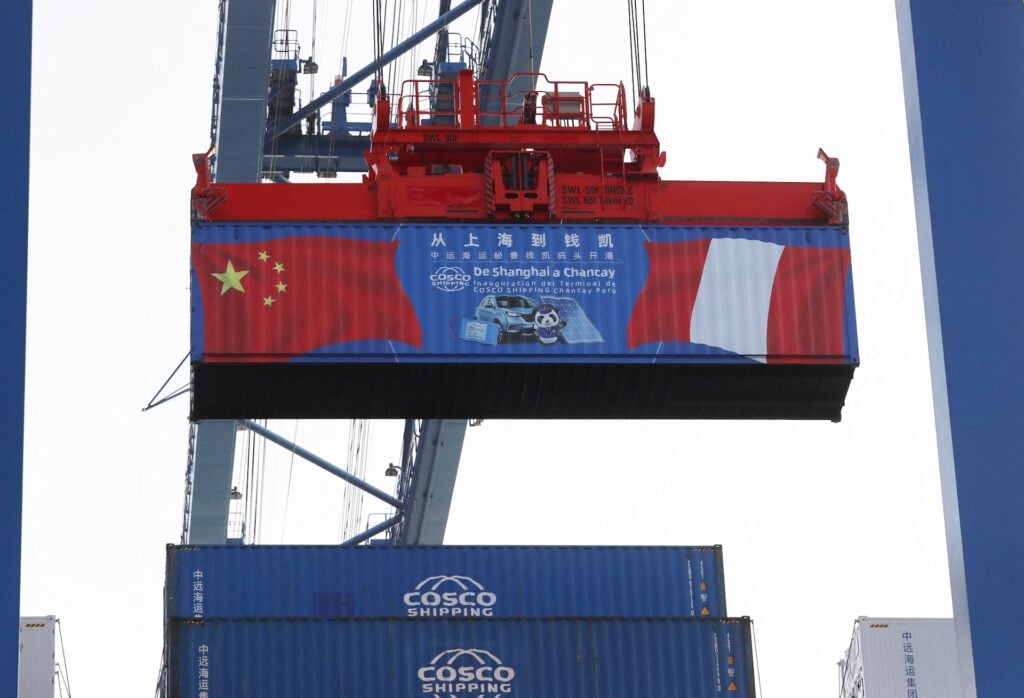

A debate persists in Peru over the regulation of service fees at the newly operational Chancay Multipurpose Port Terminal (TPMC), backed by Chinese investment. Chinese operator COSCO Shipping is resisting government efforts to control pricing, while Peruvian regulators cite the need to ensure fair rates in a market they deem insufficiently competitive.
Conflict over tariff regulation
The dispute began after the Peruvian consumer protection agency’s (Indecopi) Free Competition Commission concluded in a report that the Chinese business model does not guarantee effective competition in port services. Indecopi’s warning came following a request from Peru’s transport infrastructure regulator, Ositrán, to assess whether the port should be subject to a regulated tariff regime.
The National Port Authority has until July 24 to propose a tariff system for the Port of Chancay to Ositrán. The agency will then have 90 days to finalize and publish the pricing structure for the port’s services.
Differences with the Port of Callao
In its initial operational phase, the Chancay Port Terminal is operating with significantly lower rates compared to the Port of Callao, where prices are regulated by Ositrán. According to Forbes, this difference raises concerns about possible unfair competition practices.
“In these infrastructure projects that directly promote China’s economic and security objectives in the hemisphere, China’s goal is not to generate goodwill with the recipient countries,” Henry Ziemer, associate researcher for the Americas Program at the Center for Strategic and International Studies (CSIS), told Diálogo. “The Chinese Communist Party (CCP) believes that control or influence over a specific project adds value to its overall economic and political agenda.”
Economic and trade tensions
The dispute is also being viewed through the lens of global economic power dynamics or as a facet of a global “trade war,” where China seeks to advance its economic strategy, while facing some erosion of its influence in various key markets. According to Infobae, Peru’s approach to the control of the Port of Chancay reflects these broader tensions.
“This means that the incentives [for the works] are not necessarily aligned between Beijing and the recipient countries,” added Ziemer. “When these countries take measures that China considers detrimental to its interests, such as the regulation of the Port of Chancay, the CCP tends to respond drastically.”
Lack of transparency and its implications
Despite Indecopi’s findings, COSCO Shipping is reluctant to share key information about its business model, which could hamper Ositrán’s technical work.
“It would be a big problem in terms of setting a tariff, because symmetry of information is key for the regulator to be able to make a projection,” Verónica Zambrano, president of Ositrán, told Peruvian daily Gestión. “So, we are concerned that we may not have enough information for that.”
In addition, the port’s development faces logistical challenges, such as the lack of connectivity with Lima and Callao, as well as the absence of an urban development plan for Chancay. According to Mundo Marítimo, these shortcomings are holding back the development of more than 7,000 hectares of land with industrial potential and discouraging further investment.
International concerns
The potential lack of competition identified by the Peruvian authorities suggests that establishing a defined tariff regime seems inevitable.
“Only in this way can a single company be prevented from imposing its conditions without transparency or willingness to open up the game,” Omar Narrea, a researcher at the Center for China and Asia-Pacific Studies at Lima’s Universidad del Pacífico, told Diario Correo.
Beyond the economic argument, the regulatory debate over the Port of Chancay has triggered international worries about three possible scenarios: The port becoming a platform for surveillance and espionage against other nations’ companies, COSCO Shipping altering logistics routes to benefit China’s strategic interests and destabilize regional trade, and fears of potential Chinese military projection through the port in a conflict.
The Port of Chancay dispute underscores the clash between the Chinese business model and Peruvian regulations, placing the significant economic and geopolitical interests tied to this crucial infrastructure at the forefront. The outcome will be shaped by decisions of Peruvian authorities and the reactions of COSCO Shipping and China in this complex scenario.