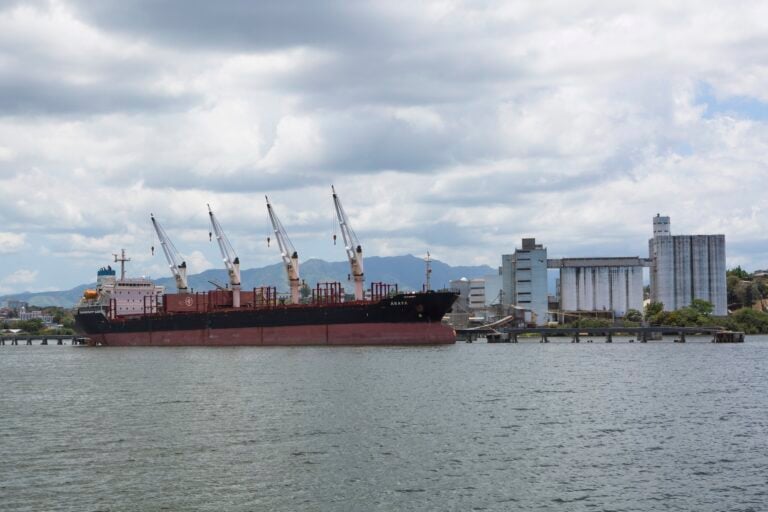


In a recent report, the Center for Strategic and International Studies (CSIS) warns about China’s progress in construction, operation, or financing of ports in Latin America and the Caribbean and their more complex array of security risks than previously understood. The study, No Safe Harbor, identifies at least 37 projects in 15 countries, a notable increase over the previous decade, with the involvement of companies controlled by the Chinese Communist Party (CCP).
According to CSIS, while these investments are presented as commercial development initiatives, the Chinese-controlled infrastructures have a dual-use potential that pose a spectrum of risks to regional security. Some ports are reportedly planned to function as naval and commercial monitoring, intelligence gathering, or logistical support in the event of conflict.
Among the cases highlighted in the report are the port of Chancay in Peru, operated by COSCO Shipping Ports, which has close ties to the CCP; the Mexican ports of Manzanillo and Veracruz; and Kingston, Jamaica, a key hub in the Caribbean.
While Beijing has established naval bases in Djibouti and Cambodia following civilian investments, the risk in Latin America is more indirect. The CSIS warns that control over strategic ports allows for the collection of logistical data, operational advantages, and the ability to limit, delay, or block the use of these facilities in a potential crisis.
The spectrum of strategic risks
The CSIC report details a range of threats that extend beyond traditional military concerns.
– Covert deployment: The report warns that civilian infrastructure can facilitate covert operations, a dynamic that is of growing concern. China is developing cruise missile launch systems hidden in containers, which poses risks if they are introduced undetected through ports under its control. British newspaper The Sun reported that China has designed “Trojan Horses” missiles camouflaged in shipping containers that can be launched from enemy ports, allowing weapons to be hidden within international commercial traffic.
Federico Rabino, an expert in international relations and director of the Fernando de la Mora Institute in Paraguay, explained that this “dynamic resembles a cold war where attacks are no longer conventional, but targeted at strategic infrastructure that defines the capacity of one state against another.” These missiles, Rabino added, serve as deterrents. “China seeks to demonstrate military power in the face of potential disputes.”
– A pillar for port expansion: China’s presence in Latin American ports is part of its Belt and Road Initiative (BRI), which seeks to consolidate a new “Maritime Silk Road.” According to news site Defense Info, Beijing seeks to establish a global infrastructure network that will consolidate its position in maritime trade through billions of dollars in investments.
For Rabino, “all of China’s actions, whether through loans, projects, or initiatives linked to the BRI, seek to increase its geopolitical influence […] and create dual nodes with commercial, technological, and potential military capabilities.” Cases such as the mega-port of Chancay in Peru, and the purchase of assets at strategic points such as the Panama Canal, reflect this pattern.
Institutional vulnerabilities: Rabino warned that companies such as COSCO, China Merchants, and ZPMC, are required by China’s National Intelligence Law to collaborate with the CCP on tasks such as collecting metadata on naval traffic or sensitive cargo. “This transcends commercial interests and raises regional security implications. Unlike Western companies, Chinese firms operating abroad directly or indirectly represent the interests of the Beijing regime,” Rabino pointed out. “This difference is key to understanding their role in current port projects.”
The lack of independent oversight in Chancay also entails risks associated with illicit trade and corrupt practices, with reports of port facilities linked to the CCP being used as routes for cocaine smuggling. The Andrés Bello Foundation also notes concerns about the use of Chinese cranes, which could facilitate the covert collection of information on commercial movements. According to European media platform Modern Diplomacy, China is advancing in its indirect control of ocean routes through civilian ports and opaque agreements, which would allow it to deploy military forces under commercial cover without openly declaring it.
– Port concentration: Of the 10 ports operated by Chinese companies in the region, seven are under the administration of Hutchison, a Hong Kong investment company that controls strategic terminals in Balboa and Cristobal, Panama. The CSIS report suggests “close coordination between Hutchison and Chinese strategic interests.”
In 2025, Hutchison announced the sale of 43 ports, including seven in Latin America, to a consortium led by BlackRock. However, this deal valued at $23 billion, is subject to a review in China. According to Rabino, “among these terminals, Balboa and Cristóbal are key. Their strategic location explains Beijing’s delay in approving the operation, as it seeks to retain influence over maritime traffic and the countries where it operates.” Reports indicate that another CCP company, identified as COSCO, has now emerged as a potential strategic investor in the deal.
Mitigation strategies
While international partners are exploring ways to reduce risks, countries in the region can also implement their own strategies to mitigate the threats associated with Chinese-controlled ports, focusing on strengthening national resilience and enhancing regional security cooperation.
Looking ahead, Rabino believes that “China’s influence will not diminish, as it has not yet consolidated its position in the region and remains committed to expanding it.”