The Caribbean Sea’s growing role in cocaine trafficking routes oused by transnational criminal organizations highlights the need to move beyond isolated national responses toward a multinational strategy that integrates military, air and maritime, intelligence, and law enforcement capabilities.
The challenge is compounded by persistently high levels of coca cultivation in Colombia. According to the United Nations Office on Drugs and Crime (UNODC), 261,000 hectares were under cultivation in 2024, a 3.5 percent increase from the previous year.
The growth in coca cultivation coincides with the continued adaptation of criminal organizations, which diversify their routes and transportation methods to evade controls. As a result, the Caribbean remains an important drug trafficking corridor to Europe and the United States, as well as a key area for detection and interdiction. Maritime domain awareness and surveillance are therefore essential components of the counterdrug response, making cooperation among countries indispensable for sharing intelligence, coordinating capabilities, and conducting joint operations across jurisdictions.
“No navy, on its own, can simultaneously cover the source, transit, destination, and money laundering areas that make up this threat. Multinational cooperation is therefore a response to the very nature of the phenomenon,” the Colombian Navy told Diálogo.
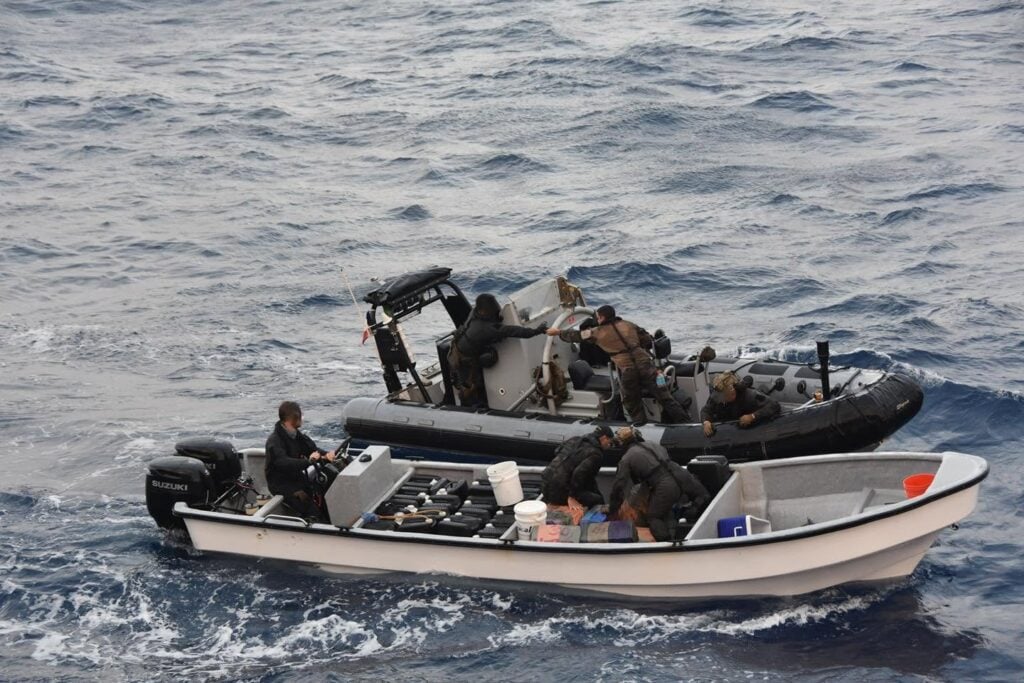
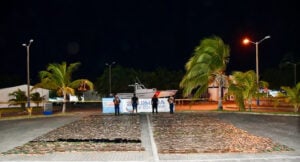
Recent operations in the Colombian Caribbean demonstrate how shared intelligence can translate into effective interdiction operations. On June 12, coordination among the Colombian Navy, the Colombian Aerospace Force, and Joint Interagency Task Force South (JIATF-S) led to the interception of two go-fast vessels bound for Central America, the seizure of 5,439 kilograms of cocaine, and the arrest of seven individuals, dealing an estimated blow of more than $250 million to criminal organizations.
The architecture of regional cooperation
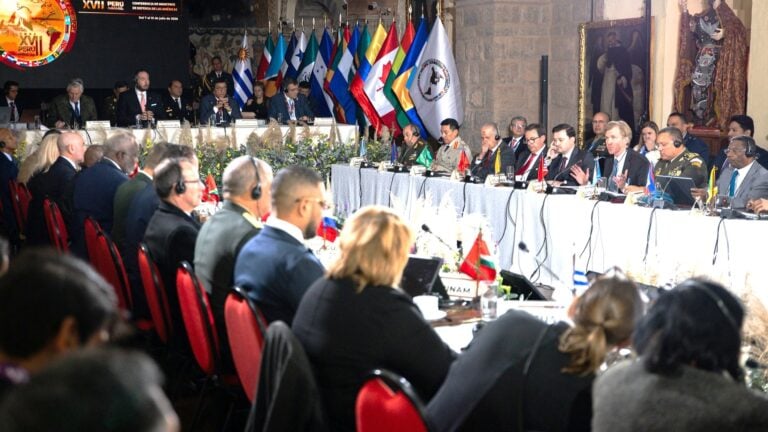
International cooperation was further strengthened with Colombia’s accession to the Americas Counter-Cartel Coalition, announced in August. During the Coalition meeting in Panama, U.S. Secretary of War Pete Hegseth also announced that Colombia’s new government had requested joint military operations with the United States against drug trafficking networks.
This new dimension builds on well-established operational cooperation based on bilateral agreements with the United States, France, Honduras, the Dominican Republic, Costa Rica, Mexico, and Panama. At the multilateral level, the Orion Multinational Strategy, created in 2018, now encompasses 62 countries, 127 institutions, and 10 multilateral organizations. This framework is complemented by interagency mechanisms with the United States, including JIATF-S, which integrates military, intelligence, and law enforcement capabilities.
These different mechanisms share a common operational principle: connecting partner capabilities throughout the entire interdiction cycle, from intelligence collection and fusion to surveillance, pursuit, and boarding, followed by judicial action against criminal networks.
Operation Tucán Royal, carried out in June 2026 by the Colombian Navy alongside the French Armed Forces in the Antilles, illustrates the value of this cooperation. The operation led to the seizure of 649 kg of cocaine bound for Central America, highlighting how intelligence sharing and coordinated air and maritime capabilities can produce concrete operational results.
“International partners perform distinct and complementary roles: They provide long-range ocean surveillance capabilities, additional naval platforms, maritime patrol aircraft, and intelligence fusion and analysis,” the Colombian Navy said. Combining these capabilities allows Colombian authorities to “close the cycle of detection, tracking, interdiction, and prosecution with an effectiveness that no nation could achieve on its own.”
The advantages of an integrated response
The rationale behind this architecture is that no single country possesses all the capabilities needed to track trafficking that crosses multiple jurisdictions. Intelligence identifies the threat, air and maritime surveillance maintains contact, naval units conduct the interdiction, and police and judicial cooperation allows authorities to move beyond the shipment itself to target the networks that finance and manage it.
According to the Colombian Navy, international cooperation has strengthened “doctrinal interoperability, developed through joint exercises and common publications; [and] real-time intelligence sharing, essential to interdiction operations.” It also helps consolidate the legal frameworks needed to accelerate cooperation among countries.
At the operational level, combining capabilities allows countries to monitor larger areas for longer periods. Naval and air assets from multiple countries can cover areas that would be difficult for a single force to monitor continuously. Coordinating maritime patrol aircraft, ships, helicopters, and rapid-response units also improves the ability to detect and track go-fast vessels and semisubmersibles.
Cooperation also reduces the time between detection and intervention. “Coordination with allied fusion centers shortens the cycle between detection, tracking, and interdiction, a decisive factor when confronting high-speed vessels and semisubmersibles,” the Colombian Navy said. In an environment where traffickers can rapidly change course or transfer their cargo, minimizing the time required to reach and stop a vessel can determine the success of an operation.
Finally, bilateral agreements and shiprider mechanisms, which allow officers from one country to embark aboard another country’s naval vessels, help overcome jurisdictional obstacles and facilitate the continuity of operations when a pursuit or interdiction involves the territorial waters, vessels, or authorities of different states. Maritime boundaries thus become areas for operational coordination among forces rather than barriers to operations.
Disrupting routes to weaken networks
Results through August 2026 demonstrate the effectiveness of this model. The Caribbean Naval Force, one of the Colombian Navy’s main operational commands, has seized 132 metric tons of cocaine hydrochloride and 17 metric tons of marijuana, with 85 percent of the results achieved through operations conducted with partner nations. According to the Colombian Navy, the seizures dealt a blow of more than $3 billion to the international illicit drug market. Authorities also intercepted 53 vessels, arrested 102 individuals, and neutralized three semisubmersibles, particularly disrupting routes used by the Clan del Golfo and transnational networks involved in trafficking drugs to Central America, North America, and Europe.
Among the most significant operations was Anvil, conducted April 30 by the Colombian Navy and the Royal Netherlands Navy. Four go-fast vessels were intercepted, more than 3 metric tons of cocaine and 800 kg of marijuana were seized, dealing an estimated $150 million blow to criminal organizations, and 12 individuals of different nationalities were arrested.
The strategic impact, however, goes beyond the drugs seized. Each vessel taken out of operation represents a logistical loss, a crew removed from the trafficking network, and a route that traffickers must reorganize. In addition, intelligence obtained during interdictions can help identify intermediaries, financiers, suppliers, and recipients, turning a seizure into a starting point for targeting the broader network.
The challenge is compounded by traffickers’ technological evolution. The discovery in 2025 of the first unmanned semisubmersible identified by Colombia in the Caribbean Sea demonstrated the ability of drug trafficking networks to adopt increasingly sophisticated systems to reduce the risk of detection, reinforcing the need to integrate sensors, intelligence, and air and maritime capabilities.
It is precisely the combination of these capabilities that expands countries’ ability to detect, track, and disrupt networks that exploit maritime boundaries and jurisdictional differences, forcing them to assume greater risks and continually adapt their methods.