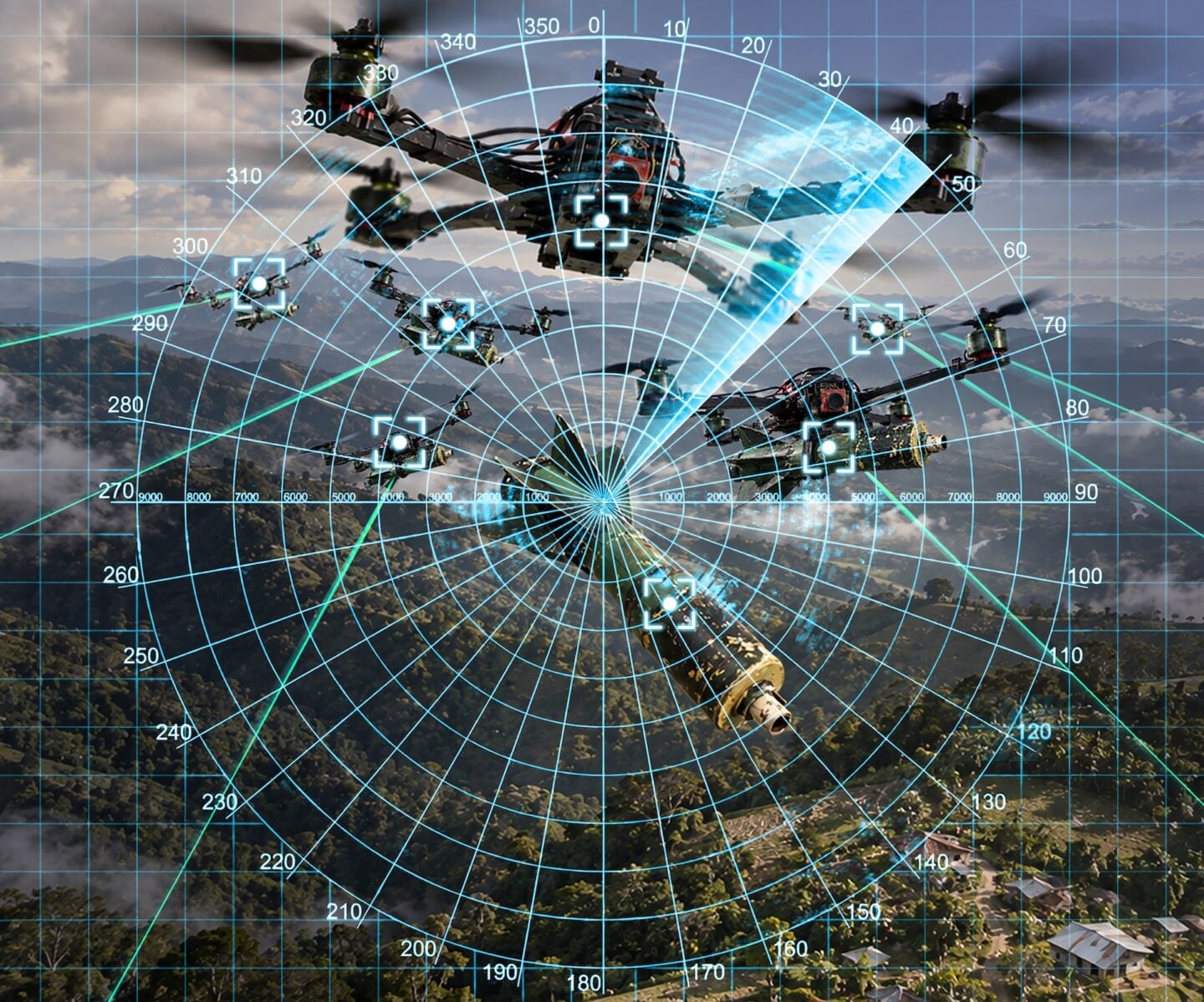

In just a few years, Colombian armed groups have transformed commercial drones originally designed for civilian purposes into weapons platforms, moving from surveillance to remote attacks with explosives, extending their operational reach, and challenging security force defenses. The rapid adoption of kamikaze drones, fiber-optic-controlled systems, and coordinated attacks involving multiple aircraft reflects an evolution that has turned Colombia into a regional laboratory for increasingly sophisticated drone warfare, as similar capabilities spread among armed and criminal groups across Latin American countries.
This evolution presents a challenge that goes beyond the introduction of a new weapon. Criminal and armed groups are adapting low-cost commercial technologies, incorporating knowledge developed in other conflicts, and modifying their tactics at a pace that requires security forces to continually reassess their detection, protection, and interception systems.
“Now, criminals are capable of modifying imported drones and creating new systems such as drone swarms and fiber-optic drones,” Colombian security and geopolitics expert Pablo Uribe Ruan told Diálogo. According to Uribe, “this technological leap has occurred in just a few months. The speed at which criminals acquire knowledge, as well as their ability to create new drone systems, is impressive.”
The National Liberation Army (ELN) and dissident factions of the Revolutionary Armed Forces of Colombia (FARC) began systematically using first-person view (FPV) drones in 2023. By allowing operators to see what the drone sees in real time and adjust its trajectory in flight, FPV technology quickly opened new offensive possibilities. Initially used in rudimentary attacks to drop grenades, FPV drones evolved into increasingly precise attack platforms deployed in coordinated operations.
The evolution also incorporates technologies and tactics developed in Ukraine. According to the Financial Times, individuals linked to Colombian armed groups have traveled to the country, which is at war with Russia, to acquire knowledge related to drone operations — a transfer of expertise that illustrates how quickly tactics developed on one battlefield can reach nonstate actors in another region.
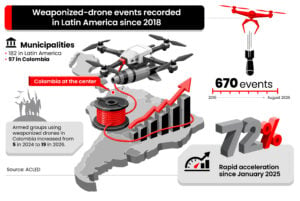
Data compiled by the Armed Conflict Location & Event Data Project (ACLED) show how rapidly the phenomenon is accelerating. Approximately 72 percent of the 670 incidents involving drones used as weapons recorded in Latin America since 2018 occurred between January 2025 and August 2026. Colombia accounts for 97 of the 182 municipalities in the region where ACLED recorded such incidents, making it what the organization describes as the regional epicenter of this expansion. The number of armed groups using drones as weapons in the country rose from five in 2024 to 19 in 2026.
Concentrated primarily in rural areas near coca crops and drug-trafficking corridors, drones are used not only against security forces but also for surveillance, territorial control, and the intimidation of communities. Their increasing availability allows armed groups to combine relatively accessible commercial technology with explosives and technical expertise acquired or shared among organizations.
From Kamikaze drones to fiber optics
Among the factors that experts say have driven this evolution are the geography of the areas where armed groups operate and the rapid spread of new tactics among them. Many of the military bases and police stations targeted are in remote rural areas that are difficult to reach by land. Drones allow armed groups to overcome some of those geographic barriers and attack from greater distances, while innovations introduced by one organization can quickly be observed and replicated by others.
One such innovation is the so-called kamikaze drone, developed from commercial platforms. Unlike drones used to drop a grenade and return, these systems carry explosives integrated into their structure and are designed to strike the target directly.
Colombian authorities identified this configuration following attacks against the José Hilario López military base in Cauca on April 25 and July 17, attributed to the Carlos Patiño Front of the Central General Staff (EMC), a FARC dissident faction led by Néstor Vera, alias Iván Mordisco. In both incidents, security forces intercepted the drones before they reached their targets. Examination of the aircraft showed that rather than dropping grenades, they carried explosives integrated into their structures.
Another technological leap involves fiber-optic-controlled drones. On February 12, the ELN used this technology in an attack against the San Jorge military base in Saravena, Arauca department, wounding two soldiers.
As Uribe explained, “what fundamentally changes with this FPV drone system […] is that it eliminates dependence on radio links and replaces them with a fiber-optic cable that deploys during flight and transmits commands and the video signal.”
The difference has direct consequences for defense. Because the connection between the operator and the aircraft does not depend on a radio-frequency link, conventional electronic jamming systems cannot sever that communication. Security forces must therefore rely on other layers of protection, including radar, electro-optical and infrared sensors, and systems capable of physically intercepting the aircraft.
The adaptation illustrates a recurring dynamic in this new technological competition: A measure designed to counter one generation of drones can lose effectiveness when armed groups modify the navigation, communications, or attack system.
 Multiple attacks and saturating defenses
Innovation is not limited to the aircraft themselves. It also extends to how they are employed. Colombian armed groups have moved from using individual drones to launching coordinated attacks involving multiple aircraft, described by Colombian authorities and media as “swarm” attacks.
In Ocaña, Norte de Santander, on September 4, an attack attributed to the ELN involving at least 16 explosive-laden drones against the Trapiche military base killed three service members. Months earlier, on April 12, in Timba, in the municipality of Jamundí, Valle del Cauca, multiple explosive-laden drones attributed to FARC dissidents simultaneously attacked Colombian troops, wounding two soldiers.
The logic behind these attacks is saturation. Multiple aircraft arriving within a short period and from different directions require security forces to detect and respond to several threats simultaneously. That dynamic creates a cost asymmetry: Relatively inexpensive commercial drones can require considerably more sophisticated detection, electronic warfare, and interception systems.
No single technology provides a complete response. Electronic jamming can be effective against certain radio links but loses that advantage against fiber-optic-guided systems. Radar and electro-optical sensors provide additional layers of protection, while physically intercepting the aircraft requires further capabilities. Attacks involving multiple drones place pressure on all those defenses simultaneously.
The threat, however, is not limited to security forces. “The problem is not only that they are a system used against the security forces, but that organized crime is also deploying drone swarms against civilians in armed-conflict areas, as we have seen in Catatumbo,” Uribe said.
The recruitment of minors adds another dimension. According to a Human Rights Watch (HRW) report, some armed groups are training children to pilot drones equipped with explosives. The practice expands these organizations’ capabilities while incorporating recruited minors into increasingly specialized roles within armed groups.
A multilayered response
Faced with the rapidly evolving threat, Colombia is developing a response that combines operational capabilities, specialized training, counter-drone systems, intelligence, and tighter controls over the importation and circulation of these systems.
Part of that adaptation began before the most recent escalation. In October 2025, the Colombian Army activated the Unmanned Aircraft Battalion (BANOT), a specialized unit designed to consolidate capabilities related to these systems. The unit includes companies dedicated to multirotor and fixed-wing aircraft operations, electronic countermeasures, and maintenance.
Training has also expanded. In April 2026, the Army graduated 105 new unmanned aircraft system operators, strengthening its institutional capacity to employ these technologies in operations and respond to their increasing use by armed groups.
These efforts are complemented by the National Counter-Drone Shield, announced in January 2026, with a planned investment of more than $1.68 billion to strengthen the detection and interception of unmanned aircraft. The program includes different categories of counter-drone systems, including fixed, semi-fixed, mobile, portable, and surface-platform capabilities.
Colombia has also tightened controls on the entry of drones and their components. Since January 2026, new regulations from the National Tax and Customs Directorate (DIAN) require advance declarations for their importation and restrict their entry to El Dorado International Airport in Bogotá and ports under Cartagena customs jurisdiction. The regulations also prohibit their entry through postal shipments and express deliveries.
In August, the Ministry of Defense also introduced legislation to establish a broader framework governing the importation, manufacture, sale, acquisition, registration, use, transportation, monitoring, and control of unmanned aircraft and counter-drone systems. The bill is making its way through the legislative process.
The measures are intended to make it more difficult for armed organizations to exploit a commercial supply chain designed primarily for civilian purposes. The scale of that market illustrates the complexity of the challenge: According to the United Nations Mine Action Service (UNMAS), the number of unmanned aircraft registered in Colombia increased from 55 in 2022 to 7,291 in 2025, while the number of registered pilots rose from 12 to 4,497 during the same period.
A threat that crosses borders
The speed of innovation also makes it difficult to treat the phenomenon as an exclusively Colombian problem. The same characteristics that have facilitated the spread of drones among armed groups within the country — relatively low cost, commercial components, knowledge sharing, and ease of adaptation — also facilitate their spread across borders.
“We have to start from the premise that Colombian organized crime is transnational in every sense of the word: It imports knowledge and goods — drones — from Ukraine, Russia, and Turkey; shares knowledge with its counterparts in Mexico and Eastern Europe; and is increasingly generating technical expertise that allows it to move from being simply an importer of drones to modifying drones that can be exported […] to Ecuador, Venezuela, or Central America,” Uribe said.
ACLED already identifies Ecuador and Brazil as new frontiers in the use of drones by criminal organizations, while Mexico remains another major regional hotspot. Colombia’s experience thus demonstrates how capabilities developed in one context can spread rapidly among organizations and across territories.
International cooperation is also part of the response. Colombia maintains cooperation with the United States in training, development of operational capabilities, interoperability, and the exchange of information and technology. In April, U.S. Southern Command (SOUTHCOM) established the SOUTHCOM Autonomous Warfare Command, a new organization focused on integrating autonomous, semi-autonomous, and unmanned systems and working with regional partners to develop these capabilities.
For Colombia and other countries in the region, however, the technological race goes beyond acquiring new equipment. Colombia’s experience demonstrates that armed groups can identify a vulnerability, acquire commercial technology, adapt knowledge from other conflicts, and modify their tactics within a matter of months.
The response therefore requires a combination of intelligence, training, regulation, information sharing, and defenses capable of adapting to different types of threats. In an environment where an innovation developed in Ukraine can appear shortly afterward in an attack in Colombia and then spread to other organizations across the region, the ability to learn and adapt quickly is becoming an operational advantage as important as the technology itself.