
Peru and the United States are strengthening cooperation against transnational organized crime through a specialized Peruvian National Police (PNP) team that works with the Federal Bureau of Investigation (FBI) to identify and dismantle criminal networks operating across borders.
The Sensitive Special Team against Transnational Organized Crime (EESCCOT) brings together vetted personnel, controlled access to sensitive information, and international cooperation to investigate criminal structures whose members move between countries, transfer illicit proceeds, and use multiple jurisdictions to evade authorities.
A specialized team for transnational investigations
In May 2026, Peru’s Ministry of the Interior approved a cooperation memorandum between the PNP and FBI, which the two institutions signed June 5. The agreement formally established EESCCOT within the Special Group against Organized Crime, part of the PNP’s Criminal Investigation Intelligence Division, to strengthen bilateral cooperation on complex investigations.
The memorandum provides for the exchange of information on matters of mutual interest and the modus operandi of transnational criminal organizations, as well as technical projects, training, capacity building, and the exchange of specialized expertise in criminal intelligence and joint investigations.
Cooperation covers investigations into homicides and other violent crimes, drug trafficking, extortion, firearms offenses, kidnapping, money laundering, corruption, and other crimes linked to transnational organized crime, as well as efforts to locate fugitives.
The FBI provides equipment and liaison personnel to support the team, while selection, vetting, and authorization procedures determine which police officers may access sensitive information and work areas.
Jorge Serrano, a Peruvian political risks and global security consultant and expert in intelligence and national defense, told Diálogo that the mechanism expands authorities’ ability to pursue organizations whose leaders and networks operate across multiple countries.
“The FBI will make it possible to pursue the leaders of these criminal organizations as they move among countries in the Andean region and Latin America,” Serrano said. “It will also help establish cooperation mechanisms with police forces in neighboring countries that are dedicated to combating organized crime.”
Vetting and continuity to protect investigations
Personnel selection is a central component of the mechanism. Officers proposed for the team must undergo background checks and vetting before gaining access to sensitive investigations. The memorandum also establishes a minimum 36-month assignment for team members, a measure designed to maintain continuity in investigations that can span years.
Serrano stressed the importance of having specialized personnel subject to rigorous screening. “They want to build a highly specialized unit here, but one that is also very strictly vetted so that individuals with ties to organized crime or drug trafficking cannot infiltrate it.”
He linked those safeguards to the growing complexity of criminal connections. “The Peruvian National Police has been overwhelmed by the connections that the various criminal organizations have established within Peru and among themselves.”
Serrano said the team’s operational value also lies in its ability to connect domestic investigations with information generated outside the country. “At the operational level, the FBI’s partnership with law enforcement […] will be put into practice through this specialized group.”
From structure to operations
The first operations involving EESCCOT demonstrated how the model can be used against organizations that operate across national jurisdictions.
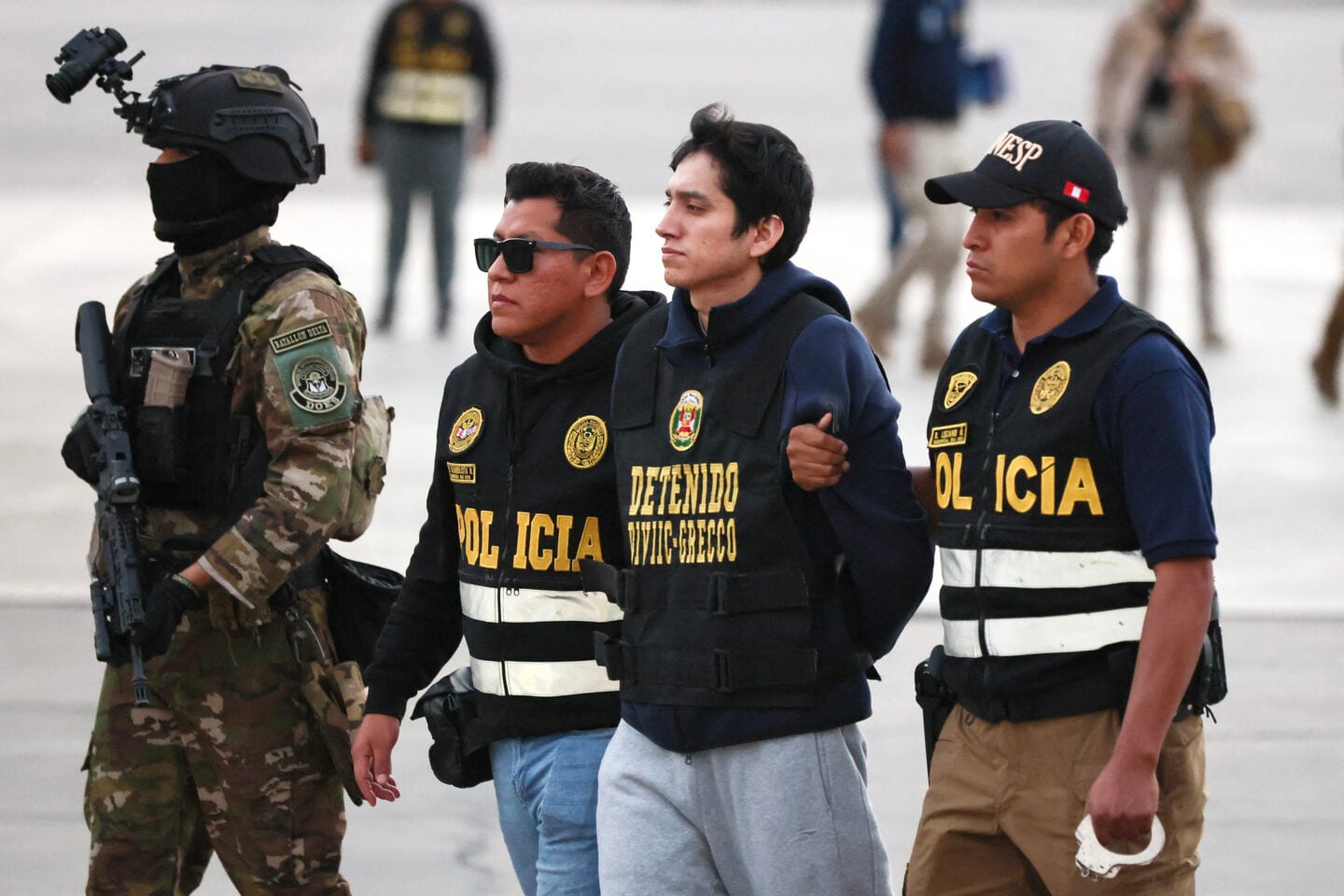
On August 27, 2026, information shared among EESCCOT, the Colombian National Police, and the DEA led authorities to locate and arrest Luis Saúl Pérez Nieto, alias Nairobi, in Bogotá. Authorities identified him as one of the leaders of Tren de Aragua. The operation combined international coordination with specialized investigative techniques.
Two days later, EESCCOT participated in the arrest in Lima of Ibelmery Adon Colina Maldonado, alias R15, who was wanted by Chilean authorities on alleged kidnapping for ransom and receiving stolen property charges. According to Peru’s Ministry of the Interior, the investigation combined the work of the Peruvian team with support from the FBI and Chile’s Special Police Investigations Anti-Kidnapping Brigade.
The operations illustrate a central challenge facing security forces across the region: Criminal organizations can disperse their leaders, resources, communications, and illicit activities across several countries, while investigations remain bound by national jurisdictions.
The bilateral PNP-FBI mechanism also comes amid growing regional coordination against such networks. In August, Peru participated in the second Americas Counter Cartel Coalition forum in Panama, alongside representatives from 18 other countries in the hemisphere. The coalition seeks to strengthen regional cooperation against cartels and other transnational criminal organizations.
Technology and training for complex investigations
The strengthening of EESCCOT coincides with a broader Peruvian effort to expand criminal investigative capabilities through multiple international cooperation mechanisms.
Among those tools is Visual Perú, software donated by the European Union that the Ministry of the Interior began gradually implementing across the PNP’s specialized criminal investigation directorates. The platform can organize information, conduct link analysis, and identify relationships, levels of influence, and connections among individuals and organizations. It can also analyze financial information, telephone records, and location data relevant to complex investigations.
Separately, the U.S. Department of Justice’s International Criminal Investigative Training Assistance Program (ICITAP) conducted courses for Peruvian investigators, prosecutors, and judges throughout 2026 on advanced investigative techniques, interagency and international cooperation, intelligence collection and analysis, cryptocurrency investigations, and digital forensics.
The activities were part of a training program focused on counterterrorism investigations and hybrid actors but included methodologies also applicable to complex criminal networks. In May, for example, 26 investigators, prosecutors, and judges from the PNP, Public Prosecutor’s Office, and Judiciary participated in a course on digital forensics, handling digital evidence, and analyzing mobile devices.
Gaps require government-wide coordination
Efforts to strengthen these capabilities also respond to vulnerabilities identified by Peruvian institutions themselves.
In June, the Special Multiparty Commission tasked with defining objectives and guidelines for combating terrorism and transnational organized crime approved a report identifying structural, operational, technological, and regulatory shortcomings in the government’s prevention, intelligence, and criminal investigation capabilities.
The report identified vulnerabilities in border control, criminal intelligence, and financial intelligence mechanisms, and recommended stronger coordination among the PNP, Public Prosecutor’s Office, Judiciary, Financial Intelligence Unit, immigration authorities, and Armed Forces. It also called for modernizing surveillance and control systems, improving access to financial information, and strengthening specialized training.
For Serrano, such coordination is critical because taking down the leaders of a criminal organization does not necessarily dismantle the structure that sustains it.
“You can even take out the leaders, but going after a leader doesn’t mean you are going to destroy the entire criminal structure,” Serrano said. “What will happen is that someone else will take that person’s place, and that is how these organizations adapt to the loss of a leader.”
The agreement, he added, is part of a broader transformation. “Peru is entering a new paradigm in the fight against organized crime in all its forms and activities, through the changes and agreements the government is putting in place.”
The combination of vetted investigators, personnel continuity, link analysis, forensic capabilities, and information sharing gives authorities tools to go beyond individual arrests and reconstruct the financial, logistical, and operational structures that allow criminal organizations to remain active.
Operations conducted with Colombian and Chilean authorities also demonstrate the growing importance of connecting investigations across countries. As criminal networks exploit borders to disperse their members and operations, mechanisms such as EESCCOT offer a way to translate information sharing and international cooperation into coordinated investigations and concrete action against transnational criminal organizations.