

The relentless expansion of the Tren de Aragua (TdA) beyond Venezuela’s borders has triggered serious security alarms regarding regional stability in several countries, including Peru. This criminal organization, which originated as a Venezuelan prison gang, has established sophisticated transnational networks dedicated to human trafficking, money laundering, and extortion across Peruvian territory.
In response, authorities have deployed integrated strategies, combining intelligence operations, specialized police units, and legal reforms, all reinforced by growing international cooperation, to halt the terrorist organization’s advance and minimize its impact across the region.
The Observatory on Organized Crime and Terrorism of Chile’s Andrés Bello University warns that the TdA poses “a regional threat due to its ability to establish parallel control structures” based on illicit activities and transnational networks.
Regional designation
TdA’s escalating violence and scope have compelled several governments across the hemisphere to implement tough legal classifications. The international response was anchored when the U.S. Department of State designated TdA as a Foreign Terrorist Organization (FTO) in late February 2025. Following this pivotal move, other nations intensified their legal actions: Due to its brutality and transnational reach, Peru’s Congress approved a motion in early 2025 declaring TdA a transnational terrorist organization, providing robust legal tools for its prosecution.
Similarly, Argentina, Ecuador, and Trinidad and Tobago, among others, classified the group as a terrorist organization, enabling aggressive legal action against its members.
Transnational reach
The TdA has successfully established specialized cells, trafficking routes, and robust criminal networks in multiple countries, evolving into a powerful transnational syndicate. Security experts across the region emphasize that TdA is highly adaptable, operating through a network of factions that leverage shared language to expand illicit economies and gain territorial control across the hemisphere.
Daniel Pontón, dean of the School of Security and Defense at the IAEN State Graduate University in Ecuador, told Diálogo that “Venezuelan migration waves have coincided with the emergence of criminal groups in countries such as Ecuador, Colombia, and Peru, as well as in Chile, Argentina, and Brazil, affecting internal security.” Pontón adds that the TdA is not a homogeneous entity, but rather a network of factions that adapt to local urban and migratory contexts, capitalizing on socioeconomic vulnerability and community ties to facilitate their expansion.
Consolidation in Peru
According to InSight Crime, the TdA established a presence in Peru as early as 2016, though its significant breakthrough occurred in 2018 with the arrest of Edison Agustín Barrera, alias Catire, who was attempting to establish a cell of the Malditos del Tren de Aragua in Lima.
Spanish daily El País identifies four critical factors driving the TdA’s expansion: First, massive Venezuelan migration facilitated the movement of high-ranking members; second, leeway granted by the Venezuelan regime to criminal gangs since 2011 allowed them to strengthen their networks; third, the flight of wanted criminals from Venezuela increased violence in host countries; and finally, the relative weakness of organized criminal structures in countries such as Peru and Chile allowed TdA to displace local actors and seize control of illicit economies.
TdA initially attempted to negotiate quotas with local gangs but quickly resorted to violence when cooperation failed. They are known to use infiltration to gather intelligence before attacking rivals and leveraged violent acts recorded on video to solidify their intimidating reputation.
In Peru, TdA primarily operates through established sub-organizations, including major factions know as Los Gallegos, Los Hijos de Dios, and Dinastía Alayón. Pontón notes that “these connections facilitate logistical services, drug transportation, and market expansion in Peru, Ecuador, Brazil, and other countries in the southern part of the continent.”
To launder money and conceal their profits, TdA uses bank accounts, front men, and rapid transfers, often converting funds into cryptocurrencies such as Bitcoin, before sending money back to Venezuela or other destinations, Perú 21 reported.
the Peruvian State response
The Peruvian State has coordinated a comprehensive response involving specialized police operations, legal reforms, and international cooperation. The Ministry of the Interior has mobilized elite units, including the General Directorate of Intelligence, the Special Group against Organized Crime, and the Tactical Actions Subunit.
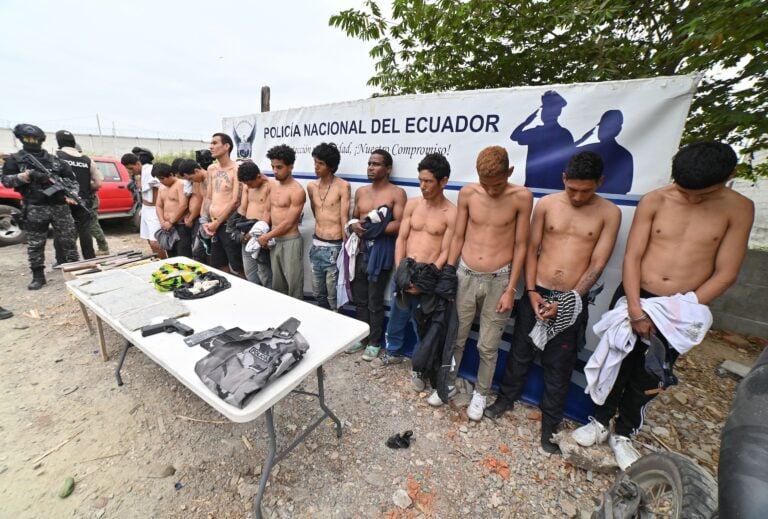
In April 2024, the government declared TdA the “number one enemy” and, in direct response, created a dedicated 300-agent elite unit specifically tasked with dismantling the organization, trained by the U.S. Department of Homeland Security, EFE news agency reported. This led to key law enforcement successes, including a joint operation in February 2025 between the Peruvian National Police and the U.S. Embassy’s Office of Homeland Security Investigations that resulted in the capture of 20 TdA members and the rescue of 84 victims, including minors, across Lima districts such as San Martín de Porres and Puente Piedra.
Following this, in July 2025, the Peruvian National Police continued its intense pressure on local TdA networks, successfully capturing several extortionists linked to the group in Lima. The concerted efforts continued into September 2025, when the Peruvian Public Ministry and Police executed a major raid to dismantle the criminal organizations known as Los Occidentales, a TdA-affiliated group accused of extorting transport workers and murdering at least five public transport drivers. The operation resulted in the detention of 24 members.
On the diplomatic front, Peru is actively promoting the exchange of financial intelligence, biometric data, and technical assistance in forums such as the Organization of American States’ General Assembly, Perú 21 reported.
Challenges to regional intelligence
For Daniel Pontón, “the main limitations in confronting the TdA are concentrated in the exchange of intelligence.” He singles out Venezuela as the biggest hindrance, citing its lack of cooperation in information flow, judicial coordination, and extradition of wanted individuals.
Pontón stresses that the most effective response hinges on the ability of South American countries to integrate their intelligence systems and sustain cooperation mechanisms, even amid political instability.
Risk of sustained expansion
When assessing TdA’s future impact, Pontón warns that “drug trafficking continues to be the central engine of the criminal economy.”
The danger, he warns, lies in the potential “balloon effect,” where pressure in the Andean countries shifts TdA operations and routes further south.
“Without coordinated action, the group could expand its presence, diversify its illicit economies, and strengthen its money-laundering mechanisms across several countries in the region,” Pontón concludes, emphasizing that the threat posed by the TdA is regional and requires an equally coordinated and decisive response.