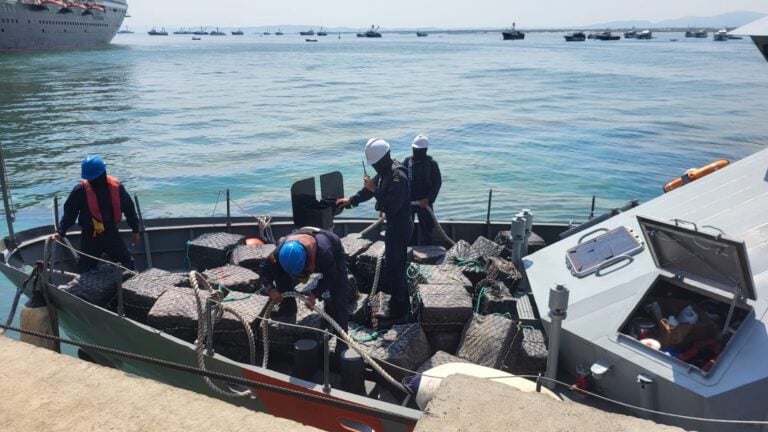


The Caribbean has ceased to be merely a secondary route for drug trafficking to Europe and has become a strategic hub for transnational criminal networks, which increasingly exploit institutional weaknesses, security gaps, and the region’s geographic advantages to move cocaine across the Atlantic. As interdiction pressure intensifies, criminal organizations are adapting their operations through more flexible routes that connect South America, the Caribbean, and Europe.
The international report, Criminal Networks and Routes from the Caribbean to Europe, produced with support from the European Union’s EL PACCTO 2.0 program and CARICOM IMPACS, revealed how criminal structures are using maritime, air, and river connections to strengthen an increasingly sophisticated transatlantic cocaine supply chain. The report warns that the Caribbean has become a critical hub for drug trafficking, particularly as other routes face increased interdiction pressure.
Marc Reina Tortosa, senior executive manager of EL PACCTO 2.0, explained that authorities are no longer confronting strictly hierarchical organizations. “We do not see large, rigid cartels, but rather fluid, transactional networks where intermediaries from Europe and the Western Balkans act as the invisible architects of the trade,” he said. He added that “The Caribbean offers these drug traffickers a unique diversification: When maritime pressure increases, they turn to air routes or river systems connecting the Amazon with the Atlantic.”
Intelligence, money, and cooperation critical to combating criminal networks
The evolution of drug trafficking requires moving beyond reactive responses and adopting offensive strategies centered on financial intelligence, multinational coordination, and sustained operational pressure.
Barbados Defence Force Lieutenant Colonel Michael Jones, executive director of CARICOM IMPACS, warned that these networks “not only traffic in goods, but also undermine the rule of law and destabilize our economies.” He added that the study provides authorities with a framework to identify vulnerabilities in criminal operations and detect suspicious vessels before they reach Caribbean shores.
For Vanessa Cárdenas, an organized crime researcher at the Observatory of International Affairs at Chile’s Finis Terrae University, the priority should focus on disrupting the financial viability of these organizations.
“The first step is to cut off the economic incentives: Hit them where it hurts,” she told Diálogo. “If the financial flows are interrupted, the network and the business lose their purpose, so it’s key to move toward regional coordination under standards for task forces and financial action.”
Cárdenas added that real-time exchanges of banking and financial intelligence between Caribbean and European authorities could help move beyond seizures toward the structural dismantling of trafficking organizations. This would include interconnected financial intelligence units, long-term joint investigations, and a greater focus on intermediaries, logistics operators, and front companies used to facilitate transnational drug flows.
Europe strengthens ports and logistics against drug traffickers
In December 2025, the European Commission launched a package of measures aimed at strengthening port security, improving container traceability, and expanding operational coordination along key trafficking corridors into Europe.
The strategy seeks to close logistical vulnerabilities exploited by criminal organizations through closer coordination among customs, judicial, and law enforcement authorities. The European plan also expands cooperation with Latin America and the Caribbean through technical assistance, intelligence sharing, and support to strengthen controls at critical nodes in the supply chain.
The objective is to move beyond isolated interdictions and focus instead on dismantling criminal structures and disrupting their financial networks.
The expansion of Caribbean trafficking routes toward Europe continues to place increasing pressure on regional governments, ports, transportation systems, and security forces. Analysts warn that criminal organizations are becoming more adaptable, technologically sophisticated, and transnational in scope, requiring stronger intelligence sharing, maritime domain awareness, financial investigations, and coordinated multinational responses.
Experts also note that the Caribbean’s complex geopolitical and security environment — including ongoing tensions surrounding Cuba’s hosting of fugitives and members of armed groups such as the National Liberation Army (ELN) — continues to complicate regional intelligence-sharing and coordinated responses against transnational criminal networks.
For Caribbean nations, the challenge extends beyond narcotics interdiction. The growing presence of transnational criminal organizations and narcoterrorist networks increasingly threatens economic stability, governance, public security, and strategic maritime corridors across the hemisphere.