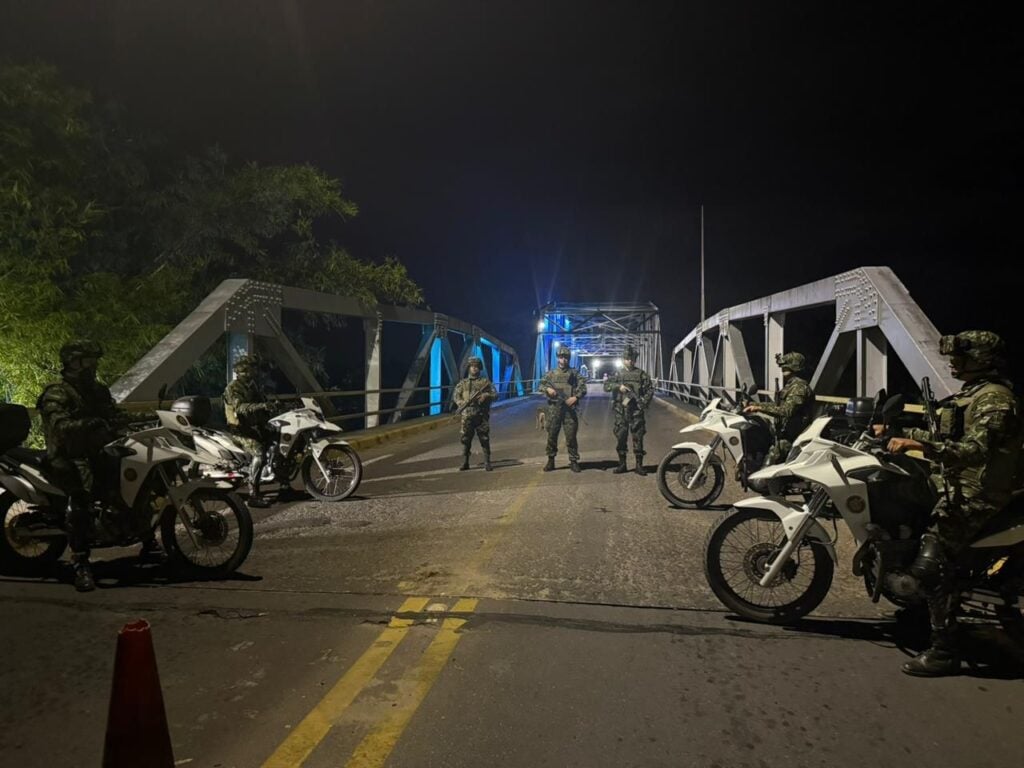

Along Colombia’s 2,219-kilometer border with Venezuela, the security challenge changes with the terrain. In Catatumbo, Colombian forces confront armed groups and the illicit economies that sustain them. Across La Guajira, long distances and open terrain make mobility and surveillance critical. Farther south, the rivers of Arauca and the Orinoquía become both transportation corridors and operational spaces.
Colombia reinforced the frontier throughout 2025 and 2026, deploying additional personnel and capabilities to respond to armed groups, narcotrafficking, smuggling, irregular border crossings, and other cross-border threats. But the response increasingly reflects the different operational environments along one of South America’s longest and most complex borders.
A more proactive approach to border security
Several initiatives have shaped Colombia’s response. Plan Frontera, activated at the start of 2026, coordinated government preparations for potential increases in migration from Venezuela, including health care, food, drinking water, temporary shelter, and other assistance. The interinstitutional effort included the ministries of Equality, Foreign Affairs, Defense, and Interior, among other government agencies, with preparations concentrated in border areas including Cúcuta, Arauca, Maicao, and Riohacha.
At the same time, Colombian military forces continued operations against armed groups and the illicit economies that sustain them under the Ayacucho campaign plan. According to Erich Saumeth, Colombian defense analyst and consultant, the approach represents a “growing emphasis on shifting from an essentially static presence to a more offensive, intelligence-driven posture.”
The border reinforcement intensified after violence surged in Catatumbo in 2025. In January 2026, Colombian authorities announced the deployment of more than 30,000 military personnel along the border, prioritizing Norte de Santander, La Guajira, Arauca, and Vichada. About 11,000 personnel were concentrated in Catatumbo, supported by intelligence capabilities, drones, counter-drone systems, armored vehicles, and other mobility assets.
Those operations have continued. In September, President Abelardo De La Espriella announced that the government and the new military and police leadership would develop a new strategy for Catatumbo targeting armed structures, their leaders, finances, and the illicit economies that sustain them.
Days later, the Colombian Army reported an intelligence-led operation in Cúcuta and Villa del Rosario against an alleged National Liberation Army (ELN) network involved in the illicit appropriation of hydrocarbons. Conducted by the Military GAULA of Norte de Santander in coordination with the Attorney General’s Technical Investigation Corps, the operation resulted in four arrests. The Army said the network diverted fuel that was transported to Norte de Santander, where it was used in the processing of coca paste in Catatumbo. The Army identified the operation as part of the Ayacucho campaign plan.
Mobilization in response to the crisis in Catatumbo
In mid-January 2025, the ELN launched a major offensive in Catatumbo against the 33rd Front of FARC dissidents, as the armed groups competed for control of territory and illicit economies. The fighting triggered one of Colombia’s largest displacement crises in recent years, forcing tens of thousands of people from their homes. In response, the Colombian government declared a “state of internal disturbance” in the region, while military helicopters evacuated hundreds of people from affected communities.
Catatumbo’s combination of lowlands, river valleys, forests, and mountainous terrain, together with its proximity to the Venezuelan border, makes the region particularly challenging for security forces. Armed groups use irregular crossings and difficult-to-access areas to move personnel and illicit goods, while legitimate trade and the daily movement of people continue across the frontier.
The Colombian Army’s 30th Brigade, part of the 2nd Division and headquartered in Cúcuta, patrols the area and conducts operations against armed groups and cocaine-production infrastructure. By January 2026, the Army reported more than 11,200 soldiers deployed throughout Norte de Santander, including special forces, rapid deployment, aviation, ground mobility, and interinstitutional capabilities.
For Saumeth, the challenge is therefore not simply putting more soldiers on the border. “The challenge there isn’t just controlling a vast border, but identifying and neutralizing threats that are constantly intermixed with the population, economic activity, and legitimate movement,” he said.
“The intense cross-border trade also demands precisely distinguishing between legitimate mobility and flows tied to drug trafficking, smuggling, and other illicit economies. That requires far more intelligence, interinstitutional coordination, and territorial control, because an indiscriminate military deployment could damage the region’s economic and social fabric,” he added.
Recent operations illustrate that approach. Rather than focusing exclusively on armed members of criminal organizations, Colombian forces have increasingly targeted the infrastructure and resources that allow them to operate, including cocaine-processing facilities, illegal fuel networks, weapons, transportation routes, and other logistical systems.
Patrolling Colombia’s long desert border
Northwest of Catatumbo, the Colombia-Venezuela border stretches through Cesar toward the sparsely populated desert peninsula of La Guajira, which extends into the Caribbean Sea. Here, security forces face a different operational environment characterized by long distances, open terrain, irregular border crossings, and routes used for contraband and narcotrafficking.
La Guajira falls within the area of responsibility of the Colombian Army’s 10th Brigade, part of the 1st Division. Its units include mechanized infantry, cavalry, artillery, engineering, and other capabilities distributed across Cesar and La Guajira.
Protected mobility is particularly important in the region, where units must cover large areas and respond rapidly across difficult terrain. Colombian forces employ armored platforms, including LAV III and M1117 vehicles, to strengthen mobility, reconnaissance, troop protection, and territorial control.
In the words of Saumeth, “The use of the GDLS 8×8 LAV III vehicles in La Guajira can be understood more as a territorial-control and deterrence decision than as a response specifically to fuel smuggling. It’s a vast border area, with mobility challenges and the presence of various threats, where a highly mobile, well-protected platform can strengthen troops’ reaction capacity.”
The contrast with Catatumbo illustrates how the same border requires different force packages. While intelligence and sustained operations against entrenched armed structures are central in Catatumbo, La Guajira places a premium on mobility, surveillance, and the ability to maintain a security presence across long stretches of sparsely populated territory.
Reinforcing Arauca
Farther south, the frontier enters another operational environment in Arauca, where the ELN and other armed structures have used border corridors and illicit economies to sustain their activities. Here, Colombia has reinforced both land and riverine capabilities.
In May 2026, then-Defense Minister Pedro Sánchez announced the phased deployment of 21 additional Army platoons — more than 600 personnel — to strategic areas of Arauca. The first platoons arrived with armored vehicles, high-displacement motorcycles, and surveillance and monitoring drones. Sixteen additional platoons, comprising about 500 personnel, were scheduled to deploy between August and October. The Colombian Aerospace Force also announced an additional helicopter to support reconnaissance, surveillance, and operations by ground forces.
Riverine capabilities complement that land presence. In March, the Colombian Navy activated a new shallow-draft river operations boat built by COTECMAR for Marine Riverine Battalion No. 52 in Arauca. The vessel was designed to improve troop mobility, reinforce patrols, and strengthen control along waterways where rivers serve as critical transportation routes.
The combination of armored mobility, motorcycles, aerial surveillance, and riverine forces reflects the particular challenge in Arauca: controlling territory and transportation corridors in an environment where the international boundary itself frequently follows the river.
The Orinoquía: security along the rivers
South and east of Arauca, the Colombia-Venezuela border extends into the Orinoco River basin and the department of Vichada, where the Meta and Orinoco rivers form long portions of the international boundary. Roads are limited across much of this vast region, making rivers essential transportation and communication routes for communities — and potential corridors for illicit activity.
That geography requires a strong riverine component alongside land and air capabilities.
The Colombian Navy’s Orinoquía Naval Force is responsible for controlling strategic river corridors including the Orinoco, Meta, Guaviare, and Arauca rivers. Its area of operations extends across more than 2,600 kilometers of waterways in Arauca, Casanare, Meta, Vichada, and Guainía.
The force combines riverine vessels, Marine infantry, land elements, and aeronaval capabilities. Marine riverine battalions are positioned in Puerto Inírida, Puerto Carreño, and Arauca, allowing forces to patrol waterways, move personnel, and maintain a security presence in areas where river access can be more important than roads.
The operational demands differ significantly from those farther north. In Catatumbo, troops operate amid dense population movements, illicit economies, coca-producing areas, and heavily contested terrain. In La Guajira, protected mobility helps units cover long distances across open terrain. In Arauca and the Orinoquía, riverine forces and shallow-draft vessels allow Colombian authorities to reach communities and patrol corridors that cannot be effectively controlled from land alone.
Recent deployments across these regions therefore represent more than an increase in troop numbers. They illustrate an effort to match capabilities to the different environments along the frontier while increasing pressure on the infrastructure that allows armed and criminal organizations to operate.
From Saumeth’s perspective, “The destruction of cocaine-processing infrastructure and operations against armed structures show exactly that shift […]. What might draw attention, more than the deployment itself, is the speed with which operational pressure on criminal organizations has increased.”
“This shows that strengthening border security can be more than just a preventive measure against potential external threats: it can also serve as a tool for regaining effective control over routes used by drug traffickers, arms traffickers and illegal armed groups,” he concluded.