
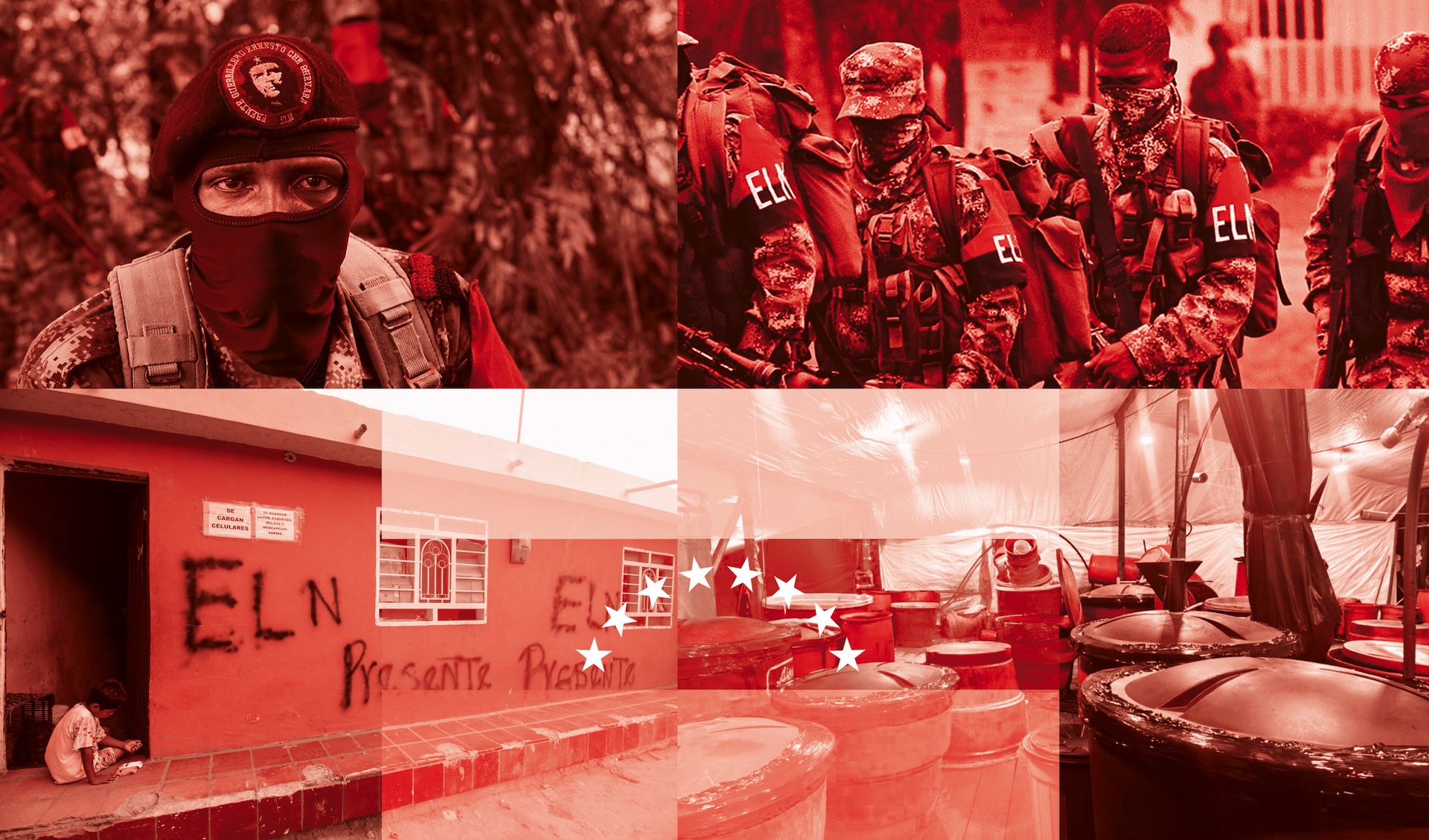
The expansion of the National Liberation Army (ELN) in Venezuela in recent years has transformed the security architecture along the border with Colombia. This strategic shift has allowed the insurgent group to establish a permanent operational rear guard that maintains a climate of coercion in the region while coordinating illicit activities, projecting its influence beyond the binational corridor.
The ELN has effectively converted Venezuelan territory into an operational sanctuary, enabling it to exert armed pressure on Colombia without bearing the logistical or political costs of a prolonged direct confrontation. According to analysis by InSight Crime, this dynamic serves as a guarantee for the group’s criminal continuity, expanding its room for maneuver against state security forces.
The analysis further indicates that these criminal structures have established functional enclaves within Venezuela’s border states. These sites are used for rest, organizational restructuring, and high-level command operations, all while the group maintains an active terrorist presence in Colombian regions such as Norte de Santander, Arauca, Chocó, Cauca, and Nariño. These strategic spaces reduce the group’s exposure during operations and facilitate seamless cross-border coordination.
Financial hub of Catatumbo
Catatumbo, in the Colombian department of Norte de Santander, remains the primary financial engine for the organization. Reports from InSight Crime indicate that revenue generated from coca crops, processing laboratories, and clandestine airstrips sustains the ELN’s current operational level. This financial flow is the backbone of their territorial control along the binational frontier.
This expansion is predicated on a functional relationship that integrates the control of illicit economies, residual ideological affinities, and the indirect management of territorial security. The prevailing assessment describes this arrangement as a hybrid criminal state, where the ELN has been granted access to strategic corridors leading to the Caribbean through Zulia state.
Illicit economies as an operational engine

While the ELN’s public rhetoric maintains that its involvement in drug trafficking is limited to the collection of fees, InSight Crime indicates a deeper level of integration that finances multiple criminal fronts. The group’s dominance over the border allows it to directly manage cocaine laboratories and oversee the logistics of international trafficking.
The ELN’s Finance and Economy Structure for the Revolution oversees border corridors containing crops, processing centers, and transit routes. Under sustained pressure from Colombian authorities, a significant portion of this production has been relocated to remote areas within Venezuela. A confidential intelligence report accessed by Colombian news outlet Noticias RCN details specific corridors used by the ELN to transport cocaine from Catatumbo to the port city of Maracaibo.
The report also highlights that networks linked to Hezbollah coordinate maritime routes departing from Venezuelan ports toward Africa and the Middle East, effectively broadening the international reach of these drug trafficking operations. The document also identifies critical logistics hubs in La Fría and Machiques dedicated to the transport of weapons, and it documents the use of explosives and deployment of snipers trained in camps on Venezuelan soil.
Institutional fragility and insurgent rise
Juan Liendo, an academic at the Peruvian Army War College, observes that “the institutional failures most exploited by armed groups are associated with the weakness of democratic governance.” He argues that this fragility, often exacerbated by corruption and political opportunism, lowers the barrier for penetration of external interests and allows for the seamless articulation of criminal economies without the need for formal political control.
When institutional legitimacy is eroded, armed groups use political narratives as a veneer for illicit activities, strengthening their territorial grip. Liendo emphasizes that “solid institutional frameworks and responsible leadership are essential to contain the expansion of insurgent structures with transnational backing.”
Armed infrastructure and institutional complicity

Reporting by Infobae indicates that the ELN has established at least 10 camps in the Venezuelan state of Zulia, strategically situated in rural sectors with direct escape routes into Colombia. These installations facilitate cross-border mobility and serve as a shield against security operations.
Some of these camps have clandestine landing strips, significantly bolstering the ELN’s logistical capabilities. The reported collaboration of elements within the Bolivarian National Armed Forces (FANB) and the Bolivarian National Guard (GNB) has been identified as a critical factor in facilitating the group’s unhindered presence in Venezuelan territory.
Liendo reaffirms that “these structures continue to operate in Venezuela, and their presence in other countries in the region allows them greater mobility and coordination.” Within this broader context, the Port of Chancay, in Peru, emerges as a vital logistical node requiring vigilant surveillance, particularly as criminal routes are reconfigured toward South America and the Indo-Pacific.
This shifting landscape could facilitate the projection of hybrid networks backed by extra-continental powers — including China, Russia, and Iran — not only for drug and illegal gold trafficking, but also for the expansion of criminal organizations with political objectives.
Reconfiguration of regional security
Although the security environment in Venezuela has undergone a significant transformation since the beginning of 2026, a report by the European Union Institute for Security Studies warns that the country continues to serve as a refuge for armed mega-gangs linked to drug trafficking, while the ELN maintains its dominance in regions vital to the illicit economy.
Despite intensified international scrutiny, the links between armed non-state actors and state structures have not been fully severed. This environment of institutional volatility remains a catalyst for the territorial and transnational expansion of the ELN and similar criminal groups, carrying profound implications for regional stability and security.
For Liendo, “preventing structures such as the ELN from replicating transnational rear guard models requires strengthening non-ideological political leadership committed to the rule of law.”
He concludes that the containment of these organizations must be anchored in robust democratic institutions, a structural offensive against corruption, and a hemispheric identity built upon shared values. Without these foundations, he warns, “armed and criminal groups will continue to exploit institutional fragility to consolidate their bases, secure financing, and project their influence beyond national borders.”