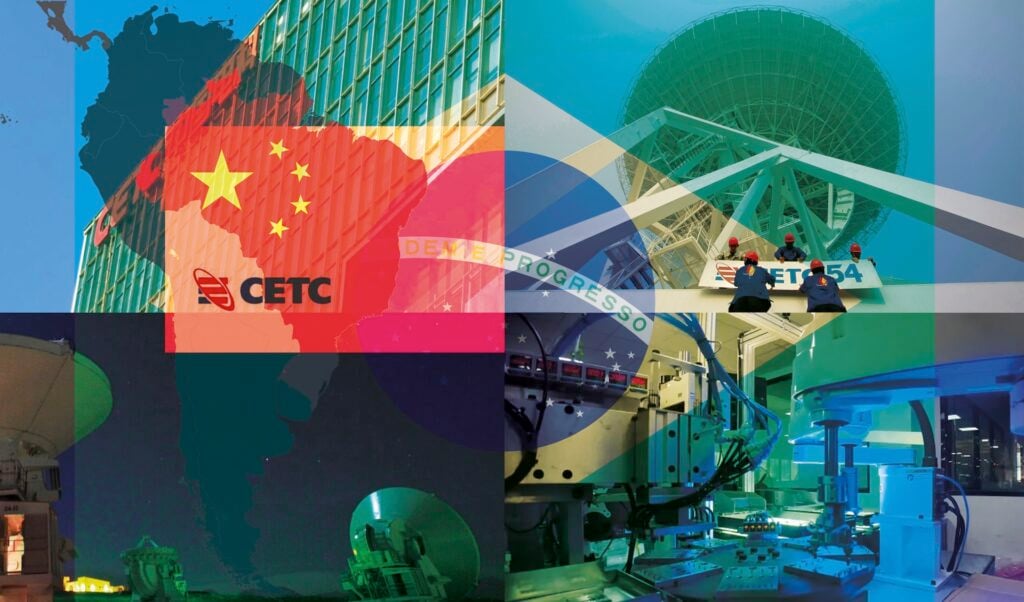

China and Brazil have begun construction of the China-Brazil Joint Radio Astronomy Technology Laboratory, a move that is drawing increased scrutiny across Latin America as Beijing deepens its presence in sensitive technological sectors. The initiative, led by China Electronics Technology Group Corporation (CETC) — a major Chinese state-owned defense electronics company — expands bilateral cooperation in space-related infrastructure at a time when governments in the region are reassessing the long-term strategic implications of Chinese investment.
The agreement was signed in December 2025 between CETC and Brazil’s Federal University of Campina Grande and Federal University of Paraíba. The project entered its construction phase shortly thereafter, according to statements from the Chinese company and Brazilian academic partners. According to CETC, the laboratory will support cutting-edge research in astronomical observation and deep-space exploration. Analysts, however, warn that cooperation in high-technology sectors such as radio astronomy cannot be viewed in isolation from China’s broader strategy of expanding its technological and strategic footprint in Latin America.
The new laboratory coincides with progress on the Baryon Acoustic Oscillations from Integrated Neutral Gas Observations (BINGO) radio telescope, another China-Brazil initiative scheduled for completion in 2026. The 40-meter instrument — engineered and supplied with significant Chinese participation — is being installed in the municipality of Aguiar, in Brazil’s northeastern state of Paraíba, chosen for its exceptionally low level of electromagnetic interference, a key requirement for radio astronomy.
Touted as the largest radio telescope in South America, BINGO is designed to study the large-scale structure of the universe and the nature of dark energy. It is also expected to contribute to tracking satellites, meteoroids, and other small bodies in near-Earth orbit.
While the stated objectives are scientific, China’s space-related infrastructure carries inherent dual-use potential. Systems capable of detecting faint cosmic signals may also contribute to space situational awareness, orbital traffic monitoring, and the tracking of objects in Earth’s orbit — capabilities with direct military relevance, including satellite intelligence, missile tracking, and secure communications support. Similar concerns have surrounded China’s deep space tracking facility in Argentina, the Espacio Lejano Station, which, despite being described as civilian, operates under agreements that limit host-nation oversight and has fueled debate about possible defense-related uses. For regional experts, the overlap between civilian research and strategic capability is central to the scrutiny surrounding new China-backed space projects.
China has increasingly used space cooperation as a vehicle for expanding its geopolitical reach across Asia, Africa, and Latin America. Through the installation of telescopes, satellite development programs, infrastructure financing, and personnel training, Beijing positions itself at the center of nations’ space architectures — shaping technical standards, access to data, and operational capabilities in ways that can translate into strategic leverage.
For Marcos Degaut, former deputy special secretary for Strategic Affairs to the President of Brazil and former secretary for Defense Products at the Brazilian Ministry of Defense, partnerships in strategic sectors such as space technology require a sober assessment of long-term dependence.
“This dependence is functional and deeply rooted in strategic sectors, which makes the issue essential for public, industrial, and diplomatic policy debates, and for a realistic assessment of contemporary economic and geostrategic relations,” says Degaut, who is also a former executive secretary of the Brazilian Foreign Trade Chamber (CAMEX) and holds a doctorate in International Security.
“In short, Brazil is becoming structurally more dependent on China in specific sectors, especially where there is low domestic industrial capacity, a lack of policy and technological capacity, and scarce national capital,” he continues.
The laboratory will operate as a scientific hub linking Brazilian universities with the Chinese state-owned defense electronics conglomerate, facilitating continuous exchanges of personnel and joint technological development. Such arrangements extend beyond isolated projects: They integrate research pipelines, technical standards, and institutional networks, embedding Chinese participation within Brazil’s evolving space ecosystem.
Beyond academic collaboration, the initiative further consolidates China’s presence in sensitive technological infrastructure in South America. By combining a major radio telescope with a laboratory dedicated to radio astronomy, Brazil and China are establishing a research cluster that could shape regional space capabilities for decades.
Across Latin America, experts warn that Chinese-backed infrastructure projects — from telecommunications networks and energy facilities to ports and now space-related technologies — are steadily embedding Beijing within critical sectors of national economies. Analysts caution that this growing footprint can influence technological standards, data governance frameworks, and long-term strategic bargaining power, particularly when partnerships concentrate in areas with defense, communications, or intelligence relevance.
Degaut argues that the core issue is not an immediate loss of sovereignty, but structural dependence — a gradual dynamic that may limit strategic flexibility.
“The country also depends on Chinese financing and capital in infrastructure and technology sectors, expanding its involvement in the Chinese development project,” says Degaut. He stresses that Brazil should reduce vulnerability by diversifying its technological partnerships and expanding cooperation with multiple innovation hubs, rather than concentrating strategic sectors within a single external axis.
“The possibility of foreign investment influencing public policy is nothing new in international economic history, as large capital flows have always generated some degree of dialogue with governments. What makes the issue more sensitive in the Brazilian case is the combination of three factors: the consistent advance of the Chinese presence in strategic sectors, Brazil’s growing commercial and financial dependence on China, and the absence of a clear national economic security strategy,” concludes Degaut.
As China entrenches itself in strategic technologies across Latin America, initiatives such as the Paraíba laboratory and the BINGO telescope illustrate how scientific cooperation can also recalibrate power dynamics. The infrastructure under construction today may ultimately define the region’s technological independence — or its long-term strategic vulnerability.