
Chile’s strong showing at the 2026 Texas Best Warrior Competition offered more than a demonstration of tactical skill — it highlighted the spirit of partnership, professionalism, and camaraderie that defines military cooperation under the State Partnership Program (SPP).
Held at Camp Swift, March 23-27, the annual event hosted by the Texas Military Department brought together 27 elite competitors for a demanding 72-hour test of endurance, technical proficiency, and leadership. Among them, Chile stood out — not only for its performance, but for the energy and perspective its service members brought to the competition.
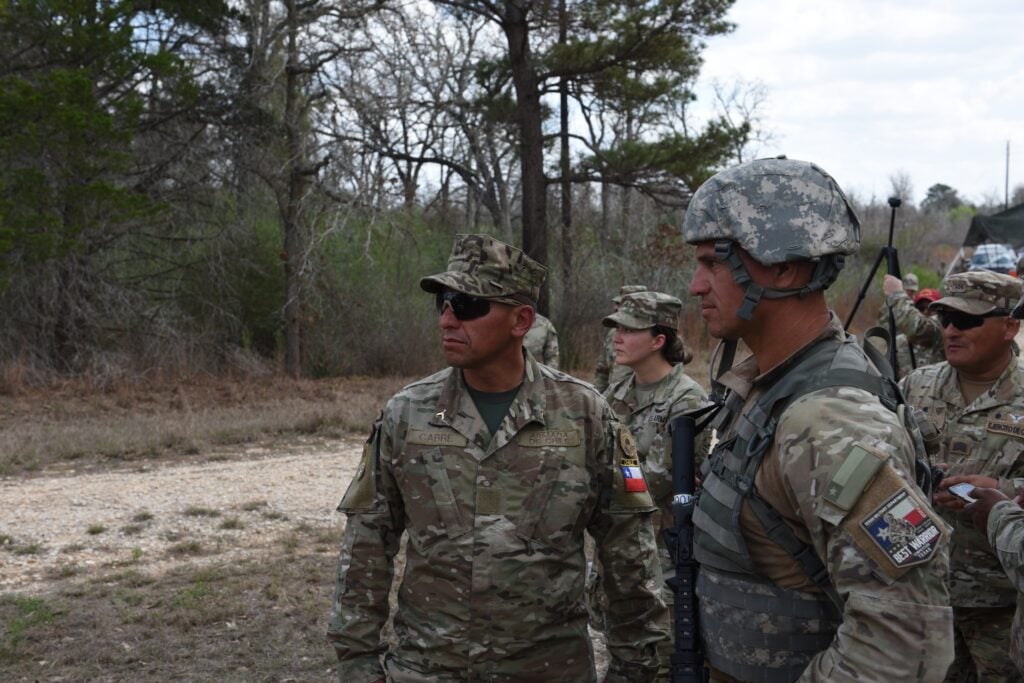
Six members of the Chilean Armed Forces participated, competing alongside U.S. National Guard personnel and partners from Egypt and the Czech Republic. Across events ranging from land navigation and weapons proficiency to communications, medical response, and a grueling ruck march, Chilean competitors consistently ranked among the best.
At the center of that success was Chilean Air Force Airman First Class Felipe Uribe, who earned the title of Overall Best Warrior after excelling across multiple disciplines, including land navigation, weapons, communications, and endurance events. His performance underscored both individual excellence and the high level of training and preparation within Chile’s ranks.
Other Chilean participants also distinguished themselves. Chilean Marine Corps Staff Sergeant Daniel Contreras Torres was recognized as the top Chilean noncommissioned officer (NCO), placing fifth overall, while Chilean Army Sergeant First Class Carla Pino stood out as the top female competitor — finishing ninth among 17 NCOs in a predominantly male field.
The competition itself was designed to push participants to their limits. Over several days, competitors navigated between simulated events on foot, testing core soldiering skills across multiple lanes, including weapons proficiency, chemical-biological-radiological-nuclear response, drone threat scenarios, physical fitness assessments, patrol operations, medical response, and radio communications. Additional challenges such as an obstacle course, combat pistol qualification, and a “mystery event” featuring simulated close-quarters combat added further complexity. The final phase combined a 400-meter swim with an endurance run — ensuring that only the most well-rounded and resilient competitors would rise to the top.
For organizers, the value of the event extended beyond competition.
“We have great partnerships with Chile and Czech Republic. For the first time this year, Egypt has come to participate in our competition,” said Texas Army National Guard Command Sergeant Major Jeremy L. Scribner, who oversaw event planning. “So, it’s great to have them here. They bring lots of flavor and expertise that our soldiers can see in this competition.”
Chilean leaders emphasized what the experience meant for their forces and for international cooperation.
“Every superior must feel proud of their subordinates; they are the true reflection of our leadership. They give everything,” said Chilean Marine Corps Sergeant Major Jaime Cabre Pizzaro.
For the competitors themselves, the opportunity to train alongside international partners was just as valuable as the competition.
“This is a tough competition, and I feel very proud because I am representing my country, Chile, the Marine Corps, and the Chilean Navy,” said Staff Sgt. Contreras Torres. “It’s an honor for me to be working with other countries, because I can learn from different nationalities.”
That exchange of knowledge and experience is a core objective of the SPP, which pairs U.S. National Guard units with partner nations to strengthen interoperability and readiness. Texas and Chile have partnered under the program since 2008, building a longstanding foundation of trust and cooperation. Events like the Texas Best Warrior Competition translate those partnerships into real-world collaboration — where soldiers not only compete, but learn from one another in high-pressure, realistic scenarios.
As the week concluded with an awards ceremony, the results reflected more than individual achievement. They showcased a shared commitment to excellence and a sense of camaraderie that extended well beyond national lines.
For Chile and its partners, the competition was not just about determining the best warrior — it was about building stronger teams, sharing expertise, and reinforcing the kind of relationships that make future cooperation both effective and enduring.