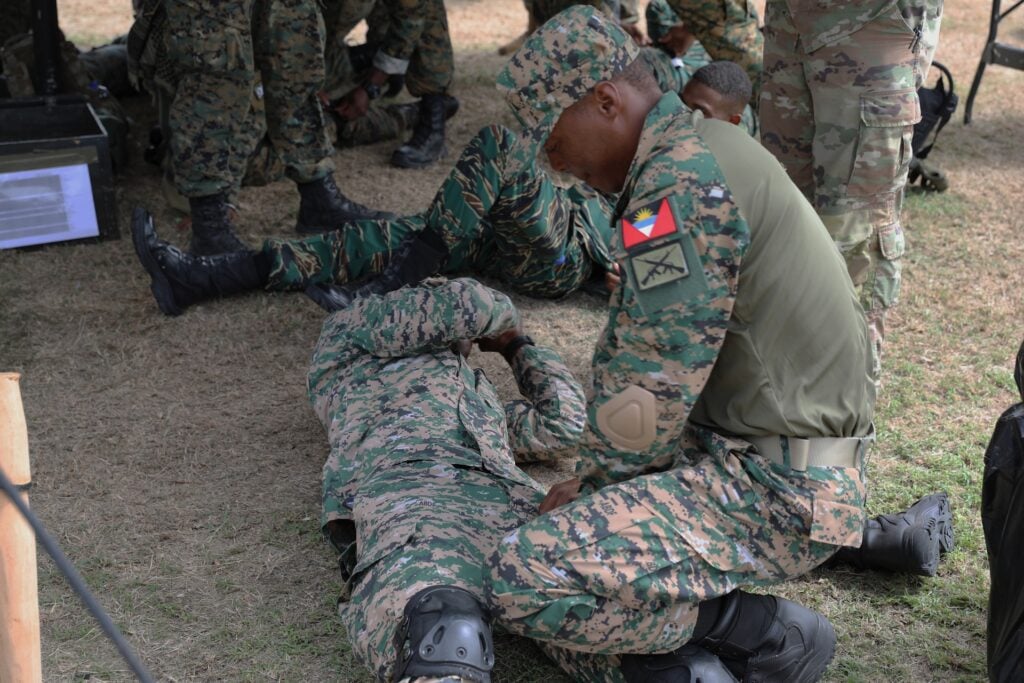

Military and security leaders from across the region convened in Antigua and Barbuda March 16-20, 2026, for the final planning conference of Tradewinds 26 (TW26), a U.S. Southern Command (SOUTHCOM)-sponsored exercise. The meeting brought together participating nations and partner organizations to coordinate scenarios, align objectives, and finalize preparations for the multinational training event.
Hosted at the American University of Antigua, the conference focused on synchronizing efforts across military, security, and civilian agencies ahead of the exercise, which will take place June 3-17. Tradewinds 26 will bring together more than 1,000 participants operating across land, air, and maritime domains.
Tradewinds is an annual exercise designed to strengthen coordination among partner nations and improve their ability to respond to regional challenges. The training integrates Field Training Exercises (FTX) and Command Post Exercises (CPX), allowing participants to rehearse both operational execution and command-and-control processes in realistic scenarios.
“Tradewinds 26 (TW26) represents the intersection of readiness and partnership,” said U.S. Army Lieutenant Colonel Innis Bryant, chief of Joint Exercises at U.S. Southern Command (SOUTHCOM), during the TW26 final planning conference. “It ensures that the Joint Force can operate seamlessly with regional allies, respond rapidly to crises, and collectively deter shared threats.”
Participating countries this year are Antigua and Barbuda (host nation), Bahamas, Barbados, Belize, Bermuda, Canada, Colombia, Dominica, Dominican Republic, Ecuador, France, Grenada, Guyana, Jamaica, Mexico, Netherlands, Saint Lucia, Saint Kitts and Nevis, Saint Vincent and the Grenadines, Suriname, Trinidad and Tobago, Turks and Caicos, United Kingdom, and United States.
Planning efforts also incorporated coordination with key regional organizations, including the Caribbean Community (CARICOM), the Regional Security System (RSS), the Caribbean Implementation Agency for Crime and Security (IMPACS), and the Caribbean Disaster Emergency Management Agency (CDEMA). These entities play a critical role in ensuring that exercise scenarios reflect real-world regional priorities, including disaster response, security cooperation, and interagency coordination.
The exercise is tailored to the Caribbean’s operational environment, with particular emphasis on humanitarian assistance and disaster response in hurricane-prone regions, as well as coordination against transnational threats. Conducting the exercise in a partner nation allows participating forces to test logistics, communication systems, and command structures under conditions that mirror real-world operations.
“Conducting these exercises in partner environments tests our operational reach,” Lt. Col. Bryant said. “It lets us practice coalition command and control and achieve service and partner force integration. These lessons cannot be replicated at home stations.”
According to U.S. Army Lieutenant Colonel Sonya Y. Frazier, assistant TW26 exercise planner, the planning process is essential to ensuring that the exercise delivers practical outcomes for all participants.
“The U.S. joint force benefits from this training by gaining practical tools and experience to better secure their interests and respond swiftly to crises,” Lt. Col. Frazier said. “Training with partners multiplies capabilities and experience, preparing participants to face varied and complex challenges together.”
Tradewinds 26 will integrate military forces with civilian agencies and Observer/Controller-Trainer teams, reinforcing a whole-of-government approach to regional security and disaster response. By aligning objectives during the planning phase, participating nations are better positioned to execute coordinated operations during the June exercise.
As preparations conclude, Tradewinds continues to serve as a key platform for strengthening operational coordination, improving interoperability, and supporting regional stability across the Caribbean.