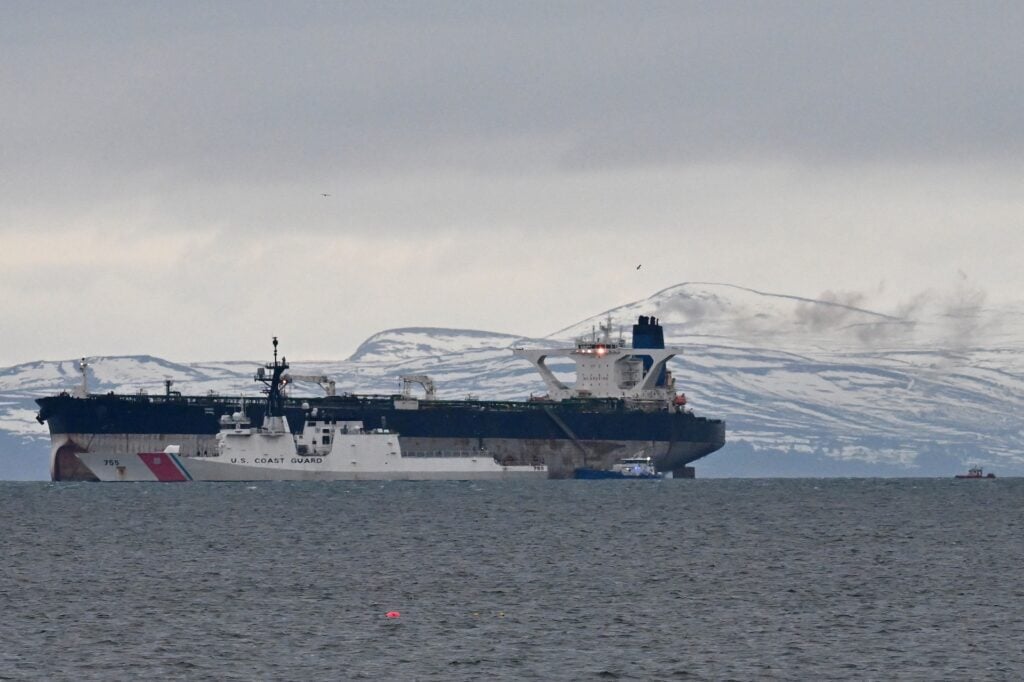

Recent maritime interdictions in the Caribbean and Atlantic are providing new insight into how illicit shipping networks operate across the hemisphere. Beyond the vessels themselves, recent cases have revealed complex systems of intermediaries, shell companies, changing registries, deceptive routing practices, and covert logistics structures designed to conceal responsibility and complicate enforcement efforts.
The findings are reshaping how maritime authorities understand sanctions evasion, illicit shipping, and the broader networks supporting covert maritime activity.
Among the most closely analyzed recent examples is the Bella-1, an aging tanker that became the focus of a weeks-long U.S. Coast Guard pursuit beginning in late December 2025 after authorities linked it to sanctions-evasion activity involving Iranian and Venezuelan oil shipments. According to multiple reports, the vessel repeatedly altered its identity and operational profile while attempting to evade interdiction across the Atlantic before reflagging under Russia, operating under the name Marinera, and being seized in early January 2026.
Analysts say the case demonstrated how sanctions-evasion networks increasingly exploit jurisdictional complexity to complicate attribution and delay enforcement responses.
“What was once a binary question — ‘Is the vessel sanctioned or not?’ — has evolved into layered risk assessment across six dimensions,” explained Dimitris Ampatzidis, a risk and compliance analyst at Kpler, a data, analytics, and intelligence firm that tracks global commodity flows in real time, in a late 2025 report. Ampatzidis cited sanction status, behavioral patterns, network associations, geographic exposure, cargo routes, and ownership transparency as key risk indicators.
The Bella-1 case also highlighted the growing role of behavioral analysis in maritime monitoring. Authorities tracking the vessel reportedly focused not only on ownership records, but also on suspicious operational behavior — route deviations, inconsistent registration information, evasive movements, and irregular tracking activity. Analysts note that these are increasingly important indicators when identifying vessels linked to sanctions evasion or illicit commerce.
Many of the same deceptive maritime practices used to evade sanctions are also exploited by transnational criminal organizations involved in narcotics trafficking, illicit finance, fuel smuggling, and weapons trafficking.
Mapping the network behind the vessel
Recent cases are also influencing how maritime enforcement agencies approach investigations. Rather than treating interdictions as isolated incidents, authorities are increasingly using them to identify operational patterns, financial connections, sanctions-evasion methods, and logistical networks spanning multiple jurisdictions. Analysts and security officials say this requires much closer coordination among naval forces, intelligence agencies, customs authorities, financial investigators, and international partners to sustain persistent maritime domain awareness across vast operational environments.
Emerging technologies are also reshaping maritime enforcement efforts across the hemisphere. Artificial intelligence-assisted monitoring systems, satellite imagery, AIS analysis, and expanded intelligence sharing are helping authorities identify suspicious vessel behavior, irregular rendezvous activity, and inconsistencies between declared and observed movements, improving the ability to detect vessels attempting to operate covertly.
This growing emphasis on integration reflects the scale of the challenge facing maritime authorities across the hemisphere. The Caribbean Sea, Atlantic approaches, and Eastern Pacific remain vast operational environments where illicit actors continue attempting to exploit gaps in oversight, jurisdictional seams, and the complexity of international maritime commerce.
“International waters are not a refuge for sanctioned actors,” the U.S. Department of War warned via X following a late February interdiction.
Strategic maritime corridors
The strategic importance of regional maritime corridors further heightens these concerns.
The Panama Canal and surrounding maritime approaches remain essential to global trade and regional security. As sanctions-evasion activity and transnational criminal operations increasingly intersect in maritime spaces, authorities across the region face growing pressure to ensure that critical shipping routes are not exploited by illicit actors operating under commercial cover.
“Our most important national asset is the Panama Canal. Being known as the ‘bridge of the world and heart of the universe’ obliges us to guarantee the safe movement of passengers and cargo through our country […],” Panama’s Minister of Public Security Frank Ábrego told Diálogo during the Counter-Cartel Conference of the Americas held in early March at U.S. Southern Command (SOUTHCOM) headquarters. Minister Ábrego also highlighted investments by the Panama Canal Authority and government efforts to strengthen cybersecurity and cyber defense to protect the Canal and its surrounding infrastructure, while underscoring close cooperation with the United States.
Recent interdictions are reinforcing a broader message across the hemisphere: As maritime authorities expand monitoring capabilities, intelligence-sharing, and multinational coordination, illicit shipping networks are facing growing pressure at sea.
Analysts say the lessons emerging from these cases are likely to continue shaping maritime-security cooperation and sanctions-enforcement efforts as authorities adapt to increasingly sophisticated maritime evasion tactics. Vessels operating outside international law and oversight, they add, will continue to be identified, pursued, and intercepted.