

The deployment of the Gang Suppression Force (GSF) marks a shift in how security operations are conducted in Haiti, introducing a more robust, coordinated approach to confronting heavily armed gangs that control large areas of the country. Backed by international partners, the force is designed to operate with greater scale, mobility, and tactical capability than previous efforts.
The GSF “represents a shift in how the Haitian state addresses the crisis, by incorporating an operational capacity with deterrent and immediate response functions,” Javier Oliva Posadas, a scholar at the School of Political and Social Sciences at the National Autonomous University of Mexico, told Diálogo. “This transition points toward institutional restructuring aimed at stabilizing areas under gang control.”
Criminal expansion and operational challenge
Haiti’s multidimensional crisis worsened in 2025 as armed groups expanded their territorial control across Port-au-Prince and beyond. According to Human Rights Watch, these groups consolidated their presence in large portions of the capital and extended their influence into multiple departments, carrying out sustained violence that has driven mass displacement.
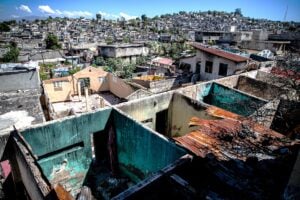
The International Crisis Group notes that these structures have evolved into actors with territorial autonomy, while estimates indicate that more than 200 armed factions are currently operating in the country.
This operational environment — fragmented, urban, and highly volatile — has complicated efforts to contain violence and restore control.
From support mission to direct intervention
The GSF replaces the Multinational Security Support (MSS) mission, which was primarily composed of police units tasked with reinforcing the Haitian National Police. In contrast, the new force introduces a more direct operational posture.
The GSF will operate under a doctrine centered on direct intervention, reflecting a shift toward actions designed to disrupt and dismantle armed groups rather than simply contain them.
Its structure calls for the gradual deployment of up to 5,500 personnel from multiple countries, with a mandate to support Haitian authorities in neutralizing armed groups, protecting critical infrastructure, and restoring operational control in contested areas.
Capabilities, technology, and execution
As part of this shift, Haitian authorities have begun integrating technological capabilities into operations, including the use of drones in urban environments. According to the International Crisis Group, initial actions have resulted in the neutralization of more than 200 members of these organizations.
Oliva Posadas emphasized that these tools strengthen deterrence and prevention by improving situational awareness. However, he cautioned that “its effectiveness will depend on intelligence analysis to generate early warnings and anticipate the actions of armed groups, in a framework that draws on experiences from El Salvador and Guatemala.”
This highlights a central operational requirement: the ability to translate information into timely and coordinated action on the ground.
Coordination and protection of strategic infrastructure
A key component of the GSF’s mission is the protection of critical infrastructure, including supply routes, logistics centers, and government facilities. Securing these assets is essential to enabling sustained operations and maintaining access across affected regions.
Regarding the command model, Oliva Posadas explained that “its operation depends on a clear allocation of functions and their execution under cooperative frameworks,” adding that “operational sustainability requires protocols of trust and complementarity among forces, similar to models of interinstitutional coordination in the region.”
The force operates within a multinational coordination structure that brings together partner nations under a shared framework, supported logistically through United Nations mechanisms.
Scope and long-term operational challenges
While the GSF introduces expanded capabilities, its long-term effectiveness will depend on sustaining operations and addressing the broader networks that enable criminal activity.
“The Gang Suppression Force can only be effective in the long term if efforts are intensified to identify, arrest, investigate, and prosecute, in accordance with international standards, those who finance and support these groups,” said United Nations High Commissioner for Human Rights Volker Türk.
Oliva Posadas reinforced this point, noting that dismantling criminal organizations requires targeting financial flows linked to illicit economies. “The approach must focus on tracking and cutting off the flow of money linked to illicit economies, under the principle of ‘follow the money,’” he said.
As operations expand, the GSF is bringing together increased operational capacity, coordinated action, and enhanced situational awareness to confront increasingly complex threats. By combining direct intervention with improved intelligence and multinational coordination, the force represents a more structured and capable approach to restoring security conditions in areas affected by armed groups.