

The Colombian Amazon faces a paradox: While farmers lack road infrastructure to transport legal products, a growing network of informal trails — precarious, unpaved rural roads — has proliferated across the region.
Authorities warn that many of these routes have become logistical corridors for transnational criminal economies, used to transport drugs, supplies for coca production, illegally mined gold, and other illicit goods.
According to monitoring by the Foundation for Conservation and Sustainable Development (FCDS) through March 2025, the Colombian Amazon had 31,207 kilometers of roads and trails. The organization reports that illegal roads increased by 51.7 percent over the previous three years, according to its report Trends and Dynamics of Deforestation in the Colombian Amazon.
“Colombia has the highest density of kilometers of trails per square kilometer in the entire continental Amazon, yet at the same time, it has one of the lowest population densities,” FCDS Director Rodrigo Botero told Diálogo.
The construction of these informal roads is closely linked to forest loss. According to the FCDS report, about 90 percent of recent deforestation occurs within 1.9 km of open roads, and roughly 80 percent occurs at an average distance of 1.2 km.
Residents of the Amazon require mobility for personal travel, commerce, and the transportation of goods. However, in many areas the construction of informal roads has been driven or financed by illegal economies and land grabbers seeking access to remote territory. These projects often advance without proper authorization and, in some cases, with the tacit support or later involvement of local authorities, Botero explained.
Another factor accelerating deforestation is the expansion of cattle ranching into newly cleared forest areas. According to FCDS, this activity frequently follows the opening of illegal roads and is often linked to land grabbing and illicit economies operating in remote territories.
“Deforestation, the arrival of livestock, public investment: This is how the phenomenon of land grabbing occurs,” Botero said.
“These drivers of deforestation create a scenario in which governance weakens, with a strong presence of illegal armed groups and illicit economic dynamics that exercise control over the territory,” the FCDS report indicates
Botero also warns that a hybrid system has emerged linking communities, illegal economies, and public investment, resulting in the development of a parallel road network that deepens ungovernability, accelerates the climate crisis, and promotes unsustainable economies. Armed groups often force ranches and farms to contribute financially to the construction of illegal roads. As a result, when authorities later attempt to dismantle these routes, some residents oppose the intervention.
Criminal control of Amazonian corridors
According to Colombian authorities, these illegal road networks are closely tied to the territorial control exercised by armed groups operating in the Amazon. By dominating river corridors and remote transport routes, these organizations sustain drug trafficking, illegal mining, and other transnational criminal activities.
“These groups assert their territorial control by dominating river corridors that function as natural highways for illicit economies,” the Colombian Military Forces’ General Command (CGFFMM) told Diálogo. “The Putumayo, Amazon, Apaporis, Vaupés, and Caquetá rivers are structural mobility axes that facilitate the transport of narcotics, chemical precursors, weapons, and resources from the illicit exploitation of mineral deposits.”
Several dissident groups of the Revolutionary Armed Forces of Colombia (FARC) operate in the Colombian Amazon. According to the CGFFMM, the most prominent structures include Comandos de Frontera, Raúl Reyes, Carolina Ramírez, and Jhonier Arenas, which together have some 1,291 members.
“This presence is neither scattered nor occasional but rather responds to a strategy of occupation and sustained control of strategic areas,” the CGFFMM said.
Many of these corridors converge near the tri-border region of Colombia, Ecuador, Brazil, and Peru, turning the Amazon into a strategic hub for the transnational projection of drug trafficking networks.
“The department of Putumayo is identified as a central area for cocaine hydrochloride production, while Guaviare and the Serranía del Chiribiquete serve as strategic rear areas that facilitate territorial connectivity between the Amazon and the Orinoquía,” the CGFFMM said.
Through illicit economies, these organizations finance parallel systems of criminal governance in rural and border areas, Botero explained. “It is the place in Colombia where the greatest concentration of multidimensional poverty exists, so basically what has happened is a gradual erosion of the population’s trust and loyalty toward the democratic system.”
Indigenous communities are among the populations most affected by the presence of illegal armed groups and illicit economies in the Amazon. According to Botero, in some territories communities face displacement, threats, and recruitment attempts as criminal actors expand their control over remote areas.
Beyond drug trafficking, Botero warns that illegal mining and the international gold trade have become increasingly important drivers of illicit economies in the Amazon, intensifying pressure on the region’s ecosystems.
These illicit activities not only finance criminal organizations but also accelerate deforestation and environmental degradation across one of the world’s most important ecosystems.
Security response and regional cooperation
Given the transnational nature of the threats in the Amazon, Colombia has been strengthening coordination with Brazil, Ecuador, and Peru in areas where major river corridors converge.
As a result, between January and February 2026, joint operations led to the seizure of 2,252 kilograms of cocaine, 6,169 kg of marijuana, and 2,691 kg of coca paste. Authorities also dismantled four laboratories used to process narcotics, seized 2,010 kg of solid chemical precursors and more than 13,500 liters of liquid precursors used in illicit production, according to the CGFFMM.
During the same period, in the Colombian Amazon, authorities carried out 193 operations against members of organized armed structures and made 160 arrests. They dismantled 179 cocaine paste laboratories, seized 464 kg of cocaine, 3,432 kg of marijuana, and 3,142 kg of cocaine paste, and confiscated 17,953 kg of coca leaves.
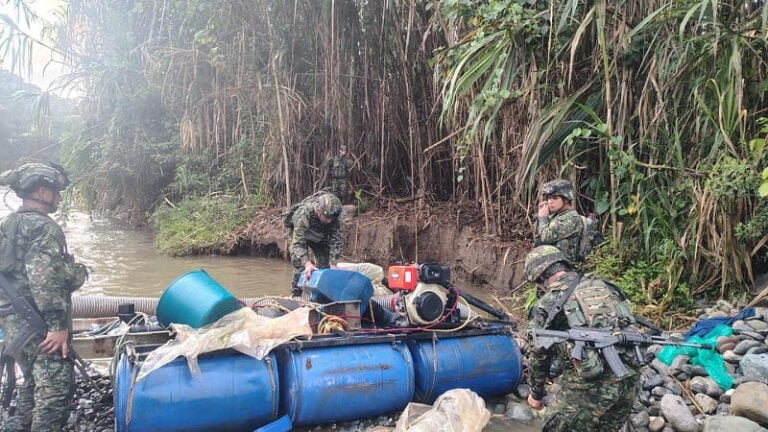
In operations against illegal mining, authorities disabled 34 dredgers, seized one dragon dredge, dismantled 14 tunnel-type extraction units, and confiscated 20 engines, pumps, or power generators used in illegal mining activities.
Sustained cooperation among regional security forces will be essential to disrupt the criminal networks operating across the Amazon, whose activities not only finance transnational crime but also accelerate the destruction of one of the world’s most critical ecosystems.