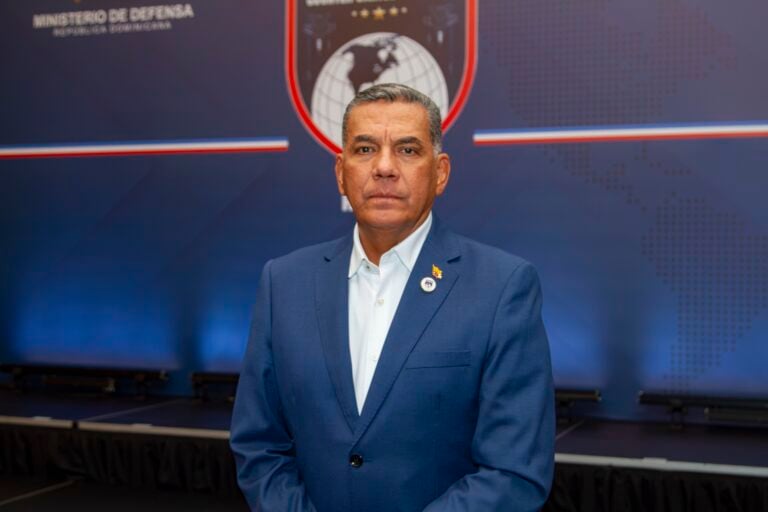
With more than three decades of service in the Chilean Navy, Captain Juan Pablo Villanueva, currently head of the Navy’s Training Center, has extensive experience in naval operations and multinational cooperation. A 1998 graduate of the Chilean Naval Academy, he commanded the frigate Almirante Cochrane (FF-05) from 2023 to 2024 and served as a liaison officer with the U.S. Navy in Norfolk, Virginia. His career also includes participation in international exercises such as RIMPAC, as well as responsibilities in planning and conducting naval operations.
During PANAMAX 2026, held in August, Capt. Villanueva served as deputy commander of the Combined Force Maritime Component Command. In an interview with Diálogo, the Chilean officer discussed the challenges of integrating naval forces from different countries, the importance of personal relationships in building multinational teams, and the role of emerging technologies in maritime operations.
Diálogo: Thank you for joining us, Captain. It’s a pleasure to have you with Diálogo Américas.
Navy Captain Juan Pablo Villanueva, head of the Chilean Navy Training Center: First, let me introduce myself. I am Chilean Navy Captain Juan Pablo Villanueva. I entered the Naval Academy in 1993 and graduated five years later, in 1998. I was born in Santiago in 1975, and I’m very happy to have served for more than 32 years in an institution that has given me so much satisfaction and where I’ve learned so much.
I served as deputy commander of the maritime component during PANAMAX 2026. My commanding officer was Rear Admiral Carlos Sardiello, commander of the U.S. Fourth Fleet, based in Mayport, near Jacksonville, Florida.
We participated in this exercise, which simulates a threat to the Panama Canal. Chile has been one of the founding countries since 2003, alongside the United States and Panama. This reflects the importance of the Panama Canal to global prosperity and, especially, to the region.
Let’s remember that approximately 65 percent of U.S. maritime traffic passes through the Panama Canal. Obviously, it’s very important to the entire region. This exercise simulated a threat to the Panama Canal and its maritime traffic, prompting the formation of a multinational force under a United Nations resolution.
This force includes several components: the Air Force, Navy, Special Forces, and Army. All these elements come together in an exercise involving 24 countries and more than 2,000 personnel. And what is the goal? To integrate capabilities and work together to defend the Panama Canal.
Diálogo: What are the main challenges in bringing together naval personnel from different countries, and what does it take to build an effective, cohesive multinational maritime force?
Capt. Villanueva: This exercise resumed in-person operations, which brings different challenges. When you conduct tabletop exercises, for example, practically everything is simulated. But here, you also have to consider operational safety. If there’s bad weather, for instance, you have to address the risks that weather conditions may pose to personnel and vessels.
But returning to your question about the essential elements of an effective multinational maritime force, I believe there are three: first, equipment, meaning the physical assets involved; second, crew training; and finally, human relationships.
When I talk about equipment, I mean the assets involved: boats, ships, aircraft, helicopters, and ground forces, such as the Army or Special Forces. First and foremost, they must be able to communicate with and understand one another so they can work toward a common objective and ultimately succeed in their operations.

The second element is training. This has to do with what I’m capable of doing and how I can do it alongside the countries participating with me. Obviously, this requires conducting effective and safe activities aimed at achieving the objective. That’s very important because it creates synergy and allows us to carry out activities that strengthen our combined capabilities to achieve our goals.
And what brings everything together, in my opinion, is human relationships. Imagine 24 different cultures. We often think that because we speak Spanish, we understand one another, but there are different expressions, ways of working, and cultures. Add English to the mix as well.
This makes it very important to establish relationships based on trust, professional respect, and personal appreciation. Eventually, you realize that everyone is working toward the same objective. That allows us to integrate the material capabilities I mentioned, such as what a ship can do, for example, and what crews are capable of accomplishing based on their training.
So, basically, I think it’s very important to consider these three areas and put them into practice. Initially, they present a major challenge, but along the way, you overcome those small differences and achieve strong teamwork.
Diálogo: What was your greatest challenge as deputy commander of the Maritime Component? Beyond the operational challenges inherent in an exercise of this magnitude, what was the greatest challenge for you personally when it came to working with people?
Capt. Villanueva: To give your audience some context, there were two different groups working together. One consisted of personnel in the field, aboard ships and aircraft, as well as Special Forces and Army personnel. But there was also a command group, which I was part of. It was a headquarters staffed by officers from these 24 countries, with experience in planning and conducting operations.
The first and most important thing was getting to know each of them, understanding how they work, what they’re accustomed to, and beginning to gather that information so I could understand their ways of operating.
There’s something very important about the maritime component that I’ve come to realize throughout my career: It’s very easy to work with and understand fellow sailors. And why is that? Because the environment shapes the way we work.
Operating at sea, with a certain degree of independence and having to rely on ourselves, means that navies share a very similar professional ethos. And that undoubtedly makes things easier.
With that common foundation of belonging to our respective navies, you begin to understand the particular characteristics of each country. In a way, that allows you to build a cohesive team, as we did this year.
The truth is it was a very rewarding experience. It wasn’t difficult, mainly because you’re working with people who are accustomed to operating at sea, and the demands of that environment shape the people who work in it.
Diálogo: Chile operates across a vast maritime area, from the Pacific Ocean to Antarctica. How does that operational experience influence the development of interoperability with partner nations?
Capt. Villanueva: We don’t view the Chilean Navy’s influence and contribution at the regional level solely from a local perspective. On the contrary, we see it as part of an integrated system in which all countries benefit from maritime security and maritime trade.
Remember that from Arica, on the border with Peru, to Antarctica, there are 5,000 kilometers. South America is 7,500 km long. Chile’s length is practically comparable to that of the entire American continent.
Our country spans three continents. We’re present in the Americas, in Antarctica, and also in Polynesia through our islands. That’s why we’ve always approached this type of participation from a regional perspective.
We’re accustomed to participating in activities involving many countries. Our search and rescue area of responsibility, for example, is the fourth largest in the world, after Australia, the United States, and South Africa. It covers 31 million square kilometers.
We have a presence in the Pacific Ocean, and that, in a way, requires us to maintain that presence, monitor maritime areas, safeguard human life at sea, and cooperate with countries across the region.
Many of the maritime challenges facing the Americas extend beyond our borders. Unfortunately, today we face common threats, such as transnational organized crime and illegal fishing, as well as humanitarian crises and natural disasters. All of this is connected to interoperability and the globalization we are experiencing today.
Diálogo: Why is it so important for partner nation navies to develop common procedures and professional relationships so they can respond effectively during real-world operations?
Capt. Villanueva: Countries sign agreements, and institutions are responsible for fulfilling the commitments their governments make.
For example, natural disasters are something we deal with very closely. We’re regularly exposed to earthquakes and tsunamis, as happened in 2010. And right now, we’re experiencing heavy rainfall, with flooding and mudslides in different parts of the country.
So, with the capabilities available to the Chilean Navy, naval units participate in these types of activities, in addition to monitoring maritime traffic, combating illegal fishing, and, of course, responding to natural disasters.
Exercises like this allow us, in a way, to establish networks of contacts and build trust that strengthens interoperability, should we need to assist another country in the region.
Let’s not forget that some time ago there was an earthquake in Venezuela, where significant humanitarian assistance was provided. Unfortunately, Colombia also experienced an earthquake that left that sister nation facing a difficult situation.
So, as I was saying, these types of exercises help build those bridges and develop the capabilities needed to respond when governments request and authorize such assistance.
Diálogo: The Chilean Navy maintains a strong cooperative relationship with the U.S. Navy, including professional exchanges and multinational exercises beyond PANAMAX. From your perspective, what has been the greatest benefit of this longstanding relationship for the Chilean Navy?
Capt. Villanueva: I believe that the greatest benefit is mutual trust. As I mentioned, PANAMAX was established in 2003 by the United States, Panama, and Chile.
Personally, I’ve had the opportunity to participate in multinational exercises involving the U.S. Navy on several occasions, including RIMPAC in Hawaii. I also participated in PANAMAX 2022 and, of course, was very pleased to take part again in PANAMAX 2026.
But this is something you build over time. I’d like to share a personal experience. Between 2020 and 2022, I had the opportunity to serve as a liaison officer in Norfolk, Virginia, working with the U.S. Navy. I was able to learn how they work and get to know them.
I also had the opportunity to study joint planning, which was one of the tools that allowed me to feel very comfortable in my role as deputy commander of the maritime component.
Through those courses and professional exchanges, I had the opportunity to learn and become familiar with their procedures. That builds mutual trust, helps identify common interests, and ultimately, personal and professional relationships serve as bridges that enable us to develop strategies together.
Diálogo: Artificial intelligence, unmanned systems, and autonomous platforms are transforming naval operations. Which of these advances do you believe will have the greatest impact on multinational maritime operations in the coming years?
Capt. Villanueva: Artificial intelligence presents a very important challenge because it allows data to be processed much faster than humans can process it. In that sense, humans are falling somewhat behind, but obviously, these are machines designed and programmed by people.
From a human perspective, we have to learn to trust these processes and use them properly, because sometimes a recommendation could put human lives at risk or lead to accidents. But ultimately, it’s a very useful tool, and we need to learn how it works and how to use it correctly.
As for unmanned vehicles, which also go hand in hand with artificial intelligence and data processing, they allow us to maintain a presence in places where humans cannot operate.
For example, an unmanned aircraft can reach altitudes where a human would require additional support. Ultimately, we have to learn to work alongside these systems.
They allow us to explore areas that are difficult or inhospitable for humans, but there must always be human oversight of how the data is processed.
We have to embrace this new technology, use it to our advantage, and make the most of all the benefits it offers.
Diálogo: What advice would you give young naval officers who aspire to develop the professional relationships and leadership skills needed to succeed in multinational maritime operations?
Capt. Villanueva: I’d like to share what I’ve learned from my own experience. Professional preparation provides a foundation, but you also have to focus on learning English.
In multinational operations, English is essential. Even though interpreters may be available for different languages, English is the common language, and procedures are also established in that language.
So, first, prepare yourself professionally; second, study English; and third, believe in yourself and what you can accomplish.
Ultimately, that allows you to achieve goals you may not initially feel prepared for. But as you grow and learn, you begin to appreciate the importance of belonging to an institution like the Chilean Navy and having the opportunity to be part of and lead a multinational team, as I did during PANAMAX.
So, the main message is to prepare yourself, learn English, and build strong personal relationships, because those relationships create bridges and lasting bonds.
Right now, I have friends in 24 countries, and if I ever need something, I know I can pick up the phone. I can put a face to each name, and that makes a tremendous difference. Ultimately, it allows us to cooperate and maintain the relationships we built during those two weeks of hard work in Florida.
Diálogo: What kind of leadership do the hemisphere’s security forces need to work together successfully?
Capt. Villanueva: That kind of leadership obviously requires knowledge and self-awareness. But today, interpersonal skills are essential in every organization, both civilian and military.
If you can’t empathize with the people you’re working with, you ultimately can’t build a team. And that’s something we achieved with the team we formed during PANAMAX 2026. We built a team that accomplished all its objectives and much more.
So, in these types of activities, leadership requires professional knowledge, but also interpersonal skills that allow you to adapt to different situations and, ultimately, work together.