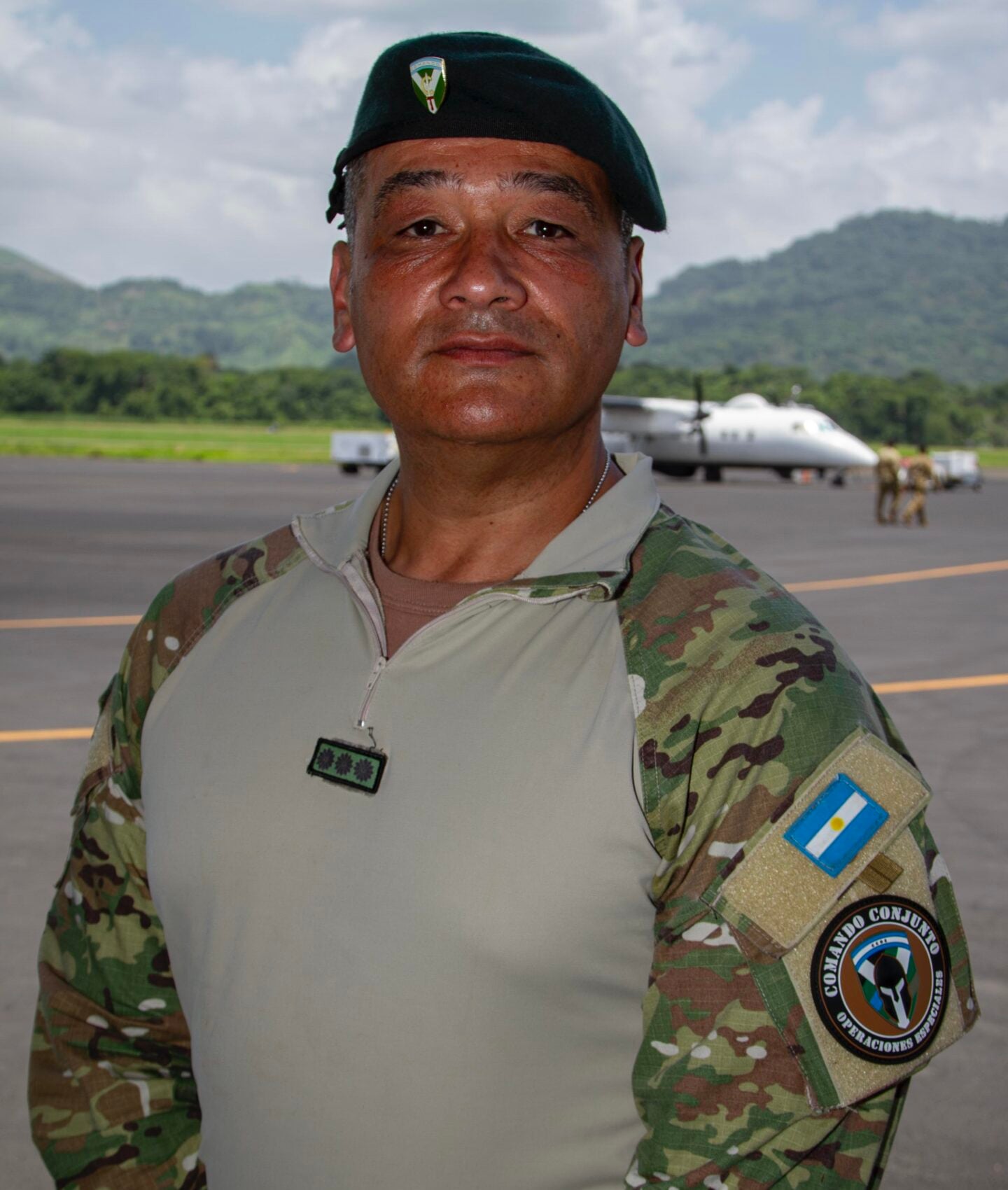

From infantry and jungle operations to military education and the command of special operations forces, Argentine Army Colonel Eduardo César Verón Rodríguez has spent decades serving in some of the military’s most demanding roles. Today, as commander of the Argentine Armed Forces Joint Special Operations Command (CCOE), that experience comes together in one mission: preparing forces to operate jointly and alongside international partners.
Diálogo spoke with Col. Verón during multinational exercise PANAMAX 2026, held in Panama in August, where he served as deputy commander of the Combined Forces Special Operations Component Command (CFSOCC). In the interview, he discussed his experience, leadership, interoperability, and the challenges of preparing special operations forces for increasingly complex environments.
Diálogo: During PANAMAX 2026, you worked alongside U.S. Special Operations Command South (SOCSOUTH) and forces from several countries in the region. What does a multinational exercise like this contribute to the development of Argentine special operations forces’ capabilities?
Argentine Army Colonel Eduardo Verón, commander of the Armed Forces Joint Special Operations Command: Throughout this year, we have worked to build interoperability capabilities with SOCSOUTH, reinforcing the commitments made following the signing of a memorandum of intent (MOI) last year [2025]. This allows us to develop greater unity of effort in the planning, coordination, command and control, and execution of special operations, particularly within multinational coalitions.
It also allows us to become familiar with modern tactics, techniques, and procedures adapted to the evolution of conflict, while taking advantage of the opportunity to work with SOCSOUTH and U.S. Special Operations Command (SOCOM), which have recent experience in armed conflicts.
These exchanges give us a clear picture of where we are and where we want to go. From there, we can adjust our joint and combined training plans, select the regional and international exercises in which it is most beneficial to participate, and better design those we conduct in Argentina, including the participation of partner nations.
Diálogo: As commander of the Joint Special Operations Command, you led Argentina’s participation in Atlantic Dagger 2026, an exercise conducted with the United States. What were its main outcomes and lessons learned?
Col. Verón: The main outcomes can be divided by level. At the tactical level, our operators worked and trained alongside their U.S. counterparts in a coordinated manner. Both sides learned from each other, strengthening camaraderie and trust while advancing interoperability in procedures, equipment, tactics, and techniques.
The exercise also allowed us to validate our own doctrine. This year, we introduced updated regulations for the conduct of joint special operations, which will help improve the future employment of Argentina’s Joint Special Operations Forces in a modern and appropriate manner.
At the operational level, we certified the staff and command staffs of elements from all three Armed Forces in joint and combined planning methodologies. During Phase II of the exercise, held in the city of Córdoba, the Joint Special Operations Command worked with the U.S. Joint Special Operations University (JSOU). A total of 52 participants completed training in the planning, command, and control of joint special operations, provided by the CCOE, and combined special operations, provided by JSOU.
One of the main lessons learned is that we do many of the same things and use similar processes, but there is still a need to standardize certain processes and planning products and understand the use of acronyms, particularly in multinational environments and within the NATO framework.
Ultimately, strategic errors cannot be corrected through tactics, and tactics must effectively serve strategic intent. By designing the exercise in two levels — a first phase of tactical training and a second phase of operational planning — we took a major step forward in combined interoperability, particularly within the NATO framework, with applications to United Nations operations as well.
Diálogo: During your career, you also served as director of the Jungle Warfare School, a position closely tied to training, doctrine, and leadership. How do those experiences contribute to preparing special operations forces to integrate effectively into a multinational command?
Col. Verón: In terms of training, the Joint Special Operations Command works with all three Armed Forces in the training and professional development of Special Operations Troops (TOE) serving at the operational level. This allows us to make recommendations for the continuous improvement of courses and the standardization of joint procedures.
In terms of doctrine, this year we updated our doctrine for the conduct of joint special operations, incorporating lessons learned from joint and combined exercises. This provides a five-year horizon before the doctrine is reviewed and 10 years before its mandatory update.
Leadership also plays a central role. Our doctrine incorporates elements related to the human factor and the command and leadership of Special Operations Troops. These forces carry out high-risk, complex missions, often in isolated, hostile, and austere environments, which require particular characteristics.
Beginning with their initial training, we seek to strengthen character, determination, understanding, and moral integrity. An operator must be capable of acting in isolation and under uncertainty, with discipline, initiative, and efficiency, including deep within enemy positions and against high-value strategic targets.
Diálogo: Special operations forces must be prepared to operate in some of the most complex environments. What capabilities do they bring that are particularly valuable within a multinational force?
Col. Verón: These forces are particularly well suited to operating in air, jungle, coastal, maritime, and urban environments. During PANAMAX, for example, they had to be prepared to confront threats capable of affecting the security and operation of the Panama Canal, infrastructure whose importance extends far beyond the country’s borders.
We are a strategic tool in the service of a multinational alliance or coalition, committed to ensuring security and the legality of operations while minimizing their impact through the surgical employment of special operations forces that, with a small number of personnel, can reach and engage high-value targets.
The ability to operate interoperably with local Panamanian forces and forces from other countries, in different languages and with different equipment and assets, gives us the versatility, adaptability, and lethality to carry out specific, high-impact missions without saturating operational areas with larger and heavier assets.
This allows the nation where we conduct these operations to avoid the impact of large-scale military maneuvers and assets and to recover more quickly once their employment has ended.
Diálogo: Integrating forces from different countries means reconciling different doctrines, procedures, languages, and operational cultures. What are the main challenges, and what is essential to building a truly integrated force?
Col. Verón: The challenges naturally arise in several areas. The first is language, a barrier that can be overcome when all participants make an effort to learn and communicate.
The second is standardizing doctrine and, above all, terminology to achieve unity of understanding and action. During PANAMAX, this process took place through Force Integration Training (FIT), which also helped minimize the risks associated with the combined employment of these forces.
The third challenge is standardizing planning, execution, command, and control processes. During PANAMAX, we worked on this with the CFSOCC staff and command post. Upon arriving in Panama, we conducted five intensive days of Battle Staff Training (BST) before beginning operations.
The exercise allowed us to work simultaneously at the tactical and operational levels and progressively advance toward rehearsals and full-mission-profile operations. That progression helps create greater unity of understanding, standardize procedures, integrate participants, and minimize risk.
But human factors are equally essential: professionalism at every level, the humility to learn and teach, and the intellectual freedom to contribute ideas that benefit everyone. Integration does not begin when forces arrive at an exercise. It is the result of a process of planning, preparation, and learning that takes place over months.
Diálogo: What qualities do you consider essential for military leaders commanding multinational forces in increasingly complex security environments?
Col. Verón: Experience, professionalism, humility, open-mindedness, adaptability, and flexibility.
Everything can change at any moment: the threat we face, weather conditions, or the assets available to us. Special operators must be able to adapt to those conditions and maintain the mental flexibility necessary to achieve the best possible outcome in accomplishing the mission.
Within a multinational Special Operations Troops force, we must also be able to employ the right or most appropriate element for each mission, seeking maximum efficiency with the lowest possible cost and risk. That is why professionalism, humility, experience, adaptability, and flexibility are fundamental within this community.
Diálogo: Where do you see the greatest potential for further strengthening cooperation among the special operations forces of Argentina, the United States, and other regional partners?
Col. Verón: I am convinced that we must capitalize on everyone’s experiences. Every country has knowledge, experience, and lessons learned that it can contribute and that enrich us all.
Conflicts evolve rapidly in increasingly complex, ambiguous, uncertain, and changing environments. If we do not share experiences, acquiring that knowledge on our own takes much longer. These exchanges strengthen mutual trust, facilitate interoperability, consolidate our own doctrine, and contribute to building combined doctrine.
The same applies to specialized equipment, weapons, drones, and communications, which are evolving at an increasingly rapid pace. Regional exchanges allow us to better understand these changes and adapt to them.
Beyond the strictly military, professional, and doctrinal aspects of Special Operations Troops, this cooperation contributes to regional security and stability. Together, we will be stronger and better prepared than if we act alone in confronting common threats and risks.