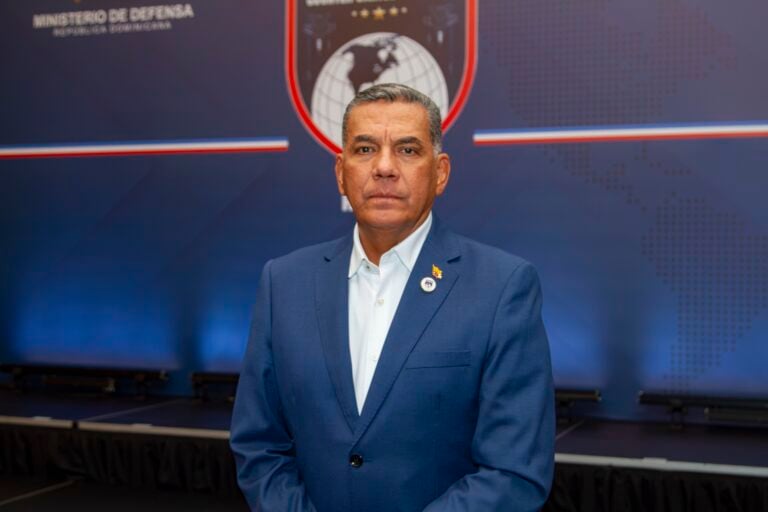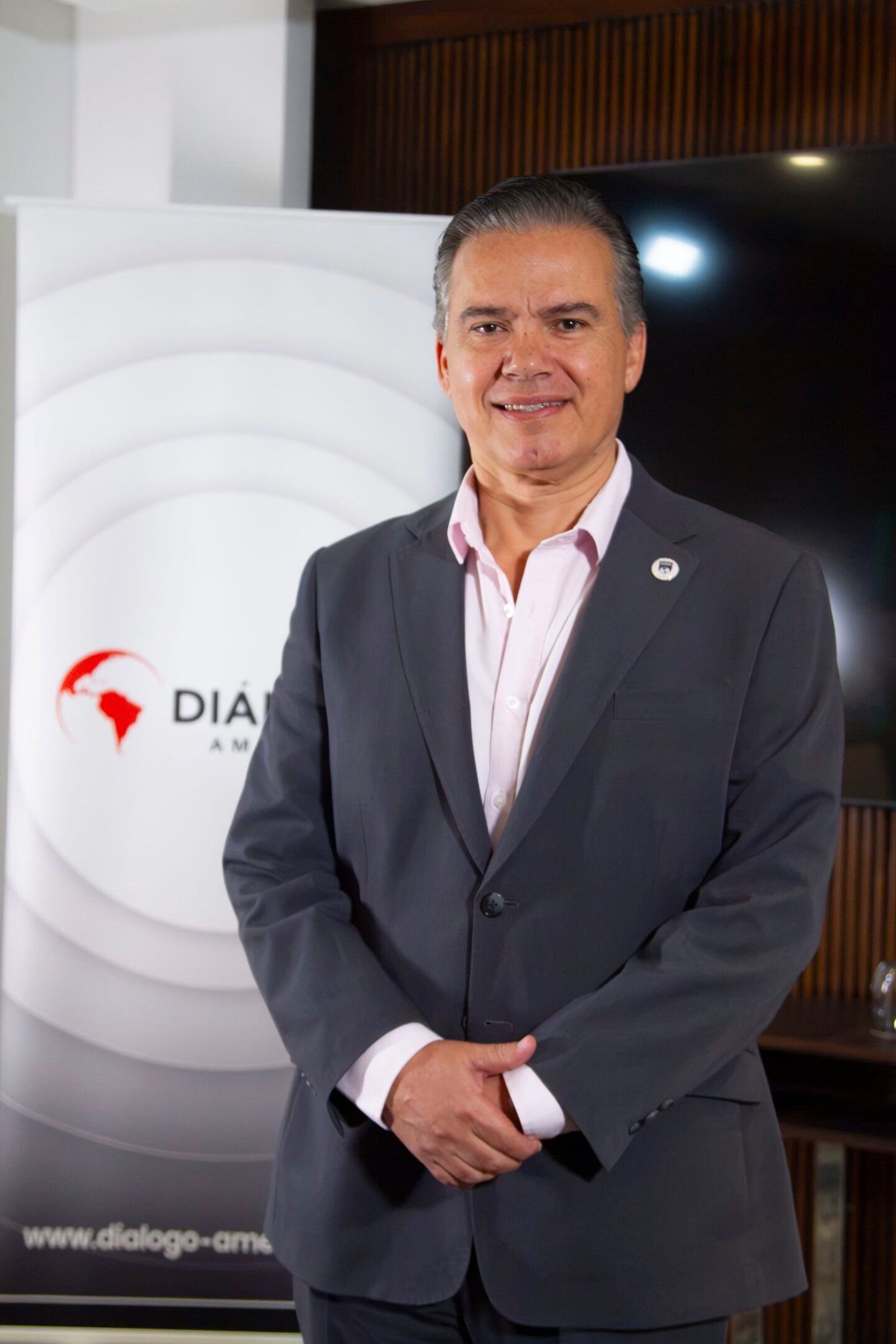
Bolivia’s Defense Minister Ernesto Justiniano Urenda has played a prominent role in combating drug trafficking and strengthening international security cooperation. An engineer by training and former legislator, he served two terms as vice minister of Social Defense and Controlled Substances, most recently beginning in November 2025, before becoming defense minister in June 2026 under President Rodrigo Paz.
His tenure has been marked by efforts to dismantle transnational criminal organizations, strengthen cooperation with neighboring countries, and expand the role of the Armed Forces in combating drug trafficking within Bolivia’s legal framework.
During the third Americas Counter-Cartel Coalition (ACCC) conference, held October 26-27, 2026, in Santo Domingo, Dominican Republic, Diálogo spoke with Minister Justiniano about Bolivia’s progress in dismantling drug trafficking networks, regional cooperation, border operations, and priorities for strengthening the country’s defense and security capabilities.
Diálogo: This is the third meeting of the Americas Counter-Cartel Coalition. What are your impressions of this gathering?
Bolivia’s Defense Minister Ernesto Justiniano Urenda: I am very pleased, first of all, with the hospitality of our host country, the Dominican Republic, but also because it is clear that this initiative is taking shape and gaining substance. It is no longer just about sending messages. It is moving toward something more substantial, toward campaign plans. That raises our expectations for what this joint effort by 19 countries can accomplish in effectively disrupting drug trafficking and criminal organizations.
Diálogo: Since Bolivia began participating in the Americas Counter-Cartel Coalition, what concrete progress have you seen, and what are your country’s priorities?
Minister Justiniano: We have made progress on several fronts. One example is the case of Sebastián Marset, which has become emblematic across the hemisphere. But more important than the individual is dismantling the criminal organization.
We are currently arresting some 30 to 40 key figures linked to drug trafficking, primarily with connections to Brazil and two internationally notorious criminal organizations, both of which are now on the U.S. list of terrorist organizations: the First Capital Command (PCC) and the Red Command (CV). These organizations have established themselves in Bolivia and operated with a degree of impunity for more than 20 years.
When we came into office with President Rodrigo Paz, we made a clear decision to establish a regional agenda, as well as an agenda with Washington. That is when we began our work. This agenda includes the Shield of the Americas and the ACCC. We have not only made an impact in the Marset case, but have also begun dismantling his criminal networks.
More recently, and this is important to mention, we arrested Attorney General Roger Mariaca. He faces allegations of facilitating drug trafficking and corruption. This was part of a structure that also threatened our country’s democracy.
We have uncovered indications that financial resources may have been provided so that for 53 days [between May and June 2026], Bolivia would face the consequences of a blockade, with shortages of food and medicine and severe economic repercussions for our country.
We overcame that situation, made progress, and secured a state of emergency that has allowed the Police and military to work together and effectively disrupt these organizations.
You could say that the arrest and investigation of the attorney general marked a turning point for the country. We now have a real opportunity to make progress on security.
Previously, we were fighting from a position of disadvantage. Now we have the upper hand, and that gives us a competitive advantage. We are not going to let up as we continue moving forward.
As you know, drug trafficking organizations are very powerful and operate across borders. Borders should not allow them to operate with impunity. Quite the opposite.
When we talk about borders, we are talking about international cooperation with our five neighboring countries, cooperation with the United States, which provides very important support, and the Shield of the Americas.
This is where the Shield of the Americas comes into play, allowing us to strengthen and improve the capabilities of both the Police and the Armed Forces.
We are currently working to change the legal framework so that the Armed Forces can play a greater role, while respecting the Police’s leading responsibility.
We believe the Armed Forces can also play a very important role in combating drug trafficking. In fact, they have already been involved in these efforts, but we want to give them a more clearly defined role.
For example, we can look at Brazil, where the Armed Forces can operate within a 150-kilometer strip along the border, or Peru, where areas such as the Apurímac, Ene, and Mantaro Rivers Valley (VRAEM) face serious security challenges and where the Armed Forces can operate alongside the Police.
Those are just two examples. I could also mention Paraguay, Ecuador, and other countries, but these examples illustrate that the Armed Forces still have a great deal to contribute.
We need to change the legal framework, and we are working on that while respecting, as the saying goes, “each has its own place at the table.” In other words, everyone has their own role: the Police have their responsibilities, and the Armed Forces have theirs.
But we need to deal a blow to these organizations, and even then, our efforts will not be enough. That is why international cooperation is so important. These criminal organizations operate across countries and recognize no borders. We should not allow borders, whether between our institutions or between countries, to limit our efforts to combat them.
Diálogo: You mentioned cooperation with Brazil. What lessons from that experience can be applied to Coalition operations along borders with countries such as Peru and Ecuador?
Minister Justiniano: We have been working very closely with Brazil. As you know, I previously served as vice minister of Social Defense, working to combat drug trafficking, and at that time there was excellent coordination between the Bolivian Police and Brazil’s Federal Police.
That has made cooperation much smoother. After a long time, Bolivia has returned to the security cooperation table as a trusted partner. This has opened doors for us to work together, and I believe the results speak for themselves, particularly the impact we have had on the PCC and CV.
Brazil is very pleased, and we want to extend that experience not only to our other borders but also to cooperation among our own institutions.
For example, during a meeting in Cusco, we discussed with Brazil’s defense minister the possibility of conducting what are known as mirror operations.
In Brazil, this type of operation is known as Operation Ágata. What does that mean? It means that our Armed Forces can do something similar to what the Police have done through Fronteras Seguras [a joint Bolivian-Brazilian border security initiative]: conduct coordinated operations, each country within its own territory, to combat smuggling, illegal mining, and drug trafficking.
We have also discussed this with Chile. “,” President Kast said during a recent meeting at the Palacio Quemado in Bolivia, referring to bringing together the Armed Forces and defense ministers to organize mirror operations.
We are going to do this with Chile, with Peru, and with other countries whose Armed Forces are already involved in combating drug trafficking or criminal organizations.
Diálogo: Bolivia recently brought together representatives from Argentina, Colombia, Ecuador, Paraguay, and the United States in La Paz to address transnational threats. How does Bolivia intend to turn these meetings into more permanent military cooperation?
Minister Justiniano: It was a very important multinational workshop. We believe these kinds of meetings, whether the one held in Bolivia or this gathering of 19 countries [ACCC], are extremely valuable because they allow us to learn from other countries’ experiences.
For example, Ecuador has adopted an approach that we would like to follow. Ecuador made changes to its legal framework, and we are studying them. Ecuador does not share a border with Bolivia, but thanks to the Shield of the Americas and these meetings, we can exchange experiences and identify each country’s strengths and weaknesses, deciding which approaches to adopt and which to set aside.
I think this is very positive. And I would like to take this opportunity to make a point I did not mention earlier: dismantling criminal organizations is more important than seizing drugs.
When we talk about dismantling an organization, we mean destroying not only its ability to transport drugs, but also its financial and economic structures, the networks it has established in other regions and countries, and the networks through which it ships and receives goods.
All of this can only be accomplished through coordination among different countries. Otherwise, we would be operating in isolation. We might be able to dismantle the network that sends cocaine, but not the one that receives it or serves as a transit point, because other countries are also involved in its transportation.
Diálogo: How is this new dynamic changing Bolivia’s strategy against organized crime?
Minister Justiniano: Bolivia, for example, is also a transit country. We do not just produce cocaine; we also serve as a transit route for drugs coming from Peru and heading to Brazil, which is the main destination for drugs in the region. In fact, we estimate that 80 percent of the cocaine leaving Bolivia goes to Brazil.
What are we doing about this? We have recently held meetings and placed on the agenda the need to conduct an audit, in cooperation with other countries, of the radar systems operating in Bolivia.
Technology has advanced significantly in many areas, and radar systems are no exception. We also want to review our satellite surveillance capabilities and our ability to track all aircraft passing through Bolivian airspace, so that we can identify these movements and work with neighboring countries.
We want all of that to be part of the audit.
Bolivia invested €190 million [$213 million] in an air traffic control system back in 2016. Now, in 2026, we are dealing with a project that was left incomplete.
This has been the subject of an investigation, and we are in the process of bringing the legal proceedings to a close. But beyond that, what we want now is a thorough review of the system, which is a fundamental component of the fight against drug trafficking. We hope to have international cooperation to make that happen.