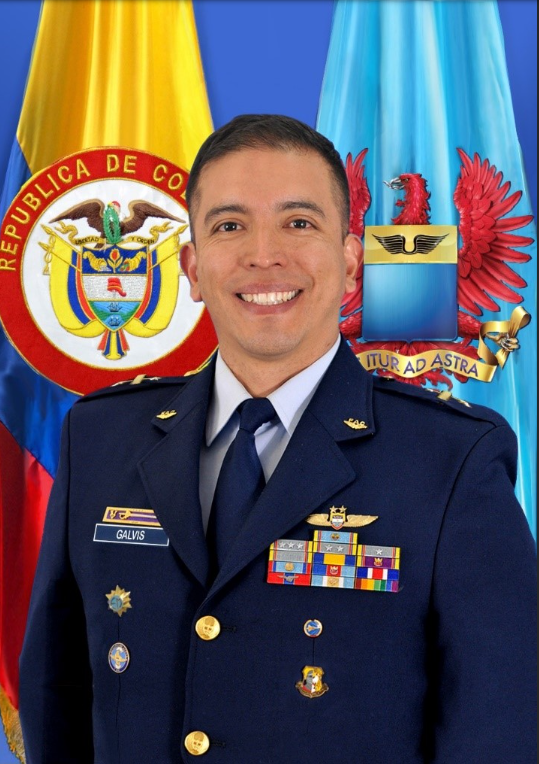

A fighter pilot with extensive experience in air operations and multinational exercises, Colombian Air Force (FAC) Colonel Carlos Andrés Galvis Espejo has served as director of Combat Operations and participated in international exercises including Red Flag, Red Flag Rescue, CRUZEX, and Relámpago. Chief of the Strategic Operational Capabilities Section and author of the study Smart Power as a Strategy for Colombian Aerospace Development, he is also involved in implementing Colombia’s acquisition of Gripen fighter aircraft. During PANAMAX 2026, he served as deputy commander of the Combined Force Air Component Command (CFACC) in Tucson, Arizona. Diálogo spoke with Col. Galvis about interoperability, regional cooperation, emerging threats, and the future of air and space power.
Diálogo: How did your experience in multinational exercises and your career in the Colombian Air Force complement each other as you took on your role in PANAMAX 2026?
Colombian Air Force Colonel Carlos Andrés Galvis Espejo, chief of the Strategic Operational Capabilities Section: They go hand in hand. The operational experience of Colombian Aerospace Force officers who lead air operations in multinational environments allows us to understand operational planning processes, regional theater defense concepts, and the procedures the United States uses, particularly for combined and joint operations.
Combined with the experience I have gained through international exercises such as Red Flag, Red Flag Rescue, and CRUZEX, this has given me a strong understanding of operational planning and, in this case, the air tasking cycle for a combined joint component. Everything I have flown, learned, and experienced in the Colombian Aerospace Force has applied directly to my role as deputy commander of the combined joint air component.
Diálogo: Until recently, you served as director of Combat Operations, with responsibilities for force generation and operational readiness. How did that experience prepare you to work within a multinational force such as PANAMAX?
Col. Galvis: As director of Combat Operations, my primary responsibility was to establish the operational planning and execution mechanisms required by Colombia’s national defense and security plans.
How does that relate to the international combined joint operational environment? The United States and its Air Force have historically been among Colombia’s strongest allies. As director of Combat Operations, combined planning was one of our most important tools for doctrinal development and for understanding both current and future regional threats and capabilities.
The synergy we have developed between our two countries has allowed us to establish methods for cooperation and mutual training. Colombia and its Aerospace Force host a very important regional exercise, Relámpago, where we receive U.S. Air Force squadrons each year. They have worked with us throughout the process of learning combined joint planning, to the point that, as a result of that experience, the Colombian Aerospace Force now leads the exercise at the regional level and shares with other countries how these types of exercises can be implemented to strengthen regional security.
Diálogo: PANAMAX brings together countries with different doctrines, capabilities, and operational cultures. From a commander’s perspective, what are the most important factors in turning those differences into an effective coalition force?
Col. Galvis: Standardization, trust, and a strong understanding of doctrine are all important, but I would focus on two things: trust and the integration of different experiences and areas of expertise.
Colombia’s approach to space operations, much like our experience in exercises such as Relámpago, has helped us become a trusted source of information for our allies. That trust, together with our knowledge of doctrine and planning, allows us to organize critical information requirements and clearly identify lines of operation, desired end states, and the regional and national objectives of commanders.
That is precisely what I was able to see at PANAMAX. What we have learned through cooperation with the United States and U.S. Southern Command has allowed us to take on a senior role in this exercise, where we have been able to integrate the capabilities of participating countries, listen to them, trust their judgment and experience, and use these opportunities to share knowledge among nations.
Diálogo: Airpower provides the speed, reach, and flexibility needed to operate across great distances and in changing operational environments. What specific capabilities did the air component bring to the PANAMAX mission?
Col. Galvis: Airpower is fundamental because it provides air superiority or air supremacy, depending on the operational theater. At PANAMAX, where ground operations, special operations, and the combined joint land component are so important, airpower provides the freedom of action that troops on the ground require.
It begins with gathering the necessary air intelligence through satellite imagery, communications intelligence, specialized platforms, and unmanned systems equipped with intelligence sensors that allow us to observe an adversary’s behavior and position over time. That information helps us meet the critical information requirements of the combined land forces.
But none of this could be sustained without the defensive capabilities provided by airpower. Its speed, the effectiveness of its capabilities, and its ability to provide a broader view of the operational theater enable the maritime, land, and special operations components to accomplish their operational objectives.
In short, airpower gave the other domains the ability to execute their plans with freedom of action where they needed it, backed by the protection of the air component.
Diálogo: Technology is playing an increasingly important role in modern operations. Which capabilities do you believe will have the greatest impact in countering transnational criminal organizations and strengthening regional security cooperation?
Col. Galvis: That is a very good question because we are seeing — and we saw it at PANAMAX — that the capabilities airpower provides today are increasingly being challenged worldwide by the threat posed by unmanned aircraft.
Traditional airpower capabilities were designed for larger, more predictable threats with technological characteristics that countermeasures can address with some degree of control. But in an irregular warfare environment, an unmanned system small enough to fit between my two hands can have a strategic effect and cause damage to ground forces or even air assets. That is forcing us to think creatively again as we look for new capabilities.
We evaluated several options. One involved using satellite imagery to monitor locations where intelligence indicated personnel were being trained to operate unmanned systems, while developing a three-phase approach to identify, intercept, and neutralize those capabilities.
At the same time, transnational crime — particularly the illicit movement of drugs to other parts of the world — requires us to continue strengthening traditional airpower capabilities: early warning radars, the ability to intercept high-, medium-, and low-performance aircraft, secure communications among countries, and the ability to track aircraft suspected of transporting drugs across borders. All of this allows us to cooperate and become more effective in countering transnational crime.
Colombia and its Aerospace Force have Plan Zeus, which grew out of a cooperative initiative between the United States and Colombia and today allows Colombia to assume greater responsibility in the Greater Caribbean in confronting this transnational threat. The strategy is helping expand air interdiction capabilities in Central American countries.
For me, the capabilities needed to confront transnational crime are concentrated in two areas: first, countering the emerging threat posed by unmanned systems; and second, continuing to integrate capabilities, doctrine, and procedures among Colombia, the United States, and countries throughout the Greater Caribbean.
Diálogo: The Colombian Aerospace Force has also shared its experience and capabilities with regional partners. Which practices or approaches from partner nations have had the greatest influence on the FAC?
Col. Galvis: The United States and U.S. Southern Command have clearly given Colombia access to very high-level training and opportunities to understand their strategy, planning doctrine, and operational doctrine.
When I arrived at PANAMAX and began working under the leadership of Major General David Mineau [commander of U.S. Air Forces Southern/12th Air Force], I was able to observe his approach to operational theater planning. Much of what I saw was not unfamiliar; many of the processes were already familiar to me. What I found particularly valuable in this position was the opportunity to approach planning and execution from a more strategic perspective.
The United States has clearly been one of the principal influences on Colombia’s military in terms of doctrine, tactics, techniques, procedures, and methods of cooperation.
Diálogo: Looking ahead to the next decade, what qualities will distinguish the most effective military leaders in multinational environments?
Col. Galvis: I believe the leaders who will be most successful in directing air and space power will be those who can clearly recognize how smaller-scale, lower-cost threats can generate strategic effects and identify the countermeasures needed to control those risks without losing the strategic perspective required to understand airpower in relation to the maritime and land theaters and other domains, including space and cyber.
Leaders must be able to connect those two worlds, because losing sight of either one can create tactical problems with strategic consequences.
In a regional environment such as the one we face today, and in an exercise like PANAMAX, leaders must also be able to recognize the best practices and experience that each country brings. Something that really struck me was seeing countries that perhaps had less experience in certain areas of combined operations contribute extraordinary ideas. Their own perspectives on airpower and the threats they face can produce answers and solutions that can be applied on a much larger scale.
Leaders must therefore also be able to integrate knowledge, experience, and trust among all the countries working together as allies against shared threats and transnational crime.
Diálogo: What does it mean to you and to Colombia to have been selected for a leadership role in a multinational combined force component?
Col. Galvis: I really like that question because it allows me to speak not only about what I saw, but also about what I felt: the importance of seeing the efforts of Colombia’s Military Forces represented and the effectiveness they have demonstrated in their operations.
I believe that forces as large and well structured as those of the United States would not give a country this opportunity unless they believed its military leadership had the capabilities required to carry out the mission effectively. At the same time, there is always room to learn, because every exercise brings something new and presents new challenges.
For Colombia and the Colombian Aerospace Force, taking on this role in the combined joint component confirms that the joint efforts of so many years have resonated with our allies and reinforces that we are moving in the right direction.
Personally, it was an enormous source of pride to be there at the CFACC in Tucson. It was an honor to sit in that air and space situational awareness center and interact with such professional teams. Being part of that final level of decision-making makes you feel the full responsibility that comes with the tremendous capabilities of airpower.
More than my name, my family name, or what I may represent as an individual, my pride came from representing the Colombian Aerospace Force in that position and representing it well. I know our officers have the ability to demonstrate that same professionalism and commitment to quality and interoperability, always seeking, through international cooperation, to contribute to the security and defense of our countries.