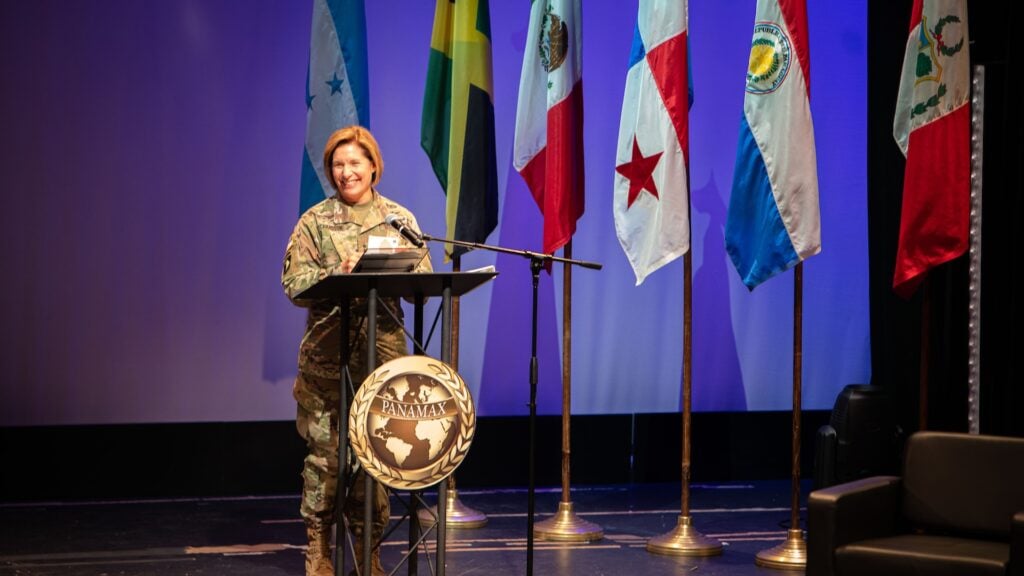

On the final day of PANAMAX 2024, participants from 20 nations reflected on a week defined by intense collaboration, shared challenges, and significant accomplishments. This year’s exercise marked the 21st iteration of PANAMAX, an event that has grown from a modest beginning to a cornerstone of multinational military cooperation.
“Participating in PANAMAX 2024 represents the dynamic change that our world is continuously undergoing,” said Panamanian National Air and Naval Service Deputy Commissioner Felix Kirven. “PANAMAX has evolved as the world evolves.”
What began over two decades ago with just Chile, Panama, and the United States has expanded into a major event on the international military calendar. With participation now spanning continents, PANAMAX serves as a vital platform for ensuring the security of the Panama Canal and promoting regional stability.
“Early on, I realized the significance of this training event as it is U.S. Southern Command (SOUTHCOM) and U.S. Army Souths (ARSOUTH) largest biennial exercise with partner nations and brings together all the Multinational Force South components,” said Paul Keith Warman, a seasoned military analyst forward/liaison officer with the Center for Army Lessons Learned (CALL) at ARSOUTH and U.S. Army North.

Warman notes the most significant change he has observed over time is the ever-increasing desire for both U.S. and partner nation forces to participate in the exercise. He believes this is due to all realizing the commonly shared and persistent threats faced across the Western Hemisphere.
“Threats portrayed in today’s PANAMAX are more complex, diverse, and realistic than in the past,” said Warman. “It is clear that all formations making up Multinational Force South recognize the value of this training time and operating together at this level of exercise.”
PANAMAX 2024 exemplifies the power of multinational cooperation and interoperability. Each year, the exercise expands not only in size but in the complexity of the scenarios and the leadership roles taken on by partner nations. One of the most significant developments in recent years has been the expansion of the exercise to include cyber operations and psychological operations task forces, reflecting the growing complexity of modern warfare.
“We’ve added a lot of innovative capabilities since my first PANAMAX,” Martin Garcia, an information operations planner who has participated in 13 iterations of PANAMAX. “When we first started, there was no cyber cell. Now, we’ve added cyberspace operations, and the planning has become more challenging as we bring in more participation and capabilities. Militaries are working together, more countries are participating, and we’ve closed the capabilities gap.”
This year, Fort Sam Houston in Texas served as a central hub for the exercise, with component commands located in Alabama, Arizona, Florida, and Virginia.
“We can see how the armed forces —whether maritime, air, land, and in this case also including cybersecurity — are evolving in a complex world,” said Deputy Commissioner Kirven, highlighting the necessity of integration and interoperability among the armed components participating in PANAMAX. “The threats against the Panama Canal have gone a bit further, so to speak. Which is why integration and interoperability are necessary for each of our armed components to perform today.”
PANAMAX 2024 stands as a powerful symbol of what can be achieved when nations unite with a shared vision. This year’s exercise has proven once again that PANAMAX isn’t just about the numbers —it’s about enduring partnerships and a collective commitment to global security.
“What does not change in PANAMAX, and shouldn’t, is the focus on U.S. and partner nation team building, improving multinational interoperability, and enhancing mutual readiness,” Warman concluded.